
Last Tuesday, a patient sat in my chair at Couture Dermatology & Laser Beverly Hills, exhausted by the constant cycle of shaving bumps and painful ingrown hairs. She looked at me and asked the question I hear every single day: exactly how many sessions for laser hair removal do I need before I’m actually done? It’s a fair point because you’re not just looking for a treatment; you’re looking for a transformation that respects your time and your investment.
I see patients who feel anxious about the cost-to-result ratio, and I completely agree that the lack of a clear timeline is frustrating. In my practice, I treat laser hair removal like high-end tailoring where your unique biology dictates the fit. This article provides the exact roadmap you need for smooth skin, based on your hair texture and body area. We’ll explore why growth cycles matter, how we use multi-wavelength lasers for all skin tones, and the specific protocols I use to ensure you get maximum results in the fewest sessions possible.
Key Takeaways
- Learn why treating hair during the anagen (active growth) phase is the only way to achieve permanent results. It’s like tailoring a bespoke garment; we have to work with your body’s natural timing.
- Discover exactly how many sessions for laser hair removal are typical for your target area, whether it’s a “fast” zone like the underarms or a “slow” zone like the legs.
- Understand how your skin’s starting point on the Fitzpatrick Scale and your unique hormonal profile will shape your personalized timeline.
- Get the “Golden Rules” for preparation, including why you should only shave 24 hours before your visit and avoid waxing or plucking entirely.
- See why a clinical, dermatologist led approach provides a level of safety and precision that generic med spas simply can’t match.
Why One Session Won’t Cut It: Understanding the Hair Growth Cycle
Think of your hair removal journey as the creation of a bespoke suit. You don’t just walk in, get measured, and walk out with a finished garment. It requires multiple fittings to ensure every seam is perfect and every thread is in place. In my Beverly Hills practice, I often tell patients that their hair follicles are not all working on the same schedule. This biological timing is the primary reason why people get confused about how many sessions for laser hair removal they actually need. If every hair on your body grew at once, we could finish your treatment in a single afternoon. But your body is far more complex than that.
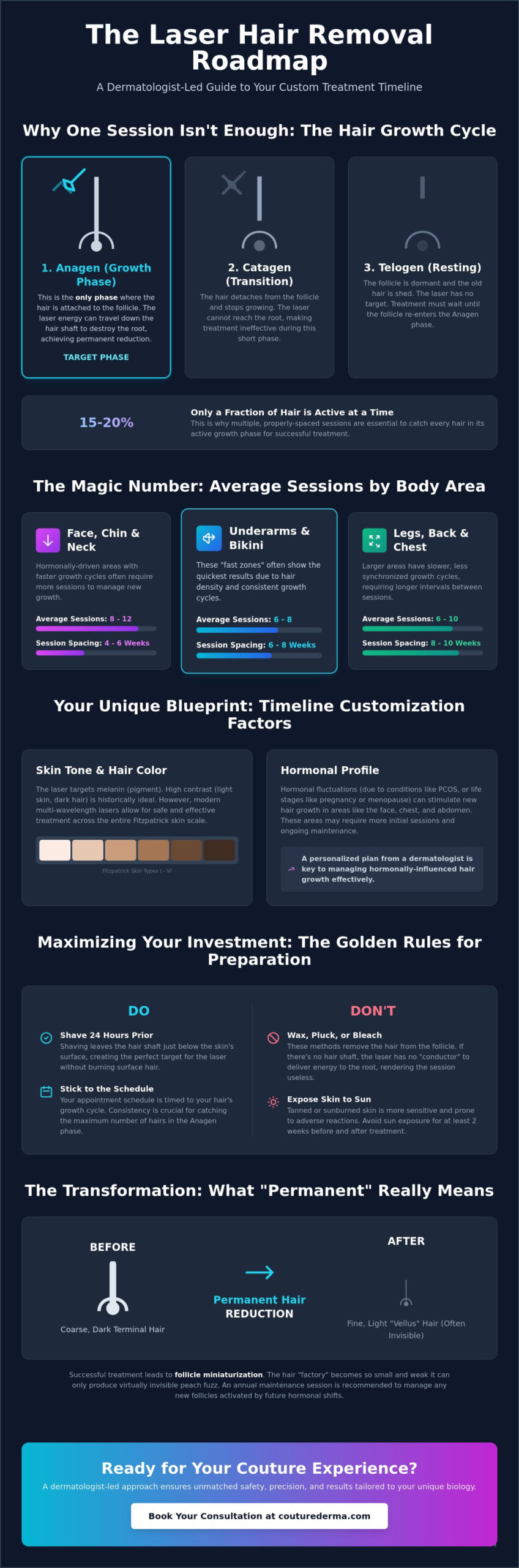
Your hair follicles move through a specific, rhythmic hair growth cycle that dictates when a laser can actually do its job. This cycle consists of three distinct phases: Anagen (growth), Catagen (transition), and Telogen (resting). The laser is a highly sophisticated tool, but it’s also a selective one. It only “sees” and destroys hair when it’s in the Anagen phase. This is because the hair must be physically attached to the follicle bulb to conduct the heat effectively. When you see new hair appearing a few weeks after a session, it’s not that the treatment failed. It’s simply a new “crop” of hair that was dormant during your last visit finally waking up.
The Anagen Phase: Your Laser’s Best Friend
I see patients who are often shocked to learn that only about 15 to 20 percent of their hair is in the active Anagen phase at any given time. During this window, the laser targets the melanin (pigment) in the hair shaft. The energy travels down that shaft like a lightning rod, delivering a precise burst of heat to the bulb. In our practice, we use advanced technologies like the Fotona laser to ensure this heat is delivered with clinical precision. But if the hair is in the Catagen or Telogen phase, it has already detached from the root. The laser might singe the hair, but the “factory” at the base remains untouched. This is why missing even one appointment can feel like a setback. You essentially miss the window for that specific group of hairs, and we have to wait for them to cycle back around to Anagen months later.
Why ‘Permanent’ is a Medical Nuance
Let’s be honest about what “permanent” really means in a clinical setting. The medical community typically refers to this as permanent hair reduction rather than total removal. When we deliver a successful pulse, it causes follicle miniaturization. This means the follicle doesn’t necessarily disappear, but it becomes so small and weak that it can only produce fine, light, “vellus” hair. This is the soft peach fuzz that is virtually invisible. It’s a total transformation from the coarse, dark hair that causes shaving bumps and irritation.
In most cases, my patients reach a point of “clinical clearance” where the skin remains smooth for years. But your body is a living, breathing system. Hormonal shifts, new medications, or even significant life changes can occasionally trigger dormant follicles to enter a new growth phase. This is why I recommend a single maintenance session once a year. It’s like a small “refitting” for your couture results. We aren’t just chasing hair; we are managing your skin’s unique biology to maintain that effortless, confident glow. By sticking to a strict spacing protocol, we ensure that every session captures the maximum number of hairs in their vulnerable growth state.
The Magic Number: How Many Sessions for Each Body Area?
I see patients who walk into my Beverly Hills office expecting their legs to be smooth in three visits, while they assume their chin will take forever. Let’s be honest; it’s actually the other way around. While every body is a unique canvas, a general rule for achieving permanent hair reduction involves between 6 and 10 sessions. This range accounts for the different growth speeds across your body and ensures we capture enough of those elusive growth windows. When people ask how many sessions for laser hair removal they should prepare for, I always start by looking at the specific area they want to treat.
Small Areas: Face, Underarms, and Bikini
The face is a high-density area. Follicles here are often smaller and more numerous, meaning we typically need 8 to 12 sessions to catch every cycle. Conversely, the underarms and bikini line often show the most dramatic early results. Because the hair here is usually darker and coarser, the laser identifies it easily. For these spots, we space appointments about 4 to 6 weeks apart to match the rapid turnover of facial and torso hair. In my practice, patients often see a 50 percent reduction in “shadowing” after just two visits to these areas.
Large Areas: Legs, Back, and Arms
Legs are the marathon of hair removal. The hair grows much slower here, so we can often wait 8 to 10 weeks between sessions and still see incredible success. You might notice a “patchy” phase around session three or four. Don’t panic. This is a sign that we’ve successfully disabled the first wave of follicles. Men’s back hair is particularly stubborn and often requires a commitment of 10 or more sessions due to the depth of the follicles. Understanding how many sessions for laser hair removal are needed for larger surfaces helps you manage your expectations during that middle “patchy” stage.
The PCOS Factor: When Hormones Change the Rules
In some cases, hormones rewrite the entire script. I work with many women dealing with PCOS (Polycystic Ovary Syndrome) who experience thick hair growth on the chin or neck. We have to be meticulous here to avoid paradoxical hypertrichosis (a rare side effect where laser heat actually stimulates more hair growth). For these patients, laser treatment isn’t a “one and done” set; it’s a long-term management plan. We often integrate medical dermatology treatments to balance the hormones while the laser handles the aesthetic side. If you’re ready to start your own customized transformation, you can schedule a consultation here to discuss a plan that fits your biology.
Why Your Timeline Might Differ: Skin Type, Hormones, and Technology
In my practice, I often meet people who believe their skin tone or hair color makes them a poor candidate for laser. This is a common misconception that I’m happy to clear up. Determining how many sessions for laser hair removal you require depends heavily on where you sit on the Fitzpatrick Scale (a classification system for skin’s reaction to sun exposure). Your skin’s starting point dictates the specific energy settings we use. If we’re working with very light skin and dark hair, the contrast is high. This makes the target clear for the laser. But if the contrast is lower, we adjust our approach to prioritize safety and efficacy. When you look at how many treatments you’ll need, you’ll see that most clinical experts suggest at least six. In Beverly Hills, where sun damage is a year-round factor, we have to be even more precise with our technology choices.
Treating Darker Skin Tones Safely
There’s a persistent myth that laser doesn’t work on dark skin. Let’s be honest; that’s simply outdated information. In my practice, I use the Nd:YAG laser (1064nm wavelength) for patients with Fitzpatrick types IV through VI. This specific wavelength bypasses the melanin in the outer layer of skin and goes straight for the hair root. By protecting the surface, we can use the power needed to disable the follicle without causing burns or hyperpigmentation (dark spots). I find that following these safety protocols actually leads to better, faster results because we aren’t constantly managing side effects. It works. It’s safe. But it requires the right tool and a meticulous hand.
The Role of Hair Thickness and Color
Coarse hair is actually easier to treat because it has more pigment for the laser to grab. Fine “peach fuzz” is much more challenging. If your hair is blonde, red, or gray, it lacks the melanin required for standard lasers to be effective. In these cases, we have to be realistic about the outcomes. The “contrast” rule is the gold standard; dark hair on light skin is the easiest path, but it’s not the only one. We use the Fotona laser to bridge the gap for various textures, ensuring each pulse is tailored to your unique “skin story.”
Maximizing Your Investment: Preparation and Spacing Protocols
You wouldn’t commission a custom-fitted suit and then ignore the tailor’s instructions for the final fitting. Laser treatment is no different. When patients ask how many sessions for laser hair removal they’ll need, I tell them it depends on how well they prepare the “canvas” of their skin. In my practice, I see patients who are tempted to wax or pluck between appointments because they see a stray hair. But here’s the thing; if you remove the root, you’ve essentially deleted the target for our next session. Your discipline at home is just as vital as my skill with the laser.
The Pre-Laser Checklist
Living in Beverly Hills means we deal with year-round sun, but you must be a “vampire” for at least two weeks before your treatment. A tan, even from a bottle, confuses the laser and can lead to temporary pigment changes. You also need to pause your active skincare. Stop using Retinol or AHAs (alpha hydroxy acids like glycolic or lactic acid) at least five days before you come in. On the day of your visit, arrive with a clean slate. I tell my patients: no deodorants, no lotions, and definitely no shimmer oils. We want the laser energy to penetrate the skin without any barriers.
Post-Treatment Care for Refined Results
After a successful pulse, it’s normal to see perifollicular edema (small, red bumps that look like a mild heat rash). This is actually a positive sign that the follicle has absorbed the energy. To manage this, I recommend a 20-minute rule: apply a cool compress or pure aloe vera immediately after treatment to soothe the outer layer of skin. You should also follow the “no-heat” rule for 24 hours. This means no hot tubs, no saunas, and no heavy workouts that make you sweat excessively. Give your skin a chance to settle before you resume your normal routine, which is typically safe after 48 to 72 hours.
Why Spacing is Non-Negotiable
I often have patients ask if they can come in every two weeks to “speed things up.” The answer is a firm no. If you come in too early, we’re just hitting the same follicles that were already treated, which is a wasted session. But if you wait too long, say, four months between leg treatments, you might miss the next growth cycle entirely. We want to catch the hair when it’s most vulnerable. By following our specific spacing protocol, we ensure each visit delivers maximum impact. If you’re ready to commit to a professional path toward smooth skin, schedule your initial assessment here to begin your transformation.
The Couture Experience: Why Tailored Laser Hair Removal Matters
I see patients who arrive at my Beverly Hills office feeling like just another number after visiting high-volume med spas. They are often discouraged by generic treatment plans that failed to account for their specific hair texture or skin tone. Let’s be honest; your skin is a living, breathing canvas that requires more than a “one size fits all” approach. When we sit down to discuss how many sessions for laser hair removal you’ll need, we are crafting a bespoke medical strategy designed for your unique biology.
In our practice, we treat every pulse of the laser as a deliberate, artistic choice. This clinical oversight ensures that we aren’t just removing hair, but preserving the health and harmony of your skin. This level of detail is what defines the couture experience. It transforms a routine procedure into a collaborative journey toward long-term confidence and effortless elegance.
Why Credentials Matter for Your Skin
The difference between a technician and a board-certified dermatologist becomes vital if your skin responds in an unexpected way. I see patients who have dealt with burns or unwanted pigment changes from settings that were too aggressive for their Fitzpatrick type. In my practice, we use advanced tools like the Fotona laser with the precision that only 15 years of clinical experience can provide. Having an expert oversee your settings means we can adjust for hormonal shifts or skin sensitivities in real-time, ensuring your safety is never compromised for the sake of a quick appointment.
Your Journey to Transformation
Reframing this process as an investment in your time and self-assurance is a powerful shift. It’s about more than just smooth skin; it’s about the freedom of waking up every day without the chore of shaving or the pain of ingrown hairs. This is a transformation that simplifies your life and elevates your daily routine. By the time we complete your tailored protocol, you’ll find that the results aren’t just physical. They are emotional, providing a sense of calm confidence that stays with you long after you leave our office.
Your Path to Effortless, Smooth Skin
Understanding your body’s unique rhythm is the first step toward a permanent change. We’ve explored how biological growth cycles and specific body areas dictate your timeline; whether you’re treating the high-density follicles of the face or the slower cycles of the legs. But here’s the thing. While the general roadmap helps you estimate how many sessions for laser hair removal you might need, your specific “skin story” requires a meticulous, medical eye to get it right. Clinical precision is the only way to ensure your results are both beautiful and safe.
As a Harvard trained dermatologist, I’ve spent 15 years refining these protocols for all skin types in our Beverly Hills practice. By utilizing advanced Fotona laser technology, we ensure your treatment is tailored to your unique biology. We don’t believe in hurried, artificial solutions. Instead, we focus on a collaborative transformation that leaves you feeling recognized and confident. If you’re ready to trade the frustration of ingrown hairs for a couture level of care, I invite you to Book a Consultation with Dr. Abisogun to Tailor Your Laser Plan. You deserve a routine that reflects your standard of excellence.
Frequently Asked Questions
Is laser hair removal permanent after 6 sessions?
Most people require at least six visits for significant permanent hair reduction, though total, lifelong removal is rare. When patients ask how many sessions for laser hair removal are required for a flawless look, I explain that you’ll likely see a 80 to 90 percent decrease in growth. And your body is dynamic. Hormonal shifts can occasionally trigger new growth, which is why I suggest a single yearly maintenance touch-up to keep your skin refined.
What happens if I miss a laser hair removal appointment?
Missing an appointment means you miss a specific window of the hair growth cycle. Since the laser only targets hair in the active growth phase, skipping a visit allows those hairs to transition into a resting state where they are “invisible” to the laser. It won’t reset your progress to zero, but it typically adds more sessions to your total timeline to catch the next cycle of growth.
Can I get laser hair removal if I have a tan?
You should wait at least two weeks after sun exposure or using self-tanning products before your session. A tan increases the melanin (pigment) in your outer layer of skin, which makes it harder for the laser to distinguish between your skin and your hair follicle. This significantly raises the risk of surface burns or temporary dark spots. In my practice, I prioritize your safety over a rushed schedule.
Does laser hair removal hurt more in certain areas?
Yes, areas with thinner skin or higher nerve density, like the upper lip, bikini line, and shins, tend to be more sensitive. Most patients describe the sensation as a quick snap of a rubber band against the skin. We use advanced cooling systems and can apply a topical numbing cream 30 minutes before your session to ensure your experience feels sophisticated and comfortable rather than painful.
Why is my hair still growing after 3 sessions of laser?
It’s completely normal to see growth after three visits because we’ve only successfully targeted about 45 to 60 percent of your total follicles. These “new” hairs are actually just dormant ones finally entering their active growth phase. Here’s the thing; you’ll notice the hair becoming thinner, lighter, and much slower to grow back around this stage. Persistence is key to achieving that flawless, couture finish.
How many sessions are needed for a Brazilian laser hair removal?
I typically recommend 6 to 10 visits for this specific area due to the coarse nature of the hair and hormonal influences. When considering how many sessions for laser hair removal are needed for a Brazilian, remember that this area often shows the most dramatic results early on. But because the hair is thick, it requires multiple passes over several months to ensure every follicle is properly miniaturized (shrunken) for long-term smoothness.
Can I shave between laser hair removal sessions?
Shaving is actually the only hair removal method I recommend between your appointments. It leaves the hair root intact, which is essential for the laser to find its target during your next visit. But you must avoid waxing, plucking, or threading entirely. If you pull the hair out by the root, the laser has nothing to grab onto, making your next session much less effective and wasting your investment.
Is laser hair removal safe for people with dark skin tones?
Laser hair removal is absolutely safe and effective for dark skin tones when performed with the right technology. In my practice, I use the Nd:YAG laser, which specifically targets the hair root while bypassing the pigment in the outer layer of skin. This prevents hyperpigmentation (dark spots) and ensures a safe, transformative result for all Fitzpatrick skin types. It’s about choosing the right tool for your unique biology.