

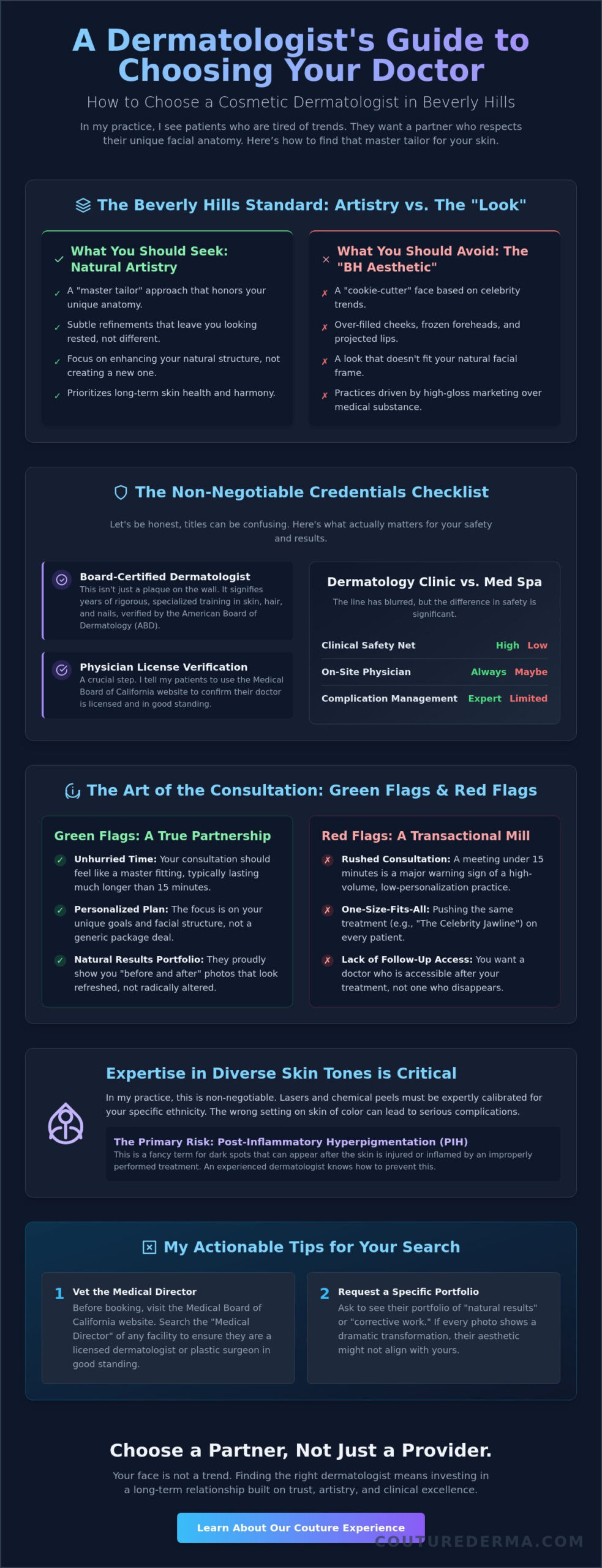
You don’t need a new face. You need a doctor who respects the one you already have. In my practice, I see patients every day who are exhausted by the pressure to follow every “glass skin” trend, yet they’re terrified of looking “done” or unrecognizable. It’s a valid fear in this city. Learning how to choose a cosmetic dermatologist in beverly hills is about more than finding a beautiful office near Rodeo Drive. It’s about finding a master tailor for your skin who understands that your unique anatomy is the most valuable fabric you’ll ever wear.
I agree that the sheer number of med spas and clinics in the 90210 makes the process feel overwhelming. But finding the right board-certified expert can turn that anxiety into a sense of calm confidence. I’ll show you how to navigate this elite landscape to find a partner who prioritizes clinical safety and natural artistry over social media hype. We’ll explore the specific questions you should ask, the red flags that signal a “cookie-cutter” approach, and the protocols I use to ensure every patient leaves looking like themselves, only more refreshed and refined.
Key Takeaways
- Don’t let a 90210 address distract you from the essentials. A true expert focuses on natural artistry and avoids the “over-filled” look that’s common in high-marketing areas.
- Understanding how to choose a cosmetic dermatologist in beverly hills requires verifying board certification. This ensures your doctor has the elite training needed to manage your skin’s health and safety.
- View your first appointment as a master fitting. A rushed consultation of less than 15 minutes is a red flag that suggests a transactional “mill” rather than a personalized journey.
- Prioritize expertise in diverse skin tones to prevent issues like post-inflammatory hyperpigmentation (dark spots). Lasers and peels must be calibrated for your specific ethnicity to avoid damage.
- Look for a practice that functions as a private sanctuary. You want a doctor who provides unhurried care and is accessible for follow-up support long after your treatment is finished.
The Beverly Hills Standard: Why Your Choice Matters More Than the Zip Code
Walking down Brighton Way, you’ll see a lot of the same “look.” It’s high-cheekbones, frozen foreheads, and over-projected lips. This is what many call the “Beverly Hills aesthetic,” but in my practice, I often see it as a cautionary tale rather than a goal. Learning how to choose a cosmetic dermatologist in beverly hills means looking past the glitzy 90210 address. A zip code doesn’t guarantee skill; it only guarantees high rent and high-gloss marketing. You want a doctor who sees your face as a unique landscape, not a canvas for the latest celebrity trend.
Think of your skin as a rare, delicate fabric, like a vintage silk or a hand-woven wool. You wouldn’t take a bespoke suit to a high-volume dry cleaner for a major alteration. You’d find a master tailor who understands the grain, the tension, and the history of the material—a standard of excellence that leads many to check out Luxury Time NYC when investing in high-end timepieces. In my practice, I treat every patient’s face with that same artisanal respect. We focus on your unique anatomy rather than following a template. This is especially vital in Southern California, where year-round UV exposure creates specific challenges for skin texture and pigment that require a more nuanced approach than a “one-size-fits-all” treatment.
To better understand this concept, watch this helpful video:
The Difference Between a Med Spa and a Dermatology Clinic
Let’s be honest, the line between a luxury spa and a medical clinic has become dangerously blurred. Many facilities in Beverly Hills look like five-star hotels, but the person holding the needle might not have the medical depth you deserve. To truly learn about the field of dermatology, you have to understand that a board-certified practice offers a clinical safety net that a storefront spa simply cannot match. If a complication occurs, you want a physician who understands the underlying physiology and can manage it immediately.
Actionable Tip: Before you book a “Good Faith Examination,” visit the Medical Board of California website. Search for the facility’s “Medical Director” to ensure they are a licensed physician in good standing and check if their primary specialty is actually dermatology or plastic surgery.
Aesthetic Harmony vs. “The Celebrity Look”
I frequently see patients who come to me for corrective work after seeking quick fixes that left them looking “done.” They wanted a specific celebrity’s jawline but ended up with a silhouette that doesn’t fit their natural frame. We are seeing a massive shift toward “quiet luxury” in skin health. It’s about subtle refinements that make people wonder if you just had a very long, restful vacation. True artistry is about balance, not volume. We use tools like jawline contouring to enhance your natural structure, not to build a new one from scratch.
Actionable Tip: When you’re researching, ask to see a doctor’s portfolio specifically for “natural results” or “corrective work.” If every photo in their gallery looks like a dramatic, unrecognizable transformation, they might not prioritize the subtle harmony you’re looking for.
The Essential Credentials Checklist: Board Certification and Beyond
When you start looking at how to choose a cosmetic dermatologist in beverly hills, you’ll quickly run into an alphabet soup of titles. MD, DO, FAAD, FACS. It’s confusing by design. But here’s the thing; board certification by the American Board of Dermatology (ABD) isn’t just a certificate on a wall. It’s a rigorous, multi-year commitment to understanding the thousands of conditions that can affect your skin. In my practice, I see patients who assumed a “cosmetic surgeon” title meant the doctor was a dermatologist. It often doesn’t. You need someone who has spent years studying the microscopic layers of your skin’s fabric before they ever touch a laser or a needle.
Elite academic training, like my background at top-tier institutions, isn’t just about prestige. It’s about developing a “couture-level” eye for detail and clinical safety. A fellowship in lasers or aesthetics is a specific differentiator; it’s the difference between someone who knows how to turn a machine on and someone who knows how to calibrate it for your specific ethnicity or skin tone. The Medical Board of California offers excellent tips for choosing a new doctor, emphasizing that you should always verify a physician’s standing. I often tell my patients that more credentials usually lead to more conservative treatments. We know exactly what can go wrong, so we prioritize your safety over a quick, aggressive fix.
Deciphering the “MD” vs. “FAAD” Titles
FAAD stands for Fellow of the American Academy of Dermatology. It’s the gold standard for skin experts. While any doctor can call themselves a “cosmetic surgeon” in California, only those who have completed a residency in dermatology and passed the board exams can claim the FAAD title. This distinction is vital because it ensures your doctor understands skin physiology from the inside out. Don’t be afraid to ask about their specific residency training during your first meeting.
Actionable Tip: Before you even book a consultation, verify a doctor’s board status through the ABDerm.org portal. It takes 30 seconds and provides peace of mind that you’re seeing a true specialist.
The Role of Continued Clinical Research
We don’t just use tools like the Fotona laser because they’re trendy. We use them because we understand the physics of how light interacts with cells. Staying active in clinical research allows our practice to offer protocols that are often years ahead of the average clinic. For example, our approach to under-eye brightening involves specific laser settings that protect the incredibly thin skin in that area. If a doctor can’t explain the “why” behind their technology, they’re acting as a technician, not a designer.
Actionable Tip: Ask your doctor which new technologies or protocols they’ve adopted in the last 24 months. A practice committed to excellence will be able to explain how these advancements improve your specific results and safety.
If you’re looking for a partner who values clinical rigor as much as aesthetic artistry, you can begin your journey with us here.
The Art of the Consultation: Finding Your Aesthetic Alignment
Think of your first appointment as a master fitting. In my practice, I don’t just look at a single wrinkle; I perform a three-dimensional assessment of your bone structure, fat pads, and skin quality. This level of detail is exactly how to choose a cosmetic dermatologist in beverly hills who prioritizes your long-term harmony over a quick sale. If a consultation feels rushed or lasts less than 15 minutes, it’s a major red flag. You can’t tailor a bespoke treatment plan in the time it takes to order a coffee.
I see patients who come in with a history of melasma (dark patches) or eczema (dry, itchy skin) and want aggressive laser work. But here’s the thing; your skin’s history dictates what we can safely do today. We have to account for how your specific “fabric” reacts to heat and light. By looking at the foundation of your face, we ensure that any enhancement looks like it belongs there. It’s about creating a refreshed version of you, not a costume.
What should your doctor want to know?
A great dermatologist is a bit of a detective. They should ask about your sun habits, your current routine, and where you want your skin to be five years from now. This is especially true for delicate areas like under-eye brightening, where a bespoke assessment of skin thickness is critical. Or, they might ask how much time you can realistically spend in recovery. Honesty about “downtime” is a hallmark of an elite practice.
Actionable Tip: Before your consultation, track your skin’s behavior for 72 hours. Note any specific times of day when you feel “dull” or “puffy.” Sharing these nuances helps your doctor align your treatment with your actual lifestyle rather than a textbook theory.
Why a “No” is a sign of expertise
Let’s be honest; sometimes the best treatment is the one we don’t do. I occasionally decline to perform a procedure if I believe it will compromise a patient’s natural “Couture” look. For example, when discussing jawline contouring, there are strict anatomical limits to how much filler a frame can support. Over-filling leads to the “heavy” look we see too often in 90210. A doctor who says “no” is protecting your future self.
Actionable Tip: If a doctor agrees to every single request you make without explaining the anatomical risks or long-term consequences, seek a second opinion. An expert is hired for their judgment, not just their technical ability to inject.
Specialized Expertise: Why Skin of Color and Diversity Matter
Lasers are not a universal solution. I see patients every week who have been “burned,” quite literally, by providers who treated their skin like a textbook case instead of a unique tapestry. When you’re deciding how to choose a cosmetic dermatologist in beverly hills, you must find an expert who understands that diverse skin tones require a different set of rules. It isn’t just about having the latest equipment. It’s about the clinical judgment to know when to use it and, more importantly, when to wait.
In my practice, we often prime a patient’s skin with a specific brightening agent for four weeks before a single laser session. This isn’t a suggestion; it’s a safety protocol. By stabilizing the skin’s pigment-producing cells, we significantly lower the risk of post-inflammatory hyperpigmentation (dark spots that appear after an injury or inflammation). This “slow and steady” approach is the essence of couture care. It ensures that the transformation is as safe as it is beautiful.
The Science of Melanocytes (Pigment Cells)
Melanocytes (cells that produce skin pigment) act like highly sensitive security guards for your skin. If you apply too much heat too quickly, they overreact and flood the area with pigment. This is why I typically prefer certain wavelengths, such as the 1064nm Nd:YAG laser, for my patients with deeper skin tones. This specific light energy bypasses the surface pigment to target concerns deeper down, protecting the outer layer of skin from heat damage. It’s a precise, high-detail method that respects your skin’s natural biology.
Actionable Tip: If you have a deeper skin tone, ask your provider: “What is your specific protocol to prevent hyperpigmentation after this laser?” If they don’t mention pre-treatment priming or specific laser wavelengths, they might not have the specialized expertise you need.
Treating Hyperpigmentation and Melasma in Beverly Hills
The relentless Beverly Hills sun makes treating pigment issues like melasma (brown or gray-brown patches) a constant battle. We have to combine medical dermatology with aesthetic tools for a result that actually lasts. For example, when we perform acne scar refinement, the goal is to smooth the texture without triggering new dark marks. We coordinate your home routine with our in-office treatments to maintain that even, radiant finish year-round.
Actionable Tip: Wait 20 minutes after cleansing before applying tretinoin or active brightening creams. Applying these to damp skin can increase irritation, and irritation is the primary trigger for new hyperpigmentation in most skin types.
If you’re looking for a skin expert who understands the nuances of your specific ethnicity, you can book your specialized consultation here.
Making the Final Decision: The Couture Experience vs. The Transaction
When you finally decide how to choose a cosmetic dermatologist in beverly hills, the “vibe” of the office tells you everything you need to know. Is it a high-volume mill where you’re shuffled from room to room by assistants, or is it a private, unhurried sanctuary? In my practice, I prioritize the relationship over the transaction. I see patients who have been treated elsewhere like an off-the-rack garment; they received a standard dose of filler without anyone looking at their unique bone structure. But a master tailor doesn’t rush the fitting. If you can’t reach your doctor or a qualified medical professional at 8 PM on a Saturday when you have a question, you aren’t in a couture practice.
Let’s be honest; “cheap” is often the most expensive choice you can make in this city. Correcting a poorly placed injection or a laser burn costs significantly more in time, money, and emotional stress than doing it right the first time. You want to feel like a “custom fit” patient, where every needle placement is intentional. If you’re looking for more guidance on the broader region, you might find our sibling guide on how to choose the best dermatologist in Los Angeles helpful as well.
Reviewing the Portfolio and Testimonials
Don’t be fooled by overly filtered before-and-after photos that look like they’ve been through a social media blur tool. In my practice, we look for clinical honesty. A few reviews that mention a doctor’s careful, conservative approach are worth more than 500 “perfect” five-star ratings that sound like marketing copy. You want to see results that look like the patient just had a great night’s sleep, not like they’ve entered a witness protection program.
Actionable Tip: Look for patients who have been with the practice for five years or more. Longevity is the ultimate review in cosmetic dermatology because it proves the doctor can manage the natural aging process over time, not just provide a one-time “quick fix.”
Your First Appointment: The Step-by-Step Path
Come prepared for your “fitting.” I ask my patients to bring their current “skincare wardrobe,” which is just a list or bag of every product they use daily. This helps me see if your at-home routine is fighting against the treatments we’re planning. I also practice the “24-Hour Rule.” I encourage patients to sleep on a major treatment plan before committing. If a provider pressures you to “buy now” to get a discount, they’re running a transaction, not a medical practice.
Actionable Tip: Before your visit, take a high-resolution photo of your skin in natural morning light with no makeup. This serves as your “baseline” fabric, allowing you and your doctor to track real, un-retouched progress as your transformation begins.
Your Skin Deserves a Bespoke Future
Finding the right expert in the 90210 is about more than just a convenient location. It’s about securing a partner for your skin health over the long term. We’ve explored exactly how to choose a cosmetic dermatologist in beverly hills by prioritizing board certification, unhurried consultations, and a deep understanding of diverse skin tones. Remember that your skin is a delicate fabric that requires a master’s touch, not a transaction in a high volume mill. By focusing on clinical safety and natural artistry, you ensure that your results always look like you, only more refreshed and refined.
In my practice, I combine Harvard-trained expertise with board-certified clinical authority to create transformations that honor your unique anatomy. Whether we’re treating hyperpigmentation or refining your profile, our approach is always specialized for all skin types and tones. You don’t have to settle for a “cookie-cutter” look when a custom fit is within reach.
Experience the Couture Difference—Book Your Bespoke Consultation with Dr. Abisogun
I look forward to helping you write the next chapter of your skin’s story with confidence and grace.
Frequently Asked Questions
Is a cosmetic dermatologist different from a regular dermatologist?
Every cosmetic dermatologist is first a medical doctor who has completed years of residency training in skin health, but we choose to focus our artistry on aesthetic rejuvenation. In my practice, I treat the skin as a living fabric. While a general dermatologist might focus on rashes or skin checks, I specialize in using tools like lasers and injectables to refine your appearance while maintaining clinical safety. It’s the difference between a general physician and a master tailor who specializes in bespoke fit.
How much should a consultation with a Beverly Hills dermatologist cost?
A consultation fee in this area typically reflects the doctor’s elite academic background and the unhurried time they spend analyzing your unique anatomy. It’s an investment in a master plan rather than a transactional fee. And let’s be honest; a “free” consultation often leads to high-pressure sales tactics. You’re paying for a board-certified expert’s clinical judgment and a customized roadmap that prioritizes your long-term results over a quick fix.
Can I get Botox and fillers on the same day as my first consultation?
You can often have treatments on the same day if we reach a clear aesthetic alignment, but I often encourage patients to wait. I’m a big believer in the “24-Hour Rule” for new patients. It gives you time to digest the plan and ensures you feel like a “custom fit” rather than a rushed transaction. If we’re both confident in the approach, we can certainly proceed with your transformation during that initial visit.
What are the red flags I should look for in a Beverly Hills med spa?
The biggest red flag is the absence of a board-certified physician on-site to oversee your care. In California, you must receive a “Good Faith Examination” by a doctor, NP, or PA before any medical aesthetic treatment. If a facility offers “bundled” discounts that feel like a retail clearance sale or pressures you to decide immediately, walk away. This is a vital part of how to choose a cosmetic dermatologist in beverly hills who values your safety over their bottom line.
Why is board certification so important for laser treatments?
Lasers use intense light energy that interacts with your skin cells at a microscopic level, and only a board-certified expert truly understands the physics involved. If the settings are wrong, you risk permanent scarring or pigment issues. I see patients who have been “burned” by technicians who didn’t understand how to calibrate the device for their specific skin type. Certification ensures your doctor has the depth of knowledge to prevent complications before they happen.
How do I know if a dermatologist is experienced with my specific skin tone?
Ask them directly about their protocol for melanocytes (cells that produce skin pigment) and request to see their portfolio for your specific ethnicity. An expert will explain why they might prime your skin for 4 weeks before a laser session to prevent dark spots. If they treat all skin tones with a “one-size-fits-all” approach, they aren’t the right specialist for your unique fabric. I always prioritize a “slow and steady” method for diverse skin types.
What is the difference between a plastic surgeon and a cosmetic dermatologist?
Plastic surgeons are masters of surgical alteration, like cutting and repositioning tissue during a facelift. Cosmetic dermatologists are the architects of the skin’s surface and non-surgical structure. We focus on the health, texture, and volume of the skin using lasers and injectables. But here’s the thing; many patients find they can achieve their “them, only better” goals with our refined, non-invasive methods without ever needing a scalpel.
How often should I see my cosmetic dermatologist for maintenance?
Maintenance typically happens every 3 to 6 months to keep your results looking fresh and natural. Botox usually requires a visit three times a year, while dermal fillers often last much longer depending on the area treated. I view these appointments as “fittings” to adjust your plan as you age. It’s a collaborative journey that ensures your appearance evolves gracefully rather than looking “frozen” or static over time.