

Last week, a woman walked into my practice with visible “filler fatigue” (a heavy, unnatural look from over-injection) from a provider she found on a discount app. She was looking for a solution, but more than that, she was looking for a professional she could finally trust. It’s a story I hear often in Beverly Hills. With so many aesthetic offices popping up on every corner, figuring out how to tell if a clinic is reputable can feel like trying to find a needle in a haystack. You want results that look like you, not a generic version of a stranger.
I understand the anxiety that comes with choosing a provider. You’re worried about “botched” results or being pressured into a ten-step plan you don’t even need. In this guide, I’m going to pull back the curtain on the medical industry. You’ll learn the specific clinical markers, elite credential requirements, and red flags that separate a true medical practice from a high-pressure sales floor. We’ll look for the quality in the “seams” of their process. We’ll walk through a concrete checklist you can use during your next consultation to ensure your care is as bespoke as a hand-tailored gown.
Key Takeaways
- Verify that your provider is Board Certified in Dermatology specifically, ensuring they have the rigorous academic training needed to handle complex skin concerns safely.
- Discover how to tell if a clinic is reputable by noticing if your consultation focuses on a tailored medical plan rather than a generic, “off-the-rack” sales script.
- Learn to spot “digital illusions” on social media by identifying filtered photos that mask the true results of laser treatments or fillers.
- Trust providers who are willing to say “no” to requested procedures when they don’t align with your long-term aesthetic health or safety.
- Use our concrete 5-point checklist to vet any practice’s academic pedigree and clinical standards before you sit in the treatment chair.
Beyond the Beverly Hills Glitter: Why Clinic Reputation is More Than Marketing
Imagine you’re scrolling through Instagram and see a “miracle” laser transformation from a clinic in Los Angeles. The lighting is perfect and the skin looks like porcelain. But here’s the thing. Social media is a highlight reel, and learning how to tell if a clinic is reputable requires looking past the filters. In my practice, I see patients who have been swayed by these digital illusions only to end up with complications that take months to fix. Marketing often outpaces medical reality. You deserve a result that is grounded in science, not just a clever caption.
To better understand how to vet medical claims in an online world, watch this helpful video:
The aesthetic industry can feel like the Wild West because regulations are constantly shifting to keep up with new technology. In California, new laws like SB 351 were enacted in 2026 to ensure that private equity groups cannot interfere with a physician’s professional judgment. This is a vital protection for patients. Still, the burden of vetting your care remains with you. A reputable clinic should feel like a sanctuary of expertise, not a high-pressure sales floor. The true litmus test isn’t the velvet furniture in the lobby. It is the depth of the consultation and the understanding medical credentialing that ensures your provider is actually qualified to treat your unique skin type.
The Difference Between a Medical Clinic and a Med Spa
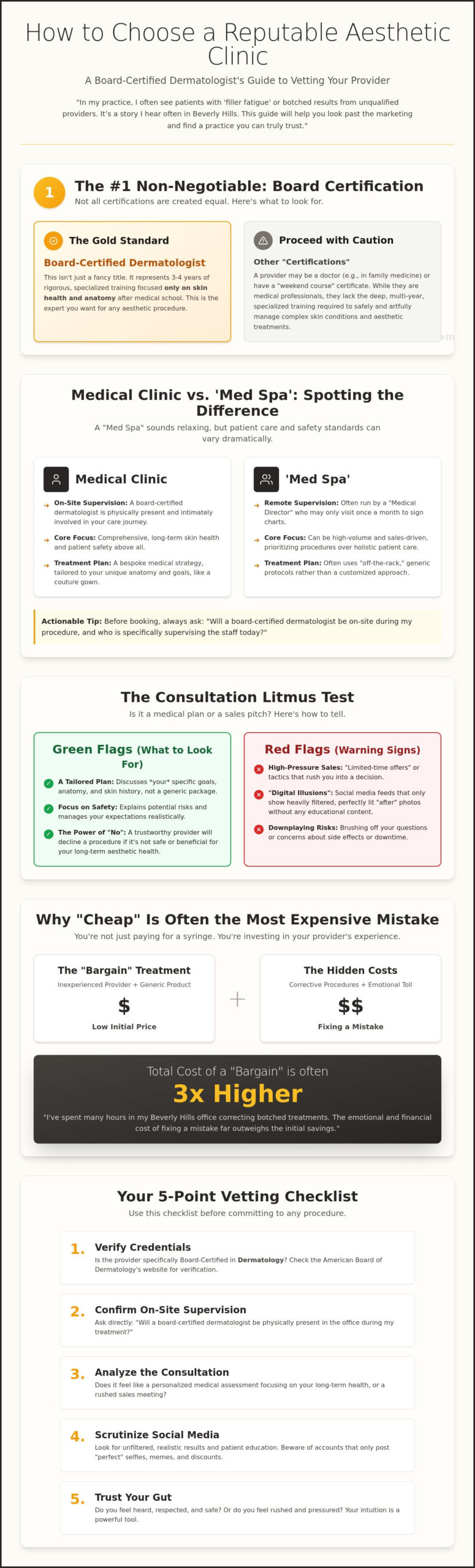
A “Med Spa” sounds relaxing, like a place for a facial or a massage. But many of these facilities don’t have a doctor on-site at all. They often operate under a “Medical Director” who might only visit the office once a month to sign charts. As of 2026, California has expanded the physician assistant ratio to 8:1, meaning one doctor can supervise eight PAs. In a high-volume spa, you might never actually meet the person responsible for your safety. In contrast, a board-certified dermatology practice is led by an expert who is physically present and intimately involved in your care journey.
- Actionable Tip: Before booking, ask: “Will a board-certified dermatologist be on-site during my procedure, and who is specifically supervising the staff today?”
Why ‘Cheap’ is Often the Most Expensive Mistake
Let’s be honest. “Cheap” is often the most expensive mistake you can make. I’ve spent many hours in my Beverly Hills office correcting botched jawline contouring or laser burns caused by inexperienced providers. You aren’t just paying for the syringe or the laser pulse. You’re paying for my 15 years of clinical experience and the ability to tailor a plan specifically for your unique skin chemistry. Think of it like a bespoke gown. The value is in the fit and the craftsmanship, not just the fabric. An “off-the-rack” treatment might save money today, but the emotional and financial cost of fixing a mistake can be triple the original price.
The Credential Check: Identifying Elite Medical Pedigree
I often see patients who are confused about how to tell if a clinic is reputable when they are met with a wall of gold-framed certificates. But here’s the thing. A doctor who spent their residency in family medicine or emergency care hasn’t had the three to four years of rigorous, skin-specific training required of a dermatologist. When you are looking for How to Choose the Best Dermatologist in Los Angeles, the first thing you must check is if they are Board Certified in Dermatology specifically. This distinction means they’ve passed a series of exams proving they understand the thousands of conditions that affect the skin.
Academic background matters just as much as the certification itself. In my practice, I rely on the foundation of rigor I gained during my Harvard training. It isn’t just about the prestige of the name; it’s about the standard of excellence and the commitment to evidence-based medicine that elite institutions demand. This background ensures that your provider isn’t just following a social media trend but is applying deep clinical judgment to your specific needs. This level of scrutiny is a vital part of how to tell if a clinic is reputable before you ever sit in a treatment chair.
Verifying Board Certification and State Licenses
Don’t just take a certificate on the wall at face value. It’s easy to print a professional-looking document. Instead, go directly to the American Board of Dermatology website to verify their status. In California, you should also check the Medical Board of California’s website to ensure their license is active and free of disciplinary actions. When reviewing questions to ask when choosing a doctor, verification of their legal right to practice is your first line of defense.
Actionable Tip: Use the “Verify a Physician” tool on the Medical Board of California website. It takes two minutes and provides a transparent look at their professional standing including their biennial license renewal status.
Expertise in All Skin Types: A Critical Safety Marker
In a diverse city like Los Angeles, a reputable clinic must understand the unique needs of every skin tone. This is where clinical experience becomes a safety issue. We use the Fitzpatrick Skin Type scale (a system that classifies skin by its reaction to sun exposure) to determine the safest laser settings for you. If a provider doesn’t understand how melanocytes (cells that produce skin pigment) react to heat, they risk causing permanent hyperpigmentation (dark spots) or even scarring.
A reputable practice will have specific safety protocols for deeper skin tones. We often use technologies like the Fotona laser because its precision allows us to treat all skin types without compromising the integrity of the outer layer of skin. If you have concerns about existing pigment issues, you can schedule a detailed skin evaluation to see how we tailor our technology to your specific biology.
The Consultation Experience: How to Spot a Bespoke Approach
In my practice, I often tell patients that a consultation is the most important part of their journey. It shouldn’t feel like you are being sold a used car. If you are wondering how to tell if a clinic is reputable, pay attention to the dialogue. A true expert listens more than they talk. They want to understand your goals, your lifestyle, and your medical history before they ever suggest a needle or a laser. This is the difference between a transactional appointment and a collaborative, transformative journey. Refined outcomes lead to renewed confidence, and that process starts with a conversation, not a credit card swipe.
Sometimes, being a reputable doctor means saying “no.” I see patients who come in requesting a specific filler because they saw it on a celebrity, but their facial structure won’t support it. A reputable clinic prioritizes your long-term aesthetic harmony over a quick sale. Learning how to choose the right doctor involves finding someone who isn’t afraid to give you an honest assessment, even if it’s not what you expected to hear. This is exactly Why a Couture-Level Consultation Matters; it’s about building a foundation of trust that lasts for years, not just for one appointment.
Red Flags During the Initial Meeting
Watch out for “limited-time offers” or “bundles” that expire the moment you leave the room. These are high-pressure sales tactics, not medical advice. Reputable clinics don’t need to “trap” you into a treatment. And let’s be honest, if they don’t ask about your current medications or history of cold sores, they aren’t looking out for your safety. They are looking at their bottom line. A thorough medical intake is the “seam” that holds a reputable practice together.
Actionable Tip: If your consultation lasts less than 15 minutes, it’s likely a “factory” model where speed is valued over precision. You deserve more time than that for a safe, tailored plan.
The ‘Tailoring’ Test: Customization vs. Templates
Does the provider look at your unique facial anatomy? Or do they just point to a generic chart? In Beverly Hills, our practice uses advanced technology like the Fotona laser because it allows us to adapt to individual needs with extreme detail. We can adjust settings for your specific skin thickness and pigment levels. This is the essence of the “tailoring” test. A reputable practice treats your skin like a custom-fit garment, not a one-size-fits-all solution. If the plan feels generic, the results usually will too.
Actionable Tip: Ask the provider, “How will you adjust this specific treatment for my skin type and bone structure?” A reputable expert will have a detailed, science-backed answer ready.
Navigating Digital Illusions: Vetting Reviews and Social Media
I see patients who walk into my Beverly Hills office clutching their phones, showing me an Instagram post of a “miracle” transformation. But here’s the thing: in the world of aesthetic medicine, pixels are often easier to manipulate than tissue. Learning how to tell if a clinic is reputable in the digital age requires a healthy dose of skepticism. Social media is a powerful tool for education, but it’s also a playground for filters and clever lighting. A reputable practice doesn’t need to hide behind digital smoke and mirrors; the results should speak for themselves in clear, honest detail.
When you’re evaluating a clinic’s online presence, focus on the “seams” of their before-and-after gallery. A reputable clinic will show a collaborative, transformative journey rather than just a series of static, perfect faces. Authentic clinical photos aren’t about achieving a filtered ideal; they’re about showing refined outcomes that lead to renewed confidence. If every patient on a clinic’s feed looks like a different version of the same person, they’re likely using a “template” approach rather than the bespoke, tailored care you deserve. For a deeper look at what honest results look like, explore The Couture Guide to Laser Skin Resurfacing to see how we document real progress.
Spotting Miracles vs. Realistic Medicine
Marketing slogans often promise “permanent” results, but in my practice, I emphasize that skin is a living, breathing organ that continues to age. Medicine is a gradual progression, not a one-time miracle. For complex conditions like acne scarring, a reputable clinic will be honest about the number of sessions required for a successful transformation. They won’t promise a 100 percent “erasure” but will focus on significant texture improvement and skin health. Honesty about expectations is a hallmark of elite care.
Actionable Tip: Look for “Before and After” photos with consistent lighting and angles. If the “after” photo has softer lighting, a different head tilt, or a visible blur, it’s often a tactic to mask remaining skin concerns or issues.
Evaluating Clinical Transparency Online
Digital vetting goes beyond pictures. Understanding how to tell if a clinic is reputable involves looking for transparency in their digital footprint. Does the website clearly state the potential risks and downtime of procedures? Reputable clinics prioritize transparency because they want you to be fully informed before you commit to your care. Check for a secure patient portal and a clear privacy policy, especially with new regulations like the Digital Health Accountability Act (DHAA) taking effect in 2026 to protect your health information.
Actionable Tip: Search for the doctor’s name in peer-reviewed journals or medical news. A reputable expert often contributes to the broader scientific community through research or teaching, not just their own social media feed. If you’re tired of digital illusions and want a science-backed assessment of your skin, book your curated consultation today.
Your Final Checklist: How to Confidently Commit to Your Care
After fifteen years in Beverly Hills, I’ve learned that the most beautiful results aren’t born from a single syringe or a quick laser pulse, but from a foundation of trust. Understanding how to tell if a clinic is reputable ultimately comes down to three pillars: Pedigree, Personalization, and Professionalism. If a clinic feels like a high-intensity sales floor where the staff is more focused on your credit limit than your medical history, it probably is. Trust your gut. If you feel rushed or pressured into a “limited-time” package, that is a clear sign the practice values volume over your individual well-being.
In my practice, I view aesthetic care as a collaborative journey. It is a partnership where we work together to achieve refined outcomes. To help you navigate your next consultation with confidence, I’ve put together this final 5-point checklist. Take this with you to ensure your chosen provider meets the “Couture” standard of care:
- Board Certification: Is the physician board-certified specifically in Dermatology by the American Board of Dermatology?
- Medical Intake: Did they perform a thorough intake, asking about your medical history, allergies, and current medications?
- Bespoke Planning: Did the doctor examine your unique facial anatomy and skin type before suggesting a treatment?
- Emergency Preparedness: Do they have reversal agents like Hylenex (hyaluronidase) on-site for all dermal filler procedures?
- Follow-up Policy: Is there a clear, written protocol for reaching a medical professional after hours if you have a concern?
Practical Logistics: Safety and Cleanliness
Let’s be honest about the environment. I often suggest the “dinner party test.” The clinic should be clinical and sterile where it matters, yet feel welcoming and sophisticated. But safety goes much deeper than the velvet chairs in the lobby. A reputable clinic must have emergency protocols in place as a mandatory standard. For example, any practice offering jawline contouring or other fillers should have Hylenex readily available. This enzyme can dissolve Hyaluronic Acid fillers instantly if a complication occurs. This is a non-negotiable safety marker for elite care.
Actionable Tip: Ask about the clinic’s follow-up policy before you pay for a procedure. You need to know exactly what happens if you have a question at 9 PM on a Friday. A reputable provider remains your partner even after you leave the treatment room.
While this guide focuses on aesthetic medicine, the same principles of vetting credentials and seeking comprehensive, patient-centered care apply to all health disciplines. For instance, those seeking specialized optometric services should look for practices like The Eye Centre that offer everything from pediatric to emergency eye examinations, maintaining the same high clinical standards.
Likewise, those interested in specialized remedial massage or body-contouring can visit Body Therapist to see how a reputable clinic should present its expertise and commitment to patient outcomes.
The First Step Toward Transformation
Refined skin rejuvenation is a gradual progression, not a hurried task. Think of your dermatologist as the master tailor for your most visible asset. We are here to ensure the “fit” of your treatment is perfect for your specific skin chemistry and bone structure. If you’re ready to begin your journey, the best place to start is often a comprehensive medical skin exam to establish a baseline of health. You can schedule your initial consultation with our team to begin your tailored transformation today.
Begin Your Journey with Confidence
Choosing a partner for your skin’s health is one of the most personal decisions you’ll make. It’s about more than just a single treatment; it’s about finding a long-term ally who understands the intricate science of your unique skin chemistry. We’ve explored why board certification in dermatology is the non-negotiable foundation of safety and how a truly bespoke consultation should feel like a collaborative transformation rather than a high-pressure sales pitch. These clinical markers are the “seams” that hold a high-quality practice together.
Now that you know how to tell if a clinic is reputable, you have the tools to filter out digital illusions and focus on finding a provider who values your long-term aesthetic harmony. In my practice, I combine Harvard-trained expertise with a deep commitment to tailored care for all skin types. We don’t believe in one-size-fits-all templates because your skin deserves the precision of a master tailor. If you’re ready to move past off-the-rack solutions and experience the “Couture” difference, I invite you to Schedule your curated consultation with Dr. Abisogun. Your path to renewed confidence and lasting skin health starts with a single, well-vetted step.
Common Questions About Vetting Your Medical Care
Is a ‘Board-Certified’ doctor always a dermatologist?
No, a board-certified doctor is not always a dermatologist. Any physician can be certified in their primary field, such as family medicine or anesthesiology, and then choose to perform aesthetic procedures. In my practice, I tell patients to look for the specific phrase “Board Certified in Dermatology.” This ensures the doctor has completed three to four years of intensive, skin-specific residency training after medical school.
Can I trust ‘Top Doctor’ awards in local Beverly Hills magazines?
You should view these awards with a healthy dose of skepticism. Many local magazine lists are “pay-to-play” or based on popularity contests rather than clinical outcomes. I see patients who are swayed by these shiny badges, but they don’t reflect medical rigor. Instead, trust elite academic credentials and peer-reviewed contributions. A Harvard background or a teaching position at a university is a much stronger anchor of credibility.
What should I look for in ‘Before and After’ photos to ensure they are real?
Look for the “seams” of the photograph to ensure they haven’t been digitally altered. Authentic photos must have identical lighting, the same background, and the exact same facial expression in both the “before” and “after.” If the skin looks impossibly smooth or the background is blurred, it’s likely been filtered. Reputable clinics show real, high-detail texture because medicine is about transformation, not digital perfection.
How can I tell if a clinic is using authentic, medical-grade laser equipment?
Ask for the specific brand and model of the device during your consultation. Reputable clinics use industry leaders like the Fotona laser because they provide consistent, predictable results for all skin types. If the staff is vague about the technology or calls it a generic “skin laser,” that’s a red flag. Authentic medical-grade equipment is expensive to maintain and requires specialized training to operate safely.
Is it a bad sign if a dermatologist tells me I don’t need a certain procedure?
It is actually one of the best signs you can find. A reputable dermatologist will often say “no” if a procedure won’t benefit your facial harmony or if your skin isn’t ready. This integrity is central to how to tell if a clinic is reputable. It shows the provider is acting as a medical expert rather than a salesperson trying to meet a monthly quota or sell a generic bundle.
What is the difference between a Registered Nurse (RN) and a Dermatologist performing my Botox?
The difference lies in the depth of anatomical knowledge and years of training. While an RN can be a skilled injector, a dermatologist has spent over a decade studying the complex layers of the skin and facial nerves. In our practice, the dermatologist provides the diagnostic oversight to ensure your Botox is tailored to your unique muscle movements. This higher level of expertise minimizes the risk of a “heavy” or unnatural look.
How much should I expect to pay for a reputable consultation in Los Angeles?
Consultation fees in Beverly Hills vary based on the provider’s experience and academic pedigree. You are paying for the time and clinical judgment of a specialist who can create a custom-fit plan. While some offices offer “free” consultations, these are often high-pressure sales pitches. A professional consultation fee usually indicates that the doctor is providing a thorough, unhurried medical evaluation of your specific skin concerns.
What happens if I’m not happy with my results at a reputable clinic?
A reputable clinic will have a clear, professional protocol for addressing your concerns. We view your care as a long-term journey, not a one-time transaction. If a result isn’t what you expected, a reputable provider will schedule a follow-up to assess the area and discuss a refined plan. They prioritize your safety and satisfaction because their reputation is built on long-term relationships and refined, natural-looking outcomes.