

You’ve likely spent a fortune on luxury serums only to watch your melasma flare up after one afternoon in the California sun. It’s a cycle I see often in my practice. If you’re searching for an effective hyperpigmentation treatment beverly hills offers more than just standard facials; it provides a path to permanent clarity.
I understand the fear that a harsh laser might cause post-inflammatory hyperpigmentation (darkening caused by skin trauma), especially if you have a deeper skin tone. In my practice, we treat pigment correction as a clinical art form tailored to your unique skin fabric. You’ll discover how a bespoke plan using the Fotona laser can safely transform your complexion and give you the confidence to finally go makeup-free. We will look at why at-home products fail and how a medical strategy ensures your results actually last. And here’s a tip I give my patients: wait 20 minutes after cleansing before applying your prescription retinoid to minimize irritation that can trigger melanocytes (cells that produce skin pigment).
Key Takeaways
- Learn why standard serums often fail against stubborn melasma and how a diagnostic lens identifies your specific pigment triggers under the intense California sun.
- Discover how a bespoke hyperpigmentation treatment beverly hills practitioners offer uses precision lasers like the Fotona to safely break up dark spots without damaging surrounding tissue.
- Understand the “50/50 rule” where high-end clinical procedures like medical peels work in tandem with your personalized at-home medical protocol.
- Master the art of long-term protection and maintenance to ensure your radiant results remain a permanent part of your skin’s story.
Understanding the ‘Couture’ of Your Complexion: What Is Hyperpigmentation?
In my practice, I often explain that What Is Hyperpigmentation? actually functions like an over-enthusiastic alarm system. Your skin is trying to protect itself from perceived threats. When you seek hyperpigmentation treatment beverly hills specialists like myself see patients who are deeply frustrated by stubborn spots that refuse to fade. These patches aren’t just aesthetic issues; they’re a signal that your skin’s internal defense mechanism is working overtime.
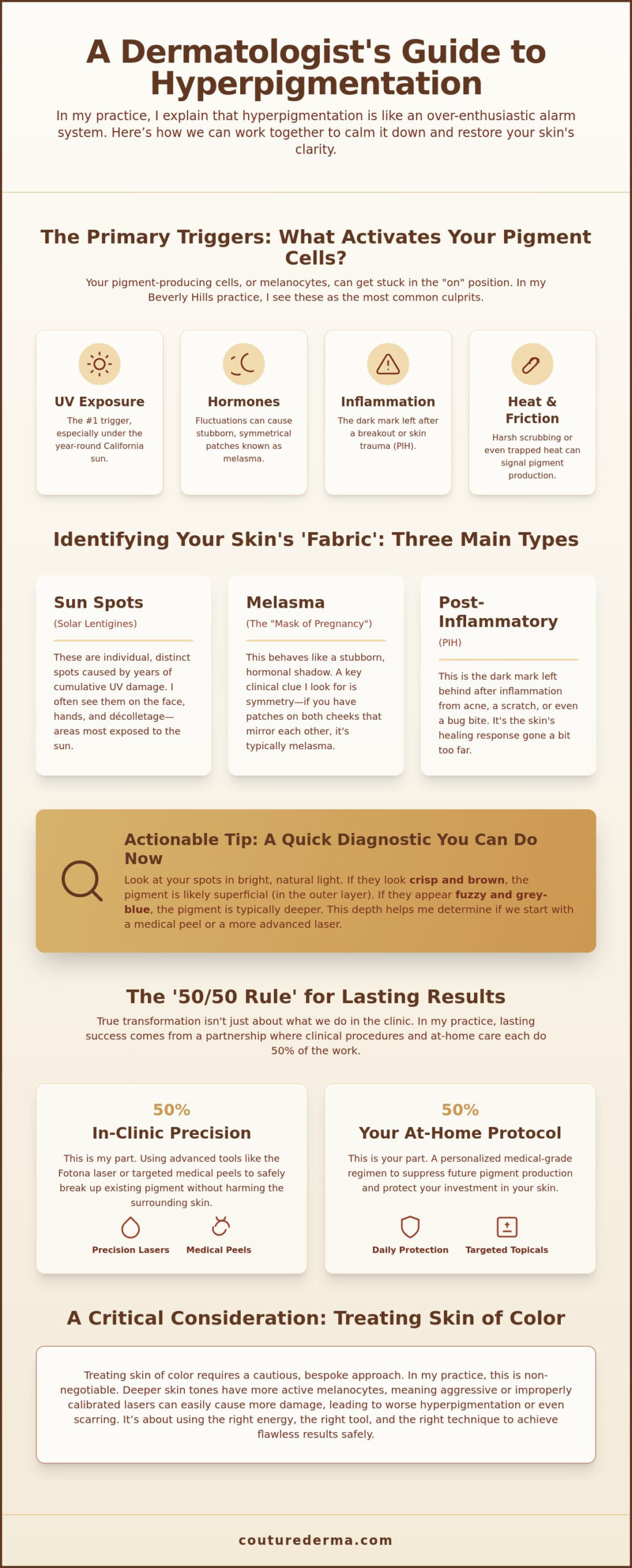
The primary culprits are melanocytes (cells that produce skin pigment). These cells are vital for your health, but they can get stuck in the “on” position due to UV exposure or hormones. Here’s a clinical observation from my years at Couture Dermatology: if those dark patches on your cheeks are perfectly symmetrical, it’s typically melasma rather than just simple sun damage. Understanding this distinction is the first step in tailoring a plan that actually works for your specific needs.
To better understand this concept, watch this helpful video:
In our clinic, we categorize these concerns into three main groups. Sun spots are focal damage from years of UV rays. Melasma behaves like a stubborn, hormonal shadow that fluctuates with stress or heat. Then there’s PIH (post-inflammatory hyperpigmentation), which is the dark mark left behind by a breakout. If you’re struggling with the aftermath of blemishes, our acne scar refinement protocols often address both the texture and the lingering pigment simultaneously.
The Science of Melanin: Why Your Skin Overproduces Pigment
Think of melanin as a response to a catalyst. Heat, friction, and inflammation are the primary triggers. In the Beverly Hills sun, even the heat trapped inside a parked car can signal your cells to produce more pigment. It’s a “trigger and response” mechanism that can be quite sensitive. And let’s be honest; scrubbing at these spots with harsh physical exfoliants often makes the condition worse. The friction creates more inflammation, which tells the melanocytes to produce even more pigment. It’s a cycle we must break with gentler, more sophisticated methods.
Identifying Your Specific ‘Skin Fabric’ and Its Needs
When choosing a hyperpigmentation treatment beverly hills patients often forget that their unique “skin fabric” dictates the safety of the procedure. Treating skin of color requires a cautious, bespoke approach. We have to be meticulous because aggressive lasers can actually cause more scarring or worsening pigment in deeper tones. It’s about recognizing whether your discoloration is focal (individual spots) or diffuse (an all-over unevenness). I see patients who try to treat both the same way, but they require very different tools.
Here’s an actionable tip you can try today. Check your spots under bright, natural light. If they look crisp and brown, the pigment is likely in the outer layer of skin. But if they appear fuzzy and grey-blue, it’s typically deeper in the dermis. This depth determines whether we use a superficial peel or a deeper laser treatment. Identifying your “skin fabric” correctly is the only way to ensure your transformation is safe and effective.
The Diagnostic Consultation: Why Beverly Hills Sun Requires a Bespoke Lens
Living in Southern California is a luxury, but the environment is a relentless challenge for your skin. Even in the middle of January, the UV index remains high enough to keep your pigment-producing cells in a state of high alert. If you are searching for an effective hyperpigmentation treatment beverly hills offers many options, but in my experience, the results typically depend on the quality of the initial diagnosis. I see patients who are genuinely surprised to learn their morning commute is often the secret culprit behind their stubborn spots. The glass in your car window usually only blocks UVB rays, leaving your skin vulnerable to the UVA rays that reach deep into the dermis and trigger melanin production.
In my practice, the “Couture” consultation is where we begin your transformation. We don’t just count spots; we examine your daily habits, your history, and your specific goals. Let’s be honest; a generic approach will rarely yield the sophisticated results you desire. Research into Advanced hyperpigmentation therapies shows that a multi-modal approach is often best, but that starts with a precise diagnosis of your unique triggers. Tip: Please bring your current skincare bag to your first appointment. Seeing the actual products you use helps me understand what is helping and what might be inadvertently causing inflammation.
If you are ready to stop guessing and start a clinical journey, you can schedule your bespoke consultation here.
Does the Los Angeles climate make my pigment harder to treat?
Heat is a silent trigger that many people overlook. In Beverly Hills, it isn’t just the light that causes melasma to flare; it’s the ambient temperature. Sitting in a hot car or even a heated yoga studio can signal your skin to produce more pigment. And then there are the environmental pollutants in the Los Angeles air. These microscopic particles act as catalysts for oxidative stress, which accelerates the aging process and deepens existing discoloration. Tip: If you spend more than 30 minutes in the car daily, I suggest applying a dedicated antioxidant serum under your SPF to neutralize free radicals caused by light passing through the glass. This is why “standard” treatments designed for cooler, less polluted climates often fail to deliver lasting results here.
Can we create a plan that works with my busy schedule?
We also need to talk about your calendar. Are you looking for a “red-carpet ready” glow for an upcoming event, or can you afford a “social pause” for a more intensive laser session? Your lifestyle dictates the intensity of the tools we use. It’s important to set clinical expectations early: pigment removal is a journey, not a single event. Tip: If you find it difficult to reapply sunscreen over makeup, I often recommend using a mineral SPF powder brush every two hours during your workday. If you are seeking a total facial refresh, you might also consider our approach to under-eye brightening to complement your pigment correction. This holistic view ensures that your results look natural and harmonious rather than fragmented.
Advanced Laser and Light Therapies: Precision Tools for Pigment
In our practice, we view lasers like the Fotona or Vbeam not as blunt instruments, but as precision needles designed to break up pigment without disturbing the surrounding skin. When you seek hyperpigmentation treatment beverly hills specialists often focus on the technology alone, but here’s the thing; the laser is only as good as the hands that guide it. We carefully tailor the depth of every laser session to match your specific concern. Using the wrong laser on the wrong skin type is like using a sledgehammer for a silk thread; it’s aggressive, unnecessary, and in most cases, avoidable.
I see patients who have been treated elsewhere with high-intensity light that actually worsened their dark spots. This usually happens because the practitioner didn’t respect the patient’s Fitzpatrick skin type (a scale that classifies skin by its reaction to UV light). Tip: I often suggest asking your dermatologist if the specific laser they are using is safe for your skin tone before the first pulse. To prepare your skin for a safer experience, I typically recommend using a tyrosinase inhibitor (a brightening agent) for two weeks prior to any laser session to “quiet” the pigment cells and prevent a reactive flare.
Will the Vbeam or Fotona work for my specific type of dark spots?
The Vbeam laser is my preferred tool for targeting the vascular component of “red” hyperpigmentation, such as lingering redness from old acne or broken capillaries. On the other hand, the Fotona laser has an incredible ability to reach deeper pigment without damaging the surface layer of skin. This makes it a safer option for many of my patients with deeper complexions. If you’re interested in how we customize these technologies, you can explore our acne scar refinement protocols which often integrate these light therapies to address both tone and texture simultaneously.
How do I decide between dramatic resurfacing and a gentler refinement?
Choosing between lasers often comes down to the balance of downtime and results. Fractional CO2 lasers offer a “dramatic renewal” by removing microscopic columns of skin, which is ideal for patients with significant sun damage. But it does require a “social pause” while the skin heals. Non-ablative options provide a “gentle refinement” with almost no downtime, perfect for the busy Beverly Hills professional. Tip: If you’re healing from a laser session, avoid hot showers or saunas for 48 hours because internal heat can trigger the very pigment we are trying to remove.
Setting clinical expectations is part of the “Couture” experience. If you have a big event like a wedding or premiere, I typically recommend scheduling your laser session at least 4 weeks in advance. This allows the skin to fully settle and reveal that radiant, even tone you’re after. Tip: During the first week of healing, swap your chemical exfoliants for a simple, bland moisturizer to support the skin’s barrier without causing irritation.
Beyond the Laser: Medical Peels and Topical Protocols
Let’s be honest; the laser does about 50% of the work. The other half of your transformation happens at your vanity. In my practice, I see patients who expect a single high-tech session to erase years of Beverly Hills sun damage, but your skin needs a daily “couture” routine to maintain those results. If you are investing in hyperpigmentation treatment beverly hills requires a commitment to medical-grade topical protocols that support the work we do in the clinic. Think of the laser as the architect and your skincare as the high-quality materials that build the final structure.
I often recommend chemical peels like the Cosmelan mask for patients with stubborn, deep-seated pigment. This isn’t your average spa facial. It’s an intensive “reset” for your pigment production that works over several weeks. Tip: Apply your Vitamin C serum in the morning to boost your sunscreen’s effectiveness against oxidative stress. This simple addition acts as a secondary shield against the Los Angeles UV rays that try to undo your progress every time you step outside.
The Role of Tyrosinase Inhibitors in Your Routine
To stop dark spots, we have to talk about tyrosinase inhibitors (ingredients that stop pigment before it starts). These are the unsung heroes of any brightening plan. In our practice, we choose between agents like Hydroquinone and Cysteamine based on your specific “skin fabric.” While Hydroquinone has been a gold standard for decades, Cysteamine is a wonderful, non-hydroquinone alternative for those who need long-term maintenance without the risk of rebound pigment. This medical-grade “lining” is what ensures your aesthetic results don’t just look good for a week; they last for years.
Chemical Peels: Refinement Without the Technology
Not every concern requires a laser. Sometimes, the most elegant solution is a series of customized chemical peels. We use TCA and Glycolic acids to gently lift surface pigment and reveal the radiant skin underneath. Our “Couture” approach often involves mixing different acids to create a custom-fit result for your specific tone. If you are struggling with uneven texture alongside your dark spots, we often integrate these peels into our acne scar refinement protocols to smooth the skin while we brighten it.
Success with these treatments often comes down to how you handle the details at home. Here is a rule I give all my patients: Wait 20 minutes after washing your face before applying tretinoin (a powerful Vitamin A derivative). Applying it to damp skin can cause unnecessary irritation, which triggers inflammation and, ultimately, more pigment. If you’re ready to build a routine that actually delivers on its promises, you can book your clinical skincare analysis here.
Navigating Your Transformation: Maintenance and Long-Term Results
I tell my patients: You wouldn’t buy a couture gown and then wash it in hot water. The same logic applies to your complexion. If you’ve just finished a clinical hyperpigmentation treatment beverly hills sunlight remains a persistent and invisible obstacle. I see patients who experience a “rebound” effect because they stop their maintenance protocols the moment their spots begin to fade. Your pigment cells have a memory; if you don’t keep them suppressed with the right tools, those dark patches typically return within weeks.
Maintenance is about protection, and SPF is your most important “accessory” every single day. But let’s be honest; a quick swipe of lotion in the morning isn’t enough to combat the year-round UV stress of Southern California. Tip: I often suggest using a tinted sunscreen that contains iron oxides if you have melasma. Iron oxides are one of the few ingredients that effectively block visible light, which we now know is a major trigger for hormonal pigment. Standard sunscreens often miss this detail, leaving your skin vulnerable even when you think you’re protected.
Why does my pigment seem to return after my treatment ends?
Pigment correction is a journey, not a destination. When you stop using your inhibitors, the melanocytes (cells that produce skin pigment) can “wake up” and begin overproducing again. This is especially true if you are prone to melasma or live in a high-heat environment like Los Angeles. Tip: If you’re spending the day outdoors, I typically recommend wearing a UPF-rated (Ultraviolet Protection Factor) hat rather than a standard straw one, as straw often has gaps that allow UV rays to reach your forehead.
How do I protect my results while living in Southern California?
SPF 30 is the bare minimum, but in my practice, I typically emphasize that behavior matters more than the bottle. I often advocate for “sun-seeking” behavior, which means looking for the shady side of the street or choosing the table under the umbrella during lunch. Tip: Set a “sun timer” on your phone for every 90 minutes if you’re at a rooftop event in West Hollywood to ensure you don’t miss a reapplication.
True aesthetic harmony is a gradual progression rather than a hurried task. We often recommend scheduling seasonal “touch-ups” to keep your pigment cells in a quiet, stable state. The emotional benefit of clear skin is moving from “concealing” your face with heavy foundations to “revealing” your natural, even tone. Tip: Store your favorite hydrating mist in the refrigerator to cool your skin after a day in the LA heat; lowering skin temperature can help prevent heat-induced pigment flares. Ready to start? Choose the best dermatologist in Los Angeles for your needs.
Your Path to Radiant, Permanent Clarity
Achieving an even skin tone in the Southern California sun requires more than just a generic approach. It demands a clinical strategy that respects your unique skin fabric. In my practice, I’ve found that the most successful transformations combine Harvard-trained expertise with precision technologies like the Fotona laser. We’ve discussed how identifying your specific pigment triggers and committing to a tailored home protocol are the essential building blocks of lasting results. But here’s the thing; the most effective hyperpigmentation treatment beverly hills can provide is one designed specifically for you.
Whether we’re utilizing medical peels or advanced laser therapies, our goal is to move you from concealing to revealing your natural beauty. We specialize in all skin types and tones to ensure every patient receives safe, high-end care. Are you ready to begin your own transformative journey? You can Book Your Couture Consultation with Dr. Abisogun to receive your bespoke treatment plan. Let’s work together to create a complexion that reflects your inner confidence and radiant health.
Frequently Asked Questions
Is hyperpigmentation treatment permanent?
Hyperpigmentation treatment isn’t a permanent “one and done” fix because your skin’s defense mechanism remains active. While we can clear current spots, new pigment often develops due to UV exposure or hormonal shifts. Think of it as a long-term relationship with your skin. In my practice, we focus on clearing the damage and then moving into a maintenance phase to keep your results locked in for years.
Can lasers make my hyperpigmentation worse?
Yes, the wrong laser can absolutely trigger post-inflammatory hyperpigmentation (PIH). This happens when the device creates too much heat for your specific skin type. I see patients who have been over-treated elsewhere, resulting in darker spots than before. It’s why choosing a specialist for hyperpigmentation treatment beverly hills is crucial. We use “cold” laser protocols to safely break up pigment without burning the surface.
How many sessions of laser treatment will I need for dark spots?
Most patients typically require between three and six sessions to achieve a significant transformation. The exact number depends on whether your pigment is focal (spots) or diffuse (all-over shading). If we’re using the Fotona laser, we often see a noticeable lift after just two visits. But let’s be honest; stubborn cases like deep melasma might require a more patient, multi-month approach to reach your goal.
What is the best treatment for melasma in Beverly Hills?
The most effective approach for melasma in our clinic is a “device stacking” strategy combined with medical-grade inhibitors. Melasma is a chronic condition, so we use gentle lasers like the Fotona alongside specialized chemical peels. This multi-layered plan addresses the pigment at different depths while calming the overactive melanocytes (cells that produce skin pigment). It’s a bespoke journey that requires clinical precision and consistent at-home care.
Are chemical peels or lasers better for hyperpigmentation?
Neither is objectively “better” because they serve different purposes within your clinical journey. Lasers are precision tools for deeper sun damage and vascular issues. Chemical peels, however, are often safer for resetting the surface of melasma-prone skin. In most cases, we combine both to refine texture and brighten tone simultaneously. It’s about finding the right fit for your unique skin fabric and lifestyle.
How much does hyperpigmentation treatment cost in Beverly Hills?
The cost of hyperpigmentation treatment beverly hills clinics provide varies significantly based on the technology used and the number of sessions required. A single laser session with a board-certified expert will differ in price from a series of medical peels. During your diagnostic consultation, we provide a transparent breakdown of your personalized plan. We focus on delivering high-end, long-term results rather than quick, temporary fixes.
Is there any downtime after a laser treatment for pigment?
Downtime depends entirely on the intensity of the tools we choose for your transformation. If we use the Vbeam or a non-ablative laser, you’ll typically experience minor redness for a few hours. However, more aggressive resurfacing might require a “social pause” of five to seven days as your skin heals. We always tailor the intensity to your calendar, ensuring you stay “red-carpet ready” when it matters most.
Can I treat hyperpigmentation if I have a darker skin tone?
Absolutely, but you must work with a specialist who understands the nuances of skin of color. I see patients who were told they couldn’t have laser treatment because of their deeper tone. That’s simply not true in 2026. We use specific wavelengths and cooling techniques to protect your skin while targeting the pigment. It’s a meticulous, cautious approach that ensures your safety while delivering a flawless, even complexion.