I see patients in my practice every week who have been told “no” by dozens of clinics because of the color of their skin. It’s a common story in my office, where many feel they’ve been locked out of the best aesthetic results due to a fear of permanent damage. If you’ve been searching for laser resurfacing for dark skin beverly hills, you likely already know that melanin-rich skin requires a much higher level of precision and care than standard protocols offer.
You’re right to be hesitant about generic treatments that might lead to post-inflammatory hyperpigmentation (dark spots that appear after skin irritation). But here’s the thing: you don’t have to settle for “no” anymore. I promise to show you how specialized technology and my “couture” approach to settings make rejuvenation safe and effective for every tone. We’ll look at why the right laser, like the Fotona, and a strict pre-treatment plan, such as using a pigment-suppressing cream for four weeks before your appointment, are the keys to the glowing complexion you deserve.
Key Takeaways
- Learn why choosing an expert who understands the unique needs of melanin-rich skin makes laser resurfacing for dark skin beverly hills both safe and transformative.
- Discover how specialized technologies like the Fotona laser use “cold” ablation to protect your skin’s pigment while targeting deep imperfections.
- Understand why a personalized pre-treatment protocol is vital for “quieting” pigment cells and preventing post-inflammatory hyperpigmentation.
- Get a clear timeline for your recovery journey, including what to expect as your skin remodels itself and reveals a more refined texture.
The Truth About Laser Skin Resurfacing for Dark Skin
I see patients who have been told for years that lasers just aren’t an option for them. It’s a frustrating, exclusionary experience that I encounter every week in my practice. But here’s the thing: laser resurfacing for dark skin beverly hills isn’t a single, rigid procedure. It’s a precision-based light treatment that we adjust specifically to protect your pigment-producing cells. In my practice, I see patients who have finally found a path to clear skin after being turned away by clinics using a “one-size-fits-all” approach that simply doesn’t work for melanin-rich skin.
To better understand how these treatments work in our local area, watch this helpful video about the patient experience:
“How do ‘melanin-friendly’ lasers actually work?”
Let’s be honest; the fear of being burned is real and valid. In the past, the “gold standard” lasers were often too aggressive for melanin-rich skin. Today, we use wavelengths that target water in the tissue instead of pigment. It is a bit like tailoring a fine silk garment; you have to choose the right “needle” for the fabric. We look for a wavelength that passes through the surface without overheating your melanocytes (cells that produce skin pigment). This allows us to reach the deeper layers where real transformation happens while keeping the outer layer of skin cool and protected.
“Why do some doctors still say lasers are unsafe for me?”
Many providers rely on textbook settings that don’t account for the unique needs of the Fitzpatrick Scale (a system for classifying skin types). If a clinic doesn’t specialize in skin of color, they often err on the side of caution by saying no. But modern fractional technology allows us to treat only tiny “fractions” of the skin at a time. This leaves bridges of healthy tissue to help you heal. In most cases, I recommend asking your provider if they use “long-pulse” settings for deeper skin tones. These settings deliver energy more slowly, which is typically much safer for your pigment cells than short, high-heat bursts. I see patients who find that this patient, methodical approach makes all the difference in their results.
Actionable Tip: Before your consultation, stop using all physical exfoliants like scrubs or brushes for at least one week. This ensures your skin barrier is healthy and intact, which is a vital step for a safe and successful laser session.
Understanding the Risks: PIH and the Fitzpatrick Scale
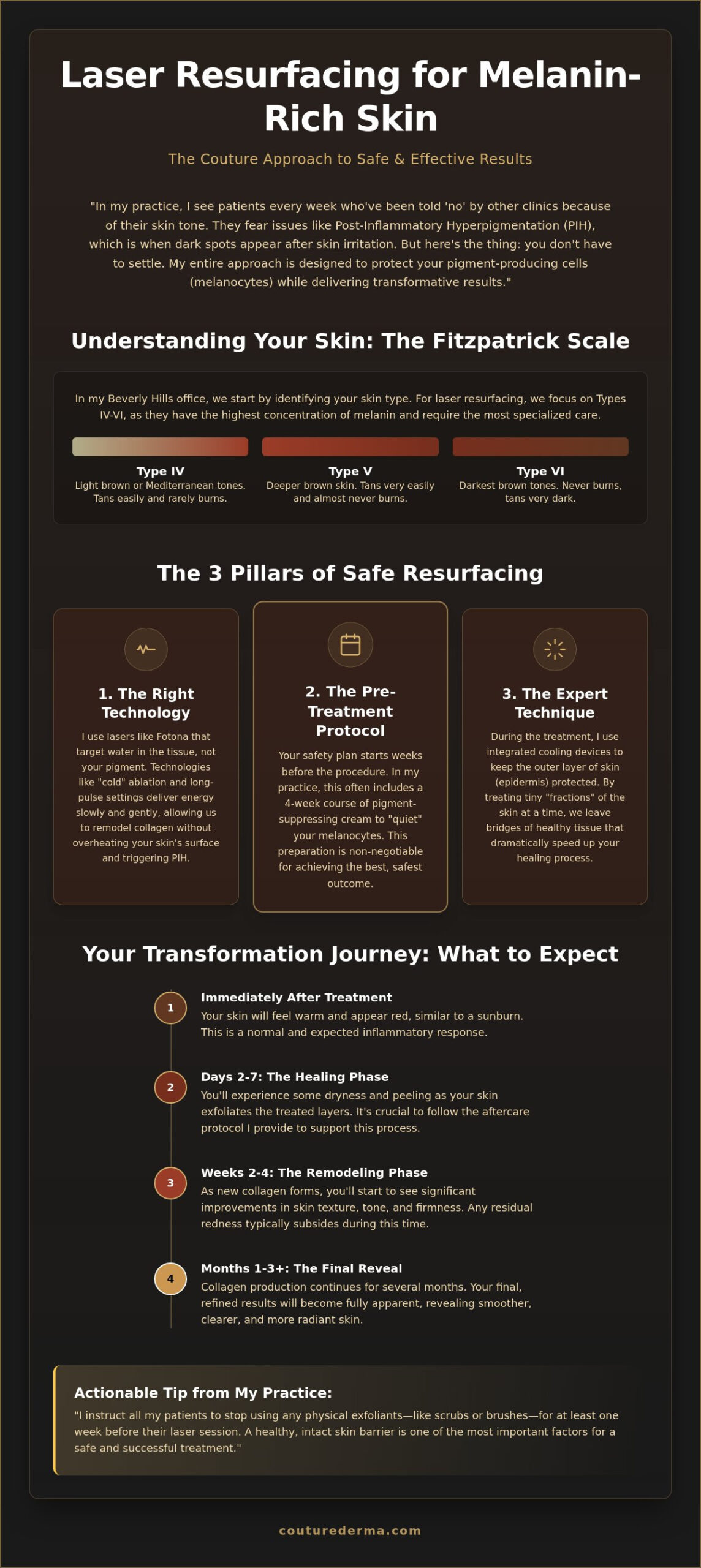
In my Beverly Hills office, I use the Fitzpatrick scale to categorize skin’s response to UV and heat. This is the foundation of every consultation I perform. Let’s be honest; the risk of Post-Inflammatory Hyperpigmentation (PIH) is real if the treatment isn’t handled with care. In most cases, PIH is the biggest hurdle we manage when performing laser resurfacing for dark skin beverly hills. It isn’t necessarily a “burn” in the traditional sense. Instead, it’s a biological response where your melanocytes (cells that produce skin pigment) go into overdrive after a perceived injury. This reaction is why Laser Therapy in Ethnic Populations requires such a high level of specialized expertise and intentionality.
The Fitzpatrick Scale: Where Do You Fall?
The scale helps us predict how your skin will behave under the laser. Type IV typically includes Mediterranean or light brown tones that tan easily and rarely burn. Type V covers deeper brown skin, while Type VI includes the darkest brown or black tones. Knowing your “type” is the first step in our couture tailoring process. In Los Angeles, the year-round sun exposure can actually shift your skin’s reactivity before a session. I often see patients whose skin is “primed” to overreact because of cumulative UV exposure, even if they don’t have a visible tan. We must account for this environmental factor before we ever touch a laser to your face.
How We Prevent “The Dark Spot” (PIH)
Preventing PIH starts with controlling the temperature of the tissue. During the procedure, we often use integrated cooling devices to protect the outer layer of skin (epidermis). By keeping the surface cool, we can deliver the necessary energy to the deeper layers without waking up those reactive melanocytes. It’s a delicate balance. We aren’t just performing a technical procedure; we are managing a biological conversation. If we respect the skin’s limits, we achieve the glow without the shadow of a lingering spot.
Actionable Tip: Here is a quick test you can do at home. If you’ve had a dark spot linger for months after a simple scratch or a minor breakout, your skin is likely “reactive.” This means you’ll typically need a longer preparation phase with specific pigment-stabilizing creams to “quiet” your pigment cells before we start your treatment journey.
If you’re ready to see how a customized plan can safely transform your complexion, you can schedule a consultation to discuss your unique skin type and goals.
Choosing the Right Technology: From Fotona to Fractional CO2
Not all lasers are created equal. In my practice, I prefer technologies that offer “cold” ablation (a process that removes skin tissue without excessive heat). For laser resurfacing for dark skin beverly hills, this precision is non-negotiable. I often use the Fotona laser to perform “TwinLight” (a dual-wavelength treatment using two different types of light) rejuvenation. This allows us to tighten the skin and smooth the surface in one session. It’s like using two different tools to refine a single piece of art; one works on the foundation while the other polishes the surface.
“Which laser technology is actually safest for my skin tone?”
In most cases, the Erbium:YAG (a gentle laser wavelength that targets water in the skin) is the staple for my patients with deeper complexions. It’s highly attracted to the water in your skin, which allows it to vaporize imperfections without “cooking” the surrounding tissue. But here’s the thing; traditional CO2 (carbon dioxide laser used for deep skin peeling) lasers are famous, but they generate a lot of heat. If we use CO2, we typically use a “fractional” approach (a method that creates thousands of microscopic treatment zones). This reduces heat buildup and leaves tiny bridges of healthy skin to help you heal faster. This is vital for acne scar refinement because we need to reach deep layers without damaging the surface.
Actionable Tip: If you are looking for a provider, ask if they have an Erbium laser. While many clinics only offer CO2, having an Erbium option often provides a much safer “cold” alternative for melanin-rich skin.
“What’s the difference between ‘peeling’ lasers and ‘heating’ lasers?”
We often categorize treatments as ablative (treatments that remove the thin outer layer of skin) or non-ablative (treatments that heat the skin underneath without damaging the surface). Non-ablative options like Pico (a laser that delivers energy in ultra-short pulses) or Clear + Brilliant (a mild laser used to improve skin texture) are great for maintenance. They work by stimulating collagen (the protein that gives skin its structure and bounce) without the peeling. I see patients who want a “one and done” miracle, but for dark skin, doing 3 or 4 gentle sessions is typically much safer than one aggressive session. Following Fitzpatrick Skin Type Recommendations (medical guidelines for safely treating different skin tones) ensures we choose the wavelength that skips your pigment and goes straight to the goal. These milder options are also excellent for under-eye brightening.
Actionable Tip: When treating pigment issues like sun spots, space your sessions at least 4 to 6 weeks apart. This gives your skin enough time to fully remodel and reveals the true results before you add more energy.
The Couture Pre-Treatment Protocol: Setting You Up for Success
Here’s the thing: the work for a safe laser treatment starts 4 to 6 weeks before you ever sit in my chair. I see patients who think they can just “walk in” for a laser, but for dark skin, we must “quiet” the pigment cells first. This pre-conditioning phase is the foundation of your skin’s transformation. In my Beverly Hills practice, I treat this as a mandatory first step to ensure your melanocytes (cells that produce skin pigment) aren’t in a reactive state. Without this prep, the risk of complications from laser resurfacing for dark skin beverly hills is simply too high.
“What is the ‘pigment inhibitor’ phase?”
To ensure your results are clear and even, I typically prescribe a pigment inhibitor to manage your specific skin condition. This might be Hydroquinone (a prescription cream that temporarily slows down melanin production) or non-HQ alternatives like Kojic Acid (a natural skin brightener derived from fungi) or Tranexamic Acid (an ingredient that blocks the chemical signals that trigger dark spots). You will apply this twice daily for at least 4 weeks. It ensures that when the laser light hits the tissue, your skin is calm and ready.
Actionable Tip:
The Transformation Journey: Recovery and Results at Couture
After we finish your session in Beverly Hills, the real magic begins. Your skin isn’t just healing; it’s remodeling itself from the inside out. I see patients who get a little nervous when they see tiny dark specks appearing on their skin a few days later. These are MENDs (Microscopic Epidermal Necrotic Debris), which look like tiny coffee grounds on the surface of your skin. It is actually a sign of a successful treatment. Your skin is simply pushing out the old, damaged tissue to make room for the fresh, healthy layers underneath. This is why laser resurfacing for dark skin beverly hills requires such a specific, tailored aftercare plan. We don’t just send you home with a generic ointment and a “good luck.”
Our couture level of aftercare is designed to protect your investment and your pigment. We treat the recovery phase as a collaborative journey. While I handle the technical precision in the office, your commitment to the post-care protocol ensures the results are as transformative as possible. Once your skin texture is refined and smooth, many of my patients find that jawline contouring provides the perfect structural frame to highlight their new, glowing complexion.
The First 72 Hours: Gentle Care
During the first three days, your skin needs peace and protection. The protocol is simple but vital. Use only a gentle, non-foaming cleanser and apply a thick occlusive (barrier-sealing) cream several times a day. You must avoid all “actives” like Vitamin C, Retinol, or exfoliating acids until the skin has fully closed and the MENDs have naturally flaked away. These ingredients are fantastic for maintenance, but they are far too aggressive for skin that is actively rebuilding itself.
Actionable Tip: Keep your post-laser skincare products in the fridge. The cool temperature helps calm the post-laser heat sensation and provides immediate relief when you apply your barrier cream.
When Will You See the “Couture” Glow?
I often tell my patients that patience is the ultimate beauty secret. By day 7, the surface of your skin is usually smooth, and you can typically start wearing makeup again. But the real “Couture” glow happens deeper down. Around month 3, the new collagen (the protein that gives skin its bounce and firmness) really starts to show. You’ll notice a visible improvement in “all skin type” concerns, from fine lines to the lingering shadows of old breakouts.
Actionable Tip: Sleep on a clean silk pillowcase for the first seven days after your laser treatment. Silk creates less friction than cotton, which helps prevent premature peeling of the MENDs and protects your sensitive new skin.
Let’s be honest; achieving these results is a marathon, not a sprint. But when we combine my 15 years of clinical experience with your diligent aftercare, the results are nothing short of life-changing. If you’re ready to start this transformative journey, schedule your consultation today to discuss a plan that respects your skin’s unique needs.
Begin Your Personalized Transformation
I see patients who have spent years feeling invisible in the world of professional aesthetics because they were told their melanin made them “too risky.” But as we’ve explored, the right technology paired with a meticulous pre-treatment protocol changes everything. Achieving safe laser resurfacing for dark skin beverly hills isn’t about luck; it’s about the precision of a Harvard-trained expert who understands the unique biology of all skin types. We move beyond the fear of PIH by using “cold” laser settings and stabilizing your pigment cells before the first pulse of light ever touches your face.
With over 15 years of clinical laser experience, I am here to guide you through every step of this collaborative journey. You deserve a skin rejuvenation plan that is as unique as a custom-fitted garment. If you’re ready to move past the frustration of being told “no” and start your own transformation, it’s time to take the first step. Schedule your bespoke skin consultation with Dr. Abisogun at Couture Dermatology & Laser Beverly Hills today.
Your radiant and refined complexion is waiting to be revealed. We’ll ensure your journey is as sophisticated and intentional as the results you seek.
Frequently Asked Questions
Is CO2 laser resurfacing safe for Black skin or dark brown tones?
Yes, but it requires a very conservative, fractional approach to avoid overheating the tissue. In my practice, I see patients who achieve excellent results with CO2 when we use lower density settings that leave bridges of healthy skin intact. It is not a “one-size-fits-all” procedure; the laser must be tailored to your specific melanin levels to prevent complications.
How much does laser skin resurfacing cost in Beverly Hills for darker skin?
The cost of laser resurfacing for dark skin beverly hills depends on the technology we use and the complexity of your skin concerns. Factors like the number of sessions required and the specific area being treated, such as the full face or just the under-eye area, will influence the final price. Because darker skin requires specialized pre-treatment protocols and high-precision lasers, the investment reflects the expert care needed to ensure safety.
What is the best laser for acne scars on dark skin?
In my experience, the Erbium:YAG laser is often the “gold standard” for treating acne scars on deeper complexions. It is known as a “cold” laser because it is highly attracted to water in the skin rather than pigment. This allows us to smooth out scar tissue without generating the excess heat that often triggers dark spots in reactive skin types.
Will laser resurfacing remove my natural skin pigment?
No, the goal of professional resurfacing is to improve your skin’s texture and health without changing your natural color. While permanent pigment loss, or hypopigmentation (white spots), was a risk with older technologies, modern fractional lasers are much safer. We focus the energy on the deeper layers to trigger collagen production while keeping your natural skin tone stable and vibrant.
How long is the downtime for fractional laser on deeper skin tones?
You can typically expect about 5 to 7 days of social downtime. During the first few days, your skin will feel like it has a mild sunburn, and you will see tiny dark specks called MENDs (Microscopic Epidermal Necrotic Debris) appearing on the surface. These look like fine coffee grounds and will naturally flake off within a week to reveal your new, refined skin.
Can laser resurfacing help with melasma in dark skin?
It can help, but we must be extremely careful because heat is a known trigger for melasma (patchy brown skin discoloration). Let’s be honest; aggressive lasers can sometimes make this condition worse. I usually prefer a “slow and steady” approach using low-energy, non-ablative lasers or Pico technology combined with a strict topical regimen to manage the pigment safely.
What happens if I get PIH after my laser treatment?
I tell my patients not to panic if they see PIH (temporary darkening of the skin after trauma). It is a biological response that we can manage effectively with medical-grade brightening creams and sun avoidance. In most cases, these dark spots are temporary and will fade as we continue to “quiet” your pigment cells with the right aftercare products.
How do I know if my dermatologist is an expert in skin of color?
Look for a board-certified dermatologist who has at least a decade of experience specifically treating Fitzpatrick types IV through VI. You should ask them about their specific pre-conditioning protocols and whether they use “long-pulse” settings for their lasers. An expert will always insist on a 4 to 6 week preparation phase to ensure your skin is stable before the procedure begins.