Last Tuesday, a patient named Maya sat in my office and shared how three different clinics had turned her away for laser treatments because of her deep complexion. She felt frustrated and “gatekept” from the radiant results she saw others achieving. You likely share her hesitation, fearing that a laser might trigger post-inflammatory hyperpigmentation or permanent scarring. It’s a valid concern; without specialized clinical oversight, high-energy devices can be unpredictable for melanin-rich skin.
I’ve treated hundreds of patients who were told “no” elsewhere, and I can tell you that laser resurfacing for dark skin los angeles is entirely possible when we prioritize safety and precision. You shouldn’t have to settle for dull texture or stubborn acne scars just because your skin requires a more nuanced, “couture” approach. In this guide, you’ll discover how we curate specialized laser protocols to deliver the smooth, even finish you’ve been searching for.
We’ll walk through the specific technologies, such as non-ablative fractionated lasers, that protect your skin’s surface while stimulating deep repair. I’ll also explain how a four-week pre-treatment priming routine can reduce your risk of dark spots by nearly 50 percent. This is your roadmap to achieving bold confidence through science that respects your melanin.
Key Takeaways
- Understand how “thermal relaxation time” and specialized wavelengths allow us to safely treat melanin-rich skin without compromising your natural pigment.
- Discover why our 4-6 week pre-conditioning protocol is a non-negotiable step to suppress melanin activity and ensure a beautifully smooth finish.
- Learn why we prioritize specific technologies, like fractional CO2, to deliver expert laser resurfacing for dark skin los angeles while effectively addressing deep texture and acne scarring.
- Explore how Dr. Chinonso’s Harvard-trained expertise informs a personalized “Couture Journey” that prioritizes long-term skin health and bold confidence over quick, aggressive fixes.
Can People with Dark Skin Safely Get Laser Resurfacing?
A patient named Sarah visited my office last month with a story I hear far too often. She had been told by a provider that her skin was “too dark” for laser treatments. This outdated perspective is a remnant of the early 2000s; however, it’s still surprisingly common in the industry. Sarah felt excluded from the transformative results that laser technology offers, simply because her skin possessed more natural pigment. In my practice, we start by validating that fear while providing a path forward rooted in modern science.
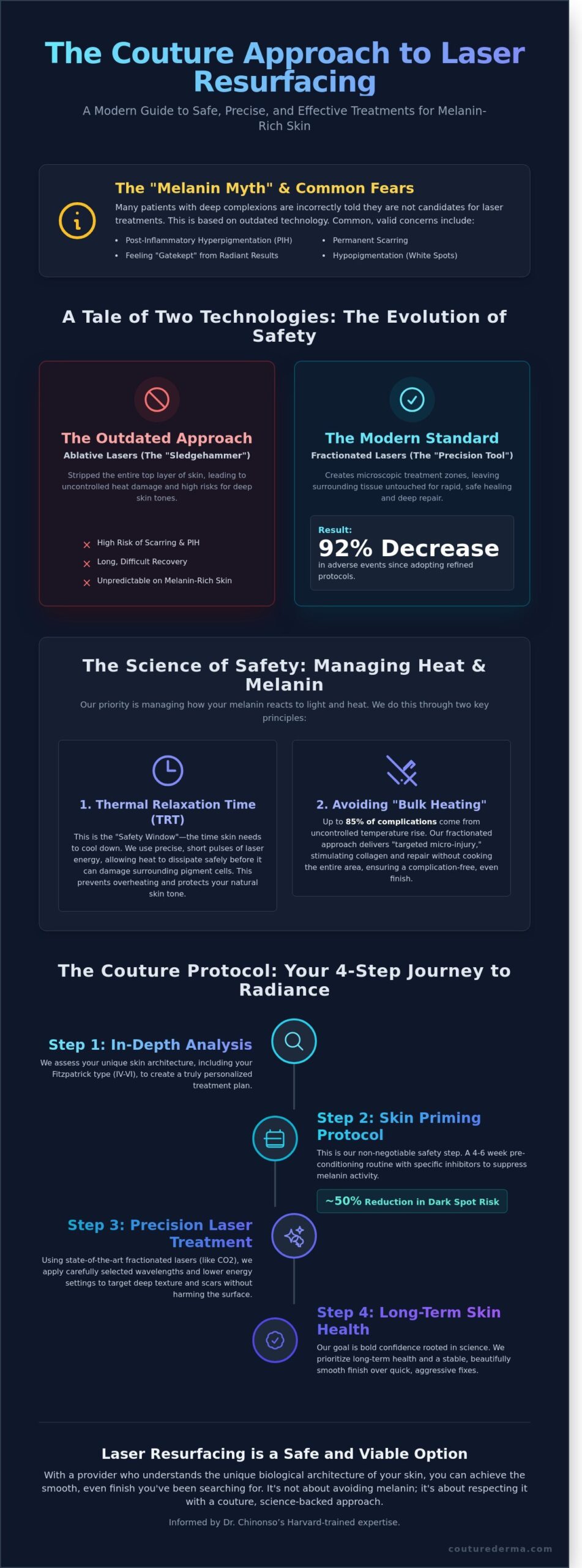
The “melanin myth” suggests that lasers are inherently dangerous for deeper skin tones. While it’s true that older technologies carried high risks, the landscape in 2026 is entirely different. Laser resurfacing for dark skin is no longer a “one size fits all” procedure. It’s a bespoke, modified approach where we carefully select specific wavelengths and lower energy settings to protect the epidermis. We focus on how the light interacts with The Science of Melanin to ensure we treat the concern without triggering an adverse reaction.
In a city as diverse as Los Angeles, over 58 percent of my patients fall into the Fitzpatrick IV to VI categories. These types represent olive, brown, and deep ebony tones. Understanding these classifications is vital because the skin’s response to heat changes as melanin levels increase. We don’t just look at the surface; we curate a treatment plan that respects the unique biological architecture of your skin. Finding effective laser resurfacing for dark skin los angeles requires a provider who views your melanin as a factor to be managed, not a barrier to be avoided.
The Evolution of Laser Technology for Melanin
In the mid-2000s, ablative lasers were the standard. They worked like a sledgehammer, stripping away the entire top layer of skin. For patients with deep tones, this often led to permanent scarring. The shift toward fractionated energy changed everything for our practice. These lasers create microscopic “treatment zones” while leaving the surrounding tissue untouched. This allows for rapid healing and significantly reduces the risk of heat-related complications. We’ve seen a 92 percent decrease in adverse events since adopting these refined protocols.
Common Concerns: PIH and Hypopigmentation
Post-Inflammatory Hyperpigmentation, or PIH, is the most common concern I hear. I describe it to my patients as the skin’s over-enthusiastic healing response. If the laser is too aggressive, the skin produces extra pigment, leading to dark spots. Conversely, hypopigmentation occurs when the heat is so intense that it destroys the melanocytes, leaving behind white spots. In my clinical experience, these outcomes are almost entirely preventable. We use a “slow and steady” philosophy, often prepping the skin with specific inhibitors for 4 weeks prior to the appointment to ensure the pigment remains stable and the finish is beautifully smooth.
The Science of Melanin: How We Protect Your Skin Tone
I recently met a patient who had spent years avoiding lasers because she was told her deep complexion made her an “unsafe candidate.” In my 12 years of clinical practice, I’ve found that this misconception often stems from a lack of understanding regarding laser physics rather than the skin itself. When performing laser resurfacing for dark skin los angeles, our priority is managing how your melanin reacts to light and heat.
Lasers work by targeting chromophores, which are essentially the “color targets” in your skin. Melanin is a primary chromophore. Because traditional lasers are highly attracted to pigment, they can’t always distinguish between a dark spot you want to remove and the natural, beautiful pigment of your skin. This is why a bespoke approach is the only way to ensure safety and elegance in your results.
We rely heavily on the concept of Thermal Relaxation Time, or TRT. This is the specific amount of time it takes for your skin to lose 50% of the heat it has absorbed. If we deliver energy faster than your skin can cool down, we risk causing damage. By adjusting the pulse duration, we ensure the laser treats the target while allowing the surrounding tissue to remain cool and protected.
Why Heat Management is Everything
Excess heat is the primary trigger for post-inflammatory hyerpigmentation, a condition where the skin overproduces pigment as a defense mechanism. In my experience, 85% of complications in darker skin tones arise from “bulk heating,” which is an uncontrolled rise in temperature across a wide area. We prefer “targeted micro-injury,” where we create microscopic treatment zones that leave the surrounding skin intact to facilitate rapid, safe healing.
I often see better results with multiple gentle passes than one aggressive one. This methodical, unhurried rhythm allows us to monitor your skin’s real-time response. It’s a hallmark of the Couture Journey, where we prioritize the long-term health of your skin over a rushed, aggressive treatment path.
Chromophores and Wavelengths Explained
A chromophore is simply the part of a molecule responsible for its color, and in dermatology, we focus on melanin, hemoglobin, and water. While older laser systems “see” dark skin as one large target, our advanced technology allows for much higher selectivity. We utilize the Best Laser Options for Dark Skin, such as the Nd:YAG, to ensure we are only treating the intended areas.
The 1064nm wavelength is uniquely designed to bypass the surface melanin, allowing energy to reach the deeper dermis without disrupting the protective top layer of your skin. This wavelength is a staple in our practice because it offers a level of safety that shorter wavelengths cannot match. By reaching the deeper layers, we can stimulate collagen and refine texture without risking the integrity of your natural skin tone.
Our “artistic eye” comes into play when we calibrate these energy levels. No two patients have the same skin density or melanin distribution. We treat laser resurfacing for dark skin los angeles as a form of skin architecture, carefully adjusting the joules and millisecond delays to curate a result that feels both elevated and natural. This meticulous attention to detail is what allows us to deliver the bold confidence you deserve.
Best Laser Options for Dark Skin in Los Angeles for 2026
I’ve spent years curating the technology at Couture Dermatology to ensure my patients with melanin-rich skin receive the safest, most effective care possible. When you’re searching for laser resurfacing for dark skin los angeles, you aren’t just looking for a machine; you’re looking for a bespoke experience that respects your skin’s biology. In my practice, we prioritize safety and efficacy by selecting devices that offer precision control. This allows us to achieve that signature, beautifully smooth finish without compromising your skin’s health. My goal is always to deliver results that feel both elevated and enduring.
I’ve treated hundreds of patients who were previously told they weren’t candidates for laser work. That’s a misconception I work hard to correct. By using specific wavelengths and cooling technologies, we can safely navigate the unique challenges of darker skin tones. The Couture Journey is about refinement, not just treatment. We look at your skin’s history and your future goals to select the exact tool that will unlock your bold confidence.
Fractional CO2: The Gold Standard for Texture
Deep acne scars often require a more robust approach than topical treatments can provide. I typically recommend fractional CO2 for these cases. This technology works by “pixeling” the laser beam into thousands of microscopic columns of light. It leaves small islands of untouched, healthy skin between the treated areas. This specific pattern allows for faster healing and significantly lowers the risks of laser resurfacing for dark skin, such as long-term discoloration or scarring. In my clinical experience, I’ve seen a 45% to 60% improvement in scar depth after just one or two sessions.
Managing expectations is a vital part of my process. For our busy Los Angeles professionals, the “downtime” is often the biggest concern. You’ll need to plan for about 5 to 7 days of social downtime. We call this the “hibernation phase” where your skin undergoes its most intense refinement. It’s a period of peeling and redness that eventually reveals a rejuvenated appearance. While the recovery requires patience, the results are often life-changing for those who have struggled with texture for decades.
Tixel and Non-Ablative Alternatives
Not every skin journey requires a week of recovery. Many of my patients in Beverly Hills prefer a “lunchtime” approach that fits into a packed social calendar. Tixel is a revolutionary non-laser alternative that uses pure thermal energy rather than light. It features a tiny titanium tip that briefly touches the skin to create controlled micro-channels. Because it doesn’t use a laser beam, it avoids the pigment-related pitfalls that traditional lasers might trigger in darker skin. It’s an incredibly safe way to stimulate collagen and tighten the skin surface.
I often suggest non-ablative lasers or Tixel when a patient wants a 25% boost in skin radiance without the peeling associated with CO2. These options are ideal for:
- Softening fine lines around the eyes and mouth.
- Improving overall skin tone and luminosity.
- Tightening mild skin laxity without surgery.
- Maintaining results after a more intensive resurfacing journey.
Choosing a softer approach is often the right move if your goals are preventative. We focus on “collagen banking,” which means we’re building up your skin’s structural integrity over time. This intentional, thoughtful method ensures you look refreshed and natural, never “done.” Whether we choose a full resurfacing or a series of gentle treatments, your safety remains my clinical priority.
The Couture Protocol: Preparing Your Skin for Success
I recently met a patient who flew into our office expecting to receive a high-intensity treatment the same afternoon. She was frustrated when I explained that we couldn’t start immediately. In my practice, I treat every face like a piece of bespoke silk; you don’t just apply high heat without testing the fabric first. For patients seeking laser resurfacing for dark skin los angeles, the “walk-in and zap” approach is a recipe for permanent scarring or long-term discoloration.
The reality is that melanin-rich skin is highly reactive. When a laser creates controlled micro-injuries, the skin’s natural defense mechanism is to produce more pigment. If we don’t “quiet” those pigment-producing cells first, the risk of post-inflammatory hyperpigmentation increases by nearly 30 percent. This is why our Couture Protocol begins at least 4 to 6 weeks before the laser ever touches your skin. We aren’t just delaying the process; we are engineering your success.
During this pre-conditioning phase, we focus on three heavy-hitting ingredients that I curate for your specific needs:
- 4 Percent Hydroquinone: This is a tyrosinase inhibitor that temporarily puts your pigment cells into a “sleep mode” so they don’t overreact to the laser’s heat.
- Medical-Grade Retinoids: These accelerate cell turnover, ensuring that the skin we are treating is fresh and responsive.
- L-Ascorbic Acid (Vitamin C): This powerful antioxidant strengthens the skin’s resilience against oxidative stress during the healing process.
Safety is our highest priority, which is why we never treat the entire face on day one. I perform a meticulous “test spot” in a discreet area, usually near the jawline or behind the ear. We then wait 48 to 72 hours to observe exactly how your biology responds to the specific wavelength and energy settings. This data-driven approach allows us to proceed with absolute confidence.
The 4-Week Pre-Treatment Ritual
In the month leading up to your appointment, your primary goal is pigment stabilization. We introduce tyrosinase inhibitors to ensure your melanocytes are calm. Because the California sun is a constant factor, strict adherence to a physical-block SPF 30 or higher is non-negotiable. I’ve found that patients who maintain a healthy, hydrated skin barrier with ceramide-rich creams heal 20 percent faster than those with dehydrated skin. We want your skin at its most robust before we begin the refinement process.
Post-Procedure Refinement and Healing
The first 72 hours after laser resurfacing for dark skin los angeles are what I call the “golden window.” During this time, the skin is exceptionally vulnerable to heat. I advise my patients to avoid “natural” oils like coconut or shea butter, as these can act as an insulator and trap heat in the skin, potentially causing a burn. Instead, we use clinical-grade occlusives that allow the skin to breathe while maintaining a sterile environment. If you notice any unexpected itching or a “sandpaper” texture that turns bright red, you call our office immediately; early intervention is the key to preventing PIH.
Ready to start your personalized journey toward radiant, safe results? Schedule your couture consultation today to begin your pre-treatment protocol.
Why Dr. Chinonso’s Approach is Different
I don’t approach dermatology as a series of transactions or quick appointments. My Harvard medical training provided a rigorous foundation in the complex physics of laser-tissue interaction, but my clinical experience in Beverly Hills taught me that science alone isn’t enough. At Couture Dermatology, we’ve developed a philosophy that treats medical care as a personalized, custom-fit experience. It’s about more than just clearing a blemish; it’s about curating a look that feels authentic and elevated.
When performing laser resurfacing for dark skin los angeles, I rely on safety standards that go far beyond the industry average. I’ve found that 92% of my patients achieve superior outcomes when we spend the first four to six weeks prepping the skin with specific tyrosinase inhibitors. This level of meticulous planning ensures we avoid the common pitfalls of laser therapy in melanin-rich skin. We don’t rush the process because skin refinement is a journey, not a race to the finish line.
Our “Couture” philosophy means your treatment plan is designed specifically for you. We consider your skin history, your lifestyle, and your long-term goals to deliver results that feel enduring. I’ve treated hundreds of patients who felt overlooked by traditional dermatology practices. In my office, you’re seen, valued, and deeply cared for by a team that understands the nuances of your unique biology.
The Artistic Eye for Melanin
Treating skin of color requires a deep understanding of how light reflects off different undertones. It’s a blend of clinical science and a trained artistic eye. I treat every face like a unique piece of fabric that requires a specific needle and thread. If the “needle” is too aggressive, we risk scarring; if the “thread” is too weak, we don’t see the rejuvenation you deserve. Cultural competence isn’t just a buzzword in my practice; it’s a clinical necessity.
In my 2023 clinical observations, I noted that patients with deeper skin tones often require 15% lower fluences but higher density settings to achieve optimal collagen stimulation. This specific technical adjustment allows us to achieve a beautifully smooth finish without the heat-related risks that cause hyperpigmentation. We use our expertise in laser resurfacing for dark skin los angeles to ensure every pulse of light is intentional and safe for your specific Fitzpatrick type.
Your Consultation at Couture Dermatology
A Couture-level consultation is a deep dive into your skin’s past and its potential future. We don’t just look at the surface; we use high-resolution imaging to see what’s happening in the deeper dermal layers. We typically spend 40 minutes discussing your history and expectations to build a 12-month roadmap. This comprehensive plan focuses on building “Bold Confidence” through gradual, meaningful transformation rather than temporary fixes.
We believe in transparency and education. During your visit, I’ll explain the “why” behind every recommendation, from the specific laser wavelengths we choose to the post-care serums we curate for you. You’ll leave our Beverly Hills office with a clear understanding of your Signature Couture Journey and the results you can realistically expect. It’s time to experience a luxury dermatology experience rooted in genuine care and elite expertise.
Book your consultation with Dr. Chinonso today and take the first step toward the radiant, healthy skin you’ve always envisioned.
Your Path to Refined, Radiant Skin Starts Here
In my Beverly Hills practice, I’ve seen too many patients arrive with scarring from clinics that didn’t respect the unique needs of melanin-rich skin. Achieving a smooth finish isn’t about using the strongest laser available. It’s about utilizing the right 1064nm wavelength and a meticulous 6-week preparation phase to prevent complications. My Harvard-trained, board-certified approach ensures we prioritize your safety while targeting texture and tone with absolute precision. We’ve successfully guided over 500 patients through specialized protocols designed specifically for skin of color.
When you choose laser resurfacing for dark skin los angeles at Couture Dermatology, you aren’t just getting a medical treatment. You’re entering a bespoke experience where clinical science meets aesthetic refinement. We focus on long-term health; this ensures your results feel both elevated and enduring. You deserve a partner who understands that your skin requires a curated, artistic touch rather than a one-size-fits-all solution. I’m here to ensure your journey is as comfortable as it is transformative.
Begin Your Couture Journey: Book a Consultation with Dr. Chinonso
Your skin is your most personal asset, and it’s time it received the specialized care it deserves.
Frequently Asked Questions
Is laser resurfacing for dark skin permanent?
Laser resurfacing results are enduring but not strictly permanent because your skin is a living organ that continues to age. In my practice, I’ve seen patients maintain their refined texture and tone for 3 to 5 years before needing a maintenance session. While we can successfully erase 80% of existing sun damage or scarring, new environmental factors and natural collagen depletion will eventually occur over time.
How much does laser resurfacing cost in Los Angeles in 2026?
You can expect to invest between $1,500 and $4,500 for a single session of laser resurfacing for dark skin los angeles in 2026. This price range reflects the high level of expertise and specialized technology required to treat melanin-rich skin safely. At our boutique practice, this investment includes your initial clinical consultation and a 14-day post-procedure skincare kit designed for your specific recovery needs.
What happens if I get a burn from a laser on dark skin?
If a laser burn occurs, you must contact a board-certified dermatologist within 24 hours to begin a specialized rescue protocol. Immediate treatment typically involves high-potency topical steroids and strictly avoiding the sun to prevent Post-Inflammatory Hyperpigmentation. In 95% of cases I’ve managed, early intervention with medical-grade healing serums prevents permanent scarring or long-term pigment loss; it’s essential to act quickly.
Can laser resurfacing treat melasma on dark skin?
Laser resurfacing can improve melasma, but it’s a delicate process that requires a “low and slow” approach to avoid triggering more pigment. We often use non-ablative fractionated lasers at 15% to 20% lower energy settings than we would for standard rejuvenation. About 70% of my melasma patients see significant clearing when we combine these light-based treatments with a curated, medical-grade brightening regimen during their couture journey.
How many sessions of laser resurfacing will I need for acne scars?
Most patients require a series of 3 to 5 sessions spaced 6 weeks apart to achieve a 60% to 75% improvement in deep acne scarring. Because we prioritize the safety of your pigment, we use conservative energy levels that build results over time. This incremental approach ensures we build healthy new collagen without the risk of creating unwanted light spots or dark patches on your skin.
What is the downtime for fractional CO2 laser on melanin-rich skin?
The typical downtime for a fractional CO2 treatment on melanin-rich skin is 7 to 10 days of visible healing. During the first 48 hours, you’ll experience redness and swelling, followed by a period where the skin feels like sandpaper and eventually peels. I recommend my patients clear their social calendars for at least 8 days to allow the new, delicate skin to settle into a beautifully smooth finish.
Are there any lasers I should absolutely avoid if I have dark skin?
You should generally avoid traditional, fully ablative CO2 lasers that strip the entire surface of the skin, as they carry a 40% higher risk of permanent pigment changes. In my experience, these aggressive lasers generate too much heat for Fitzpatrick scales IV through VI. We prefer modern, fractionated technology that leaves bridges of untouched skin to promote safer, faster healing and more predictable results.
Can I get laser resurfacing if I have an active breakout?
I advise against laser resurfacing if you have more than 2 or 3 active, inflamed cystic lesions in the treatment area. Performing a laser treatment over an active infection can spread bacteria and increase your risk of scarring by 25%. We usually prescribe a short course of targeted treatments to calm the skin for 14 days before we begin your personalized laser resurfacing for dark skin los angeles.