

Last week, a patient sat in my office and admitted she hadn’t left her house without a layer of heavy foundation in over three years. Like many who seek melasma treatment for face beverly hills, she was tired of wasting money on brightening creams that simply didn’t work. In my practice, I see this social anxiety daily; the fear that your patchy skin is all people notice or that a laser might cause rebound hyperpigmentation, which is a frustrating darkening of the skin after a treatment.
I understand how exhausting it feels when your complexion feels like a puzzle you just can’t solve. But here’s the thing: melasma isn’t just a surface spot; it’s a chronic over-communication between your cells that requires a curated, multi-layered protocol to silence. I’m going to show you how a tailored, clinical approach can manage even the most stubborn pigment. We will explore the specific steps to restore your skin’s natural harmony so you can finally have the confidence to go makeup-free in the SoCal sun.
Key Takeaways
- Learn why I treat hyper-reactive skin like a delicate silk fabric, requiring an intentional and gentle clinical protocol rather than aggressive, high-heat procedures.
- Identify how “silent triggers” like heat from a parked car or blue light from your MacBook can darken pigment even when you’re wearing standard sunscreen.
- Discover why a couture melasma treatment for face beverly hills focuses on layering gold-standard topicals and medical-grade interventions for a custom fit.
- Master specific application techniques, such as waiting 20 minutes after cleansing before applying Tretinoin, to maximize the efficacy of your pigment-correcting actives.
- Understand how to transition your results from a successful clearing phase into a long-term maintenance routine that preserves your skin’s clarity and harmony.
Why Melasma Treatment for the Face in Beverly Hills Requires a Bespoke Approach
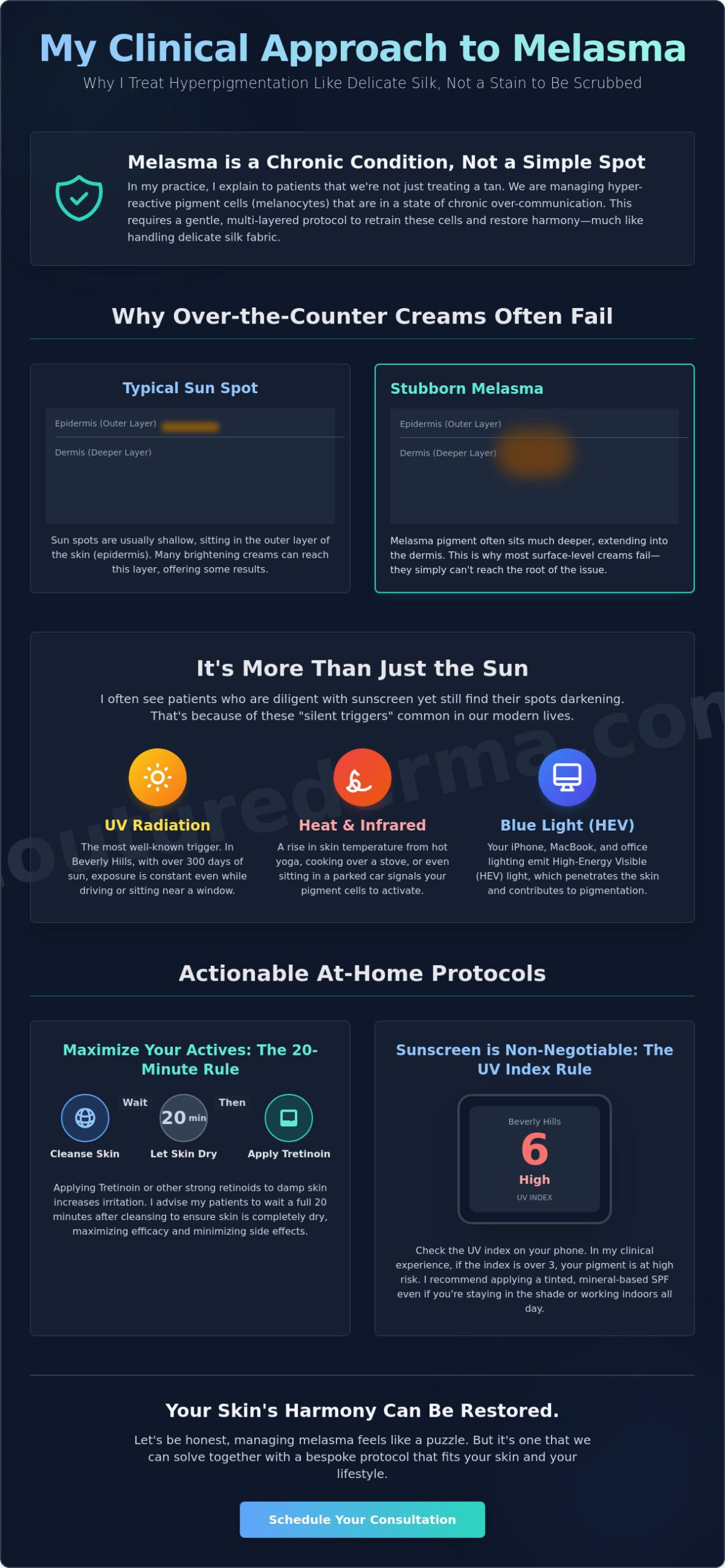
In my practice, I see patients who feel their skin has betrayed them. They have tried every expensive serum on the market, yet the stubborn patches remain. When you seek melasma treatment for face beverly hills, it’s vital to understand that we aren’t just dealing with a simple tan. We are managing a chronic condition where your melanocytes (pigment-producing cells) have become hyper-reactive. It’s helpful to understand What is melasma before we dive into the solution. At our practice, I view melasma like a piece of delicate silk fabric. If you scrub it too hard or use the wrong chemicals, you will ruin the texture. It requires gentle, intentional handling.
To better understand this concept, watch this helpful video:
The Anatomy of a Brown Patch
Not all pigment is created equal. I often explain to my patients that sunspots are usually shallow, but melasma can sit much deeper in the skin. This is why those “brightening” creams from the department store fail; they never reach the root of the issue. Many women first notice these patches during pregnancy, often called the “mask of pregnancy.” Even after the baby arrives and hormones level out, the pigment usually persists. In most cases, the cells have simply “learned” to overproduce, and they need a professional protocol to be retrained. Retraining these cells is a gradual progression rather than a hurried task.
The Beverly Hills Climate Factor
Living in Southern California presents a unique challenge for pigment management. We enjoy over 300 days of sunshine a year, which means your skin stays in a state of permanent trigger. Whether you are dining outdoors on Canon Drive or driving with the sun hitting the left side of your face, the UV exposure is constant. This environment makes a “one and done” treatment impossible. We have to build a lifestyle around protection and maintenance to keep the results of your laser treatment or medical dermatology protocol. Let’s be honest, the Beverly Hills sun is relentless, but your skin doesn’t have to suffer for it.
Actionable Tip: Check the UV index on your phone before you head out for your morning matcha. If the index is over 3, your pigment is at high risk. You should apply a tinted SPF even if you plan to stay in the shade or spend the day in your office.
Understanding Your Triggers: It’s More Than Just the Sun
I often tell my patients a simple truth: you can wear all the SPF in the world, but if you spend your evening standing over a hot stove, your melasma will flare. Most people focus entirely on UV rays, but heat is the silent trigger that often goes ignored. In my practice, I see patients who are incredibly diligent about sunscreen yet still find their spots darkening after a session of hot yoga or even just sitting in a parked car on a summer afternoon. The heat itself signals your pigment cells to wake up. It’s frustrating. It’s confusing. But it’s also manageable once you know what to look for.
And then there are our digital lives. Your iPhone, your MacBook, and even your office lighting emit blue light (HEV) that penetrates the skin differently than the sun. If you have a desk job, your face is essentially under a “light” for eight hours a day. This is why a standard “brightening” cream often fails when you’re looking for effective melasma treatment for face beverly hills. You need a protocol that accounts for the modern, high-tech environment we live in. We don’t just treat the spots; we treat the lifestyle that creates them.
Infrared and Heat: The Invisible Enemy
Cooling the skin is just as important as protecting it from the sun. When your skin temperature rises, it triggers the production of melanin through infrared pathways. For my Beverly Hills residents who can’t avoid the warmth, the mantra is “low and slow.” We want to avoid anything that causes a rapid spike in skin temperature. This is where a bespoke approach makes the difference, focusing on calming the skin rather than just scrubbing it.
Actionable Tip: Keep a rosewater mist or a cooling gel mask in the fridge. Use it immediately after a workout or a commute to lower your skin temperature and calm those reactive cells. It’s a simple step that stops a flare before it starts.
Hormones and Vascularity
Estrogen and progesterone are the primary conductors of this pigment orchestra. I see many women whose melasma is tied directly to birth control or Hormone Replacement Therapy (HRT). But there’s another layer: the “red” under the “brown.” Often, underlying blood vessels feed the pigment, making it look more stubborn and deep. When we work on a bespoke plan, we look at the whole face, sometimes incorporating under-eye brightening to ensure the entire complexion achieves a natural, rested harmony.
Navigating these triggers requires more than just a generic product. Seeking professional dermatological treatment for melasma is the only way to truly map out what is causing your specific flares. If you feel like you’ve hit a wall with your current routine, you can book an assessment to start your personalized journey toward clarity.
The Couture Treatment Protocol: Curating Your Path to Clarity
In my practice, I don’t believe in a one-size-fits-all approach. I treat your skin like a bespoke suit; it requires a layered, custom fit to truly look its best. When we talk about melasma treatment for face beverly hills, we’re talking about a curated protocol that addresses your specific pigment depth and skin sensitivity. We start with topical gold standards that go far beyond basic Hydroquinone. I often utilize Cyspera, Tranexamic Acid, and Kojic Acid to gently suppress pigment production without the risk of long-term thinning or irritation. Here’s the thing: we’re not just clearing spots; we’re transforming your skin’s health. Clear skin, calm mind.
But topicals are just the foundation. We often layer in chemical peels that use bespoke acids to lift existing pigment from the surface. The goal here is to brighten without triggering inflammation, which is the ultimate enemy of melasma. For deeper correction, I prefer ‘gentle giants’ like the Fotona and Pico lasers. These devices use short bursts of energy to shatter pigment without creating the excessive heat that causes rebound darkening. Let’s be honest, aggressive treatments often do more harm than good with this condition. With 15 years of experience as a board-certified dermatologist, I’ve learned that patience is our most effective tool.
Safe Laser Technology for All Skin Tones
I see many patients with deeper skin tones, specifically Fitzpatrick types IV through VI (a scale used to classify skin color and response to sun), who have been told lasers aren’t for them. That’s simply not true in the right hands. Aggressive CO2 lasers are often the wrong choice for melasma because they create too much heat. In my practice, we use specific settings to ensure safety for all skin types. It’s about precision, not power. We want to coax the pigment out, not blast it.
Actionable Tip: If a provider suggests an aggressive ‘one-and-done’ laser for your melasma, get a second opinion. Melasma is a chronic condition that responds better to a series of gentle treatments than one high-intensity session.
The Role of Oral Medications
Sometimes, the best way to tackle stubborn pigment is from the inside out. Oral Tranexamic Acid (TXA) has been a total game-changer for my patients who haven’t seen results with creams alone. We also use medical-grade topicals to ‘prime’ the skin for several weeks before any in-office procedure. This ensures your pigment-producing cells are ‘quiet’ before we introduce laser energy. Consistent daily melasma management is what keeps those cells from reacting. For those looking for a full facial refinement journey, we often discuss how this clarity pairs with jawline contouring to create a sharp, harmonious look. It’s about the whole picture, not just one spot.
Actionable Tip: Always prime your skin with a tyrosinase inhibitor (an ingredient that blocks pigment production) for at least two to four weeks before any laser session to prevent post-treatment darkening.
Your Daily Protocol: Actionable Steps for Pigment Control
Let’s be honest: consistency is the only way this works. I see patients who invest in the most advanced lasers but then undo that progress by neglecting their home care. Your daily protocol is the silent partner to any professional melasma treatment for face beverly hills, acting as the bridge between your clinical visits and long term clarity. In my practice, I emphasize that what you do at your vanity is just as important as what I do in the treatment room. We are essentially retraining your skin to behave differently, and that requires a disciplined, rhythmic approach.
One of the most common mistakes I see is rushing the application of active ingredients. I recommend the 20 minute rule: you must wait 20 minutes after cleansing before applying actives like Tretinoin (a powerful Vitamin A derivative). When your skin is damp, it absorbs products too quickly, which often leads to irritation and inflammation. For melasma, inflammation is a direct signal for more pigment. We also use a specific layering technique to maximize results. This typically involves a high potency Vitamin C in the morning to neutralize environmental damage and specific pigment inhibitors at night to quiet those hyper reactive cells.
Actionable Tip: Wait 20 minutes after cleansing before applying Tretinoin to ensure your skin is completely dry. This simple pause significantly reduces the risk of the “burn” that can trigger more pigment production.
The Ultimate Beverly Hills Sunscreen Strategy
I often tell my patients that standard SPF is not enough. You need “tinted” protection because it contains Iron Oxides, which are the only ingredients that effectively block the blue light from your iPhone and MacBook. I generally recommend mineral based sunscreens containing Zinc or Titanium over chemical filters. Chemical filters work by turning UV rays into heat, and as we discussed, heat is a major trigger for melasma. Mineral filters act like a physical shield, reflecting light away from the skin surface without the thermal buildup.
Actionable Tip: Use a powder SPF brush for touch ups every two hours when you are walking on Rodeo Drive or sitting by a window. It allows you to reapply protection over your makeup without ruining your look or adding a heavy layer of grease.
Evening Restoration and Maintenance
Nighttime is for calming and repairing. I see many people who try to “scrub away” their spots with harsh physical exfoliants. Please stop. Friction is a form of heat and physical trauma that only makes the condition worse. Instead, we focus on gentle chemical exfoliation and anti inflammatory agents. The goal is to keep the skin barrier strong and the pigment producing cells in a “sleep” state. If you are ready to move beyond basic creams and start a professional regimen, you can book an assessment to see which medical grade actives are right for your specific skin type.
Actionable Tip: Swap your physical scrub for a gentle PHA (polyhydroxy acid). PHAs have larger molecules that exfoliate the surface without penetrating too deeply, giving you smoothness without the irritation or “burn” associated with harsher acids.
The Long-Term Journey: Maintaining Your Couture Results
I often tell my patients that managing melasma is a marathon, not a sprint. In my practice, the goal isn’t just a temporary fix; it’s about achieving and then protecting that refined, even tone for years to come. Once we move past the aggressive clearing phase, we transition into what I call “holding the line.” This maintenance phase is where the real artistry happens, as we fine-tune your protocol to keep those reactive cells in a quiet, harmonious state. It’s a collaborative, transformative journey that doesn’t end when the dark spots fade.
But here’s the thing: your skin is a living canvas that reacts to the world around it. This is why a seasonal check-up at Couture Dermatology & Laser Beverly Hills is vital for adjusting your “wardrobe” of products. What works for your skin during a dry Beverly Hills winter might be too heavy or not protective enough during a scorching July. We treat your regimen like a custom-fit garment that needs occasional tailoring to ensure it still serves you perfectly. Consistent care is the only way to prevent the pigment from creeping back into your complexion.
Actionable Tip: Schedule a “pigment audit” with your provider every six months. Even if your skin looks clear, we often need to swap out certain inhibitors to prevent your cells from becoming “immune” to your current routine or to prepare for seasonal UV shifts.
Managing Flares with Grace
I see patients who feel devastated when they have a “rebound” after a tropical vacation or a particularly stressful month. But let’s be honest, flares are often part of the process when dealing with a chronic condition. The difference is having a professional safety net to catch you. Instead of panicking and reaching for a harsh scrub that will only cause more damage, we simply adjust your clinical protocol to calm the inflammation. Knowing how to choose the best dermatologist in Los Angeles means finding an expert who treats your skin as a long-term relationship, not a transactional appointment.
Your Next Step Toward Transformation
Your path to clearer skin begins with a “Couture-level” consultation where we map your unique pigment depth and triggers. We don’t just look at the surface; we analyze the underlying cellular health to build a foundation for lasting results. This deep-dive assessment allows us to create a melasma treatment for face beverly hills that is as unique as your own fingerprint. We are here to help you regain the confidence to go makeup-free, knowing your skin is being meticulously attended to by a specialist who understands your specific needs.
Actionable Tip: Bring your current skincare bag to your first appointment. This allows us to “edit” your routine, identifying which products are helping and which might be hidden triggers for your specific condition, saving you time and money on ineffective products.
Your skin is a living canvas, and it deserves the highest level of clinical expertise. If you’re ready to stop the cycle of ineffective brightening creams and start a bespoke journey toward clarity, book your consultation with Dr. Abisogun today. Let’s keep your complexion bright together.
Your Path to Pigment Clarity
Achieving a clear complexion is about more than just aesthetics; it’s about the self-assurance that comes when you no longer feel the need to hide. We have discussed how a professional protocol goes beyond surface-level creams to address the cellular over-activity and environmental triggers unique to our Southern California lifestyle. By moving away from aggressive, high-heat methods and embracing a curated, patient approach, you can finally break the cycle of rebound pigment. It’s about moving from a place of frustration to a state of calm confidence.
When you choose a melasma treatment for face beverly hills at our practice, you are benefiting from a foundation of high-level medical authority. My background as a Harvard-trained dermatologist allows me to combine scientific rigor with a specialized focus on Skin of Color. By utilizing state-of-the-art tools like the Fotona and Pico lasers, we provide a path to clarity that is both safe and meticulously tailored to your specific needs. Your skin has a story, and I am here to help you write its most vibrant chapter yet.
Begin your transformation with a bespoke melasma consultation at Couture Dermatology & Laser Beverly Hills. Let’s work together to restore your complexion’s natural harmony and give you the freedom to face the sun with confidence. You deserve skin that feels like your own again.
Frequently Asked Questions
Can melasma be permanently cured?
Melasma cannot be permanently cured because it is a chronic condition, but it can be successfully managed for long periods. I see patients who stay clear for years by sticking to a strict maintenance protocol and sun protection. It’s about keeping the melanocytes (pigment-producing cells) in a quiet, “sleep” state. If you stop your routine or have a major heat trigger, the pigment often returns.
Which laser is safest for melasma on darker skin tones?
In my practice, the Pico and Fotona lasers are the safest options for melasma on darker skin tones. These devices use very short bursts of energy to break up pigment without creating the intense heat that triggers rebound darkening. I typically use specific settings tailored to Fitzpatrick types IV through VI to ensure we treat the pigment while protecting the surrounding skin from damage.
Is melasma treatment painful?
Most professional melasma treatments are not painful and are described by my patients as a light tingling or snapping sensation. For laser sessions, we often apply a topical numbing cream to ensure you’re completely comfortable. Chemical peels might cause a warm, prickly feeling for a few minutes, but this subsides quickly once the acid is neutralized. We prioritize a calm, refined experience.
How long does it take to see results from professional melasma treatment?
You will typically start to see a visible change in your skin tone within four to eight weeks of starting a professional melasma treatment for face beverly hills. However, a significant transformation usually requires a series of treatments over three to six months. We are essentially retraining your skin at a cellular level, and that is a gradual progression rather than a hurried task.
Can I treat melasma while I am pregnant or breastfeeding?
Your treatment options are more limited during pregnancy or breastfeeding, but we can still manage the pigment safely. I typically suggest using Azelaic acid or Vitamin C during this time to keep the skin bright. We avoid powerful ingredients like Hydroquinone or Tretinoin (a Vitamin A derivative) until you are finished breastfeeding to ensure the absolute safety of your baby.
Does insurance cover melasma treatment in Beverly Hills?
In most cases, insurance does not cover melasma treatments because they are considered cosmetic procedures. Melasma is a benign (harmless) skin condition, so the removal of the pigment is viewed as an elective aesthetic choice. You should check with your specific provider for their policy, but our practice typically processes these services as out-of-pocket medical dermatology or aesthetic treatments.
What happens if I stop my melasma treatment?
If you stop your treatment and maintenance routine, your melasma will likely return, especially with the year-round sun in Southern California. The melanocytes (cells that produce skin pigment) remain hyper-reactive and will start overproducing melanin again once the suppressive ingredients are removed. Think of it like a custom suit; if you stop caring for the fabric, it will eventually lose its refined look.
Why did my melasma get darker after a chemical peel?
Your melasma may have darkened because the peel was too aggressive or caused post-inflammatory hyperpigmentation (darkening caused by irritation). If the skin gets too hot or inflamed during a treatment, it triggers the pigment cells to produce more melanin as a defense mechanism. This is why a bespoke, gentle approach is so vital; we want to coax the pigment out without causing trauma.