
Last Tuesday, a patient visited our practice at Couture Dermatology & Laser Beverly Hills with a common concern. She wanted to know the truth about microneedling vs laser resurfacing before her next big social event. In my practice, I see patients every day who feel overwhelmed by the sheer number of options for skin refinement. You want a rejuvenated look, but you’re rightfully anxious about potential hyperpigmentation (dark spots) or downtime that doesn’t fit your busy schedule.
Choosing between these two powerhouses shouldn’t feel like a gamble. I’ve spent 15 years helping people find the right balance between mechanical collagen induction and advanced thermal energy. It’s about tailoring the treatment to your specific skin tone and lifestyle needs. A custom fit for a custom life. Here’s a tip I often share: if you’re prone to dark spots, we typically prep your skin with a pigment inhibitor for two weeks before any light-based treatment. This guide will clarify which path solves your specific concerns and give you a predictable timeline for your results. Let’s look at how these tools work differently to transform your complexion while keeping your safety at the forefront.
Key Takeaways
- Learn why microneedling relies on mechanical micro-channels to build collagen while laser resurfacing uses thermal energy to create a sophisticated tightening effect.
- Identify which technology best addresses your primary concerns, from smoothing textured acne scars to correcting solar elastosis (deep sun damage).
- Navigate the microneedling vs laser resurfacing decision with safety in mind, especially if you have melanin-rich skin prone to dark spots.
- Discover how to strategically time your sessions around the Beverly Hills social calendar to ensure you look your best for awards season or galas.
- Understand why a bespoke, multi-session protocol is essential for achieving natural results that honor your unique complexion over time.
Microneedling vs. Laser Resurfacing: The Fundamentals of Rejuvenation
In my Beverly Hills practice, I see patients who think these are interchangeable, but the mechanism matters deeply. Think of your skin like a piece of fine silk that has lost its luster. You can either use a fine needle and thread to reinforce the weave from within, or a precision steam press to smooth and tighten the surface. Both methods improve the fabric, but they do it through different physics. Choosing between microneedling vs laser resurfacing is really about deciding whether your complexion needs a mechanical nudge or a thermal transformation.
Microneedling is technically known as Collagen induction therapy (CIT). It uses tiny needles to create thousands of mechanical micro-channels in the skin. On the other hand, laser resurfacing uses thermal energy remodeling. This involves using specific wavelengths of light to either vaporize the outer layer or heat the deeper tissues to trigger a healing response. When we weigh the benefits of microneedling vs laser resurfacing, we have to look at how each one talks to your cells.
To better understand how these two technologies interact with your skin, watch this helpful comparison:
The Mechanical Approach: How Microneedling Works
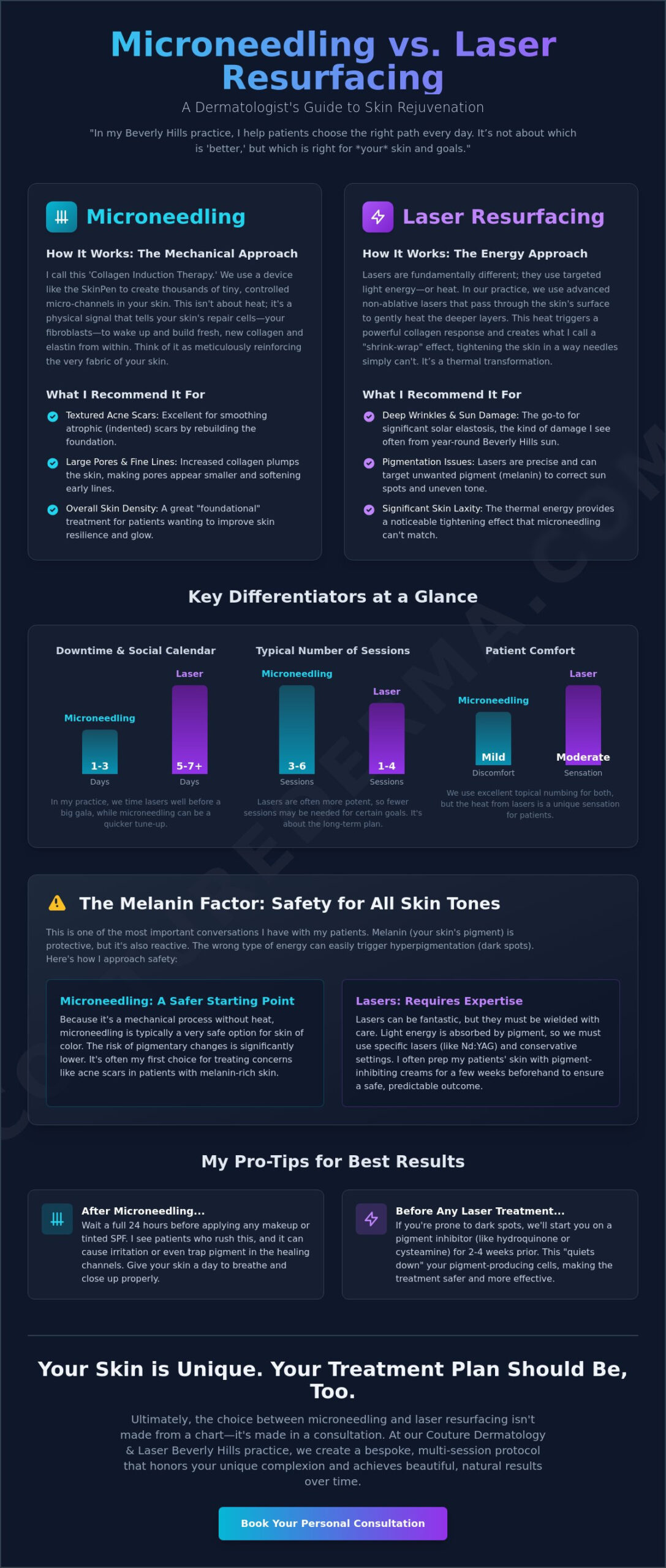
In my practice, I often use the SkinPen because it creates precise, vertical channels. This is vital for acne scar refinement and a safe recovery. At-home rollers often enter the skin at an angle, which can cause “track-mark” scarring or unnecessary tearing. Professional microneedling targets fibroblasts (cells that make collagen) by tricking them into thinking there’s an injury. These cells rush to repair the micro-channels, producing fresh collagen and elastin. Because the surface disruption is so minimal, the downtime is typically shorter than most lasers. It’s an elegant way to rebuild skin density without the heat.
Pro Tip: Wait at least 24 hours after a microneedling session before applying any makeup or tinted SPF. This gives the micro-channels enough time to fully close and prevents irritation or potential infection from trapped pigments.
The Energy Approach: How Lasers Transform Skin
Lasers are far more targeted and assertive. They look for specific chromophores (targets like pigment or water) in your skin to deliver energy. An ablative laser actually removes thin layers of skin to reveal the fresh tissue underneath. A non-ablative laser, like the systems we use at Couture Dermatology, passes through the surface to heat the underlying tissue without “breaking” the top layer. This heat causes a “shrink-wrap” effect that needles simply can’t achieve. Light energy can reach depths that needles shouldn’t touch; this makes lasers powerful for treating deep wrinkles or significant sun damage that has accumulated over years of California sun exposure.
Comparing the Mechanisms: Mechanical Precision vs. Thermal Energy
In my practice, I see patients who want a dramatic lift without the surgical price tag. When we look at the nuances of microneedling vs laser resurfacing, the biggest differentiator is what I call the “Heat Factor.” Lasers use thermal energy to create a controlled burn, while microneedling relies on physical needles to create change. Both have their place, but they speak to your skin in very different languages.
| Feature | Microneedling | Laser Resurfacing |
|---|---|---|
| Mechanism | Mechanical (Physical needles) | Thermal (Light energy) |
| Primary Target | Texture and acne scars | Deep wrinkles and sagging |
| Downtime | 1 to 3 days | 5 to 10 days (for ablative) |
| Ideal Candidate | All skin types; younger patients | Significant sun damage; lighter skin |
Here is a clinical pearl: if you have active melasma (pigment patches), avoid high-heat lasers. In most cases, heat wakes up those pigment-producing cells and makes the patches darker. Stick to microneedling or low-energy options instead.
The ‘Shrink-Wrap’ Effect of Laser Energy
Thermal energy causes something microneedling cannot: immediate collagen contraction. It is a bit like putting a wool sweater in a hot dryer; the fibers tighten up instantly. This is why lasers remain the gold standard for deep, etched-in wrinkles and skin laxity. But let’s be honest, that heat comes with “social downtime.” You will likely want to stay home for a week while your skin sheds its outer layer and reveals the fresh tissue underneath.
The Physical Channeling of Microneedling
Microneedling is the “gentle stitch” for those avoiding heat-based complications. Yale Medicine emphasizes the microneedling safety for skin of color because it does not trigger the melanocytes (cells that produce skin pigment) the way heat does. These micro-channels allow for bespoke infusions of PRP (platelet-rich plasma) or specialized growth factors. I find mechanical needles are also safer for areas with delicate “skin fabric” like the neck. This approach is particularly effective when enhancing results with artful jawline contouring to create a refined, youthful profile without the risks of thermal injury.
If you are ready to see which mechanism will best refine your unique complexion, you can view our available consultation times to start your transformation.
Choosing Your Treatment: Which Concern Are You Targeting?
“But which one do I actually need?” is the question that echoes in my consultation room every single day. I see patients who are desperate to fix their skin but feel frozen by the sheer number of choices available. If you’re comparing microneedling vs laser resurfacing, the decision usually comes down to the specific depth of your concern. I often tell patients that microneedling is for the texture, but laser is for the architecture. One refines the surface, while the other rebuilds the foundation.
Eradicating Acne Scars: Depth and Precision
When it comes to a Couture approach to acne scar refinement, the type of scar dictates our tool. Rolling scars, which look like wavy indents with sloping edges, often respond beautifully to microneedling. The needles “un-tether” the fibrous bands pulling the skin down. But deep “ice-pick” scars or “boxcar” scars with sharp, vertical edges usually require the aggressive energy of a CO2 laser. The laser can vaporize the scar tissue and force the skin to rebuild from the bottom up. It is a more intense process, but for deep architectural changes, it is often necessary.
Clinical Tip: For rolling scars, I often combine microneedling with subcision (a technique to break up scar tissue) in the same session. This double-layered approach provides a much smoother finish than either treatment alone. If you have active acne, we must wait until the breakouts are clear before starting either procedure to avoid spreading bacteria.
Reversing the Beverly Hills Sun: Pigment and Tone
Living in Los Angeles means dealing with year-round sun damage and solar elastosis (the yellowing and thickening of skin caused by chronic UV exposure). If your main issue is lentigines (sun spots), lasers like the Vbeam or Fractional CO2 are the clear winners. These devices target the pigment directly to shatter it, a principle that also applies when you explore Laser Tattoo Removal to address unwanted ink. Microneedling is a “quieter” way to brighten the skin. It improves overall tone without triggering the heavy inflammation that can lead to dark spots in some patients. For large pores and overall texture, the “Couture Choice” is often a series of microneedling sessions to tighten the skin’s “weave” without the downtime of a full resurfacing laser.
Here is the thing about our California sun: it makes your skin reactive. In my practice, I tell everyone that you must prep your skin with a tyrosinase inhibitor (a pigment blocker) for at least two weeks before any laser treatment. Apply your pigment blocker every morning and evening for 14 days leading up to your appointment. This protocol helps “sleep” the melanocytes (cells that produce skin pigment) so they don’t overreact to the laser’s heat. It’s a simple step that significantly lowers your risk of post-treatment darkening.
Actionable Tip: Wait at least 48 hours after a laser or microneedling session before using any exfoliating acids or retinols. Your skin is in a vulnerable state, and using these too early can cause chemical burns on the fresh tissue.
The Melanin Factor: Safety for All Skin Tones
Let’s be honest, the aesthetic industry has historically underserved those with darker skin tones. In my practice, we specialize in skin of color, and we never gamble with heat settings. I see patients who have been turned away from other clinics or, worse, had their skin damaged by improper laser use. When we discuss the nuances of microneedling vs laser resurfacing for melanin-rich skin, the conversation shifts from “what is fastest” to “what is safest.” We use the Fitzpatrick Skin Type scale to guide us. This scale ranges from Type I (very fair, always burns) to Type VI (deeply pigmented, rarely burns). The higher you are on this scale, the more your skin reacts to heat by producing excess pigment.
And that is the primary risk: Post-Inflammatory Hyperpigmentation (PIH). This condition involves dark spots caused by skin trauma or heat. While lasers have become much more sophisticated, microneedling remains the “universal” treatment because it is entirely mechanical. It doesn’t rely on light or heat, which means it doesn’t wake up the melanocytes (cells that produce skin pigment) in a defensive way. It is a predictable, elegant way to refine the skin without the anxiety of unexpected darkening.
Why Microneedling Wins for Darker Skin Tones
The absence of heat is the reason microneedling is my go-to for Fitzpatrick IV-VI complexions. In most cases, I tailor the needle depth to ensure we are stimulating the right layers without causing deep dermal trauma. I often recommend a series of 4 to 6 microneedling sessions rather than one aggressive laser for my darker-skinned patients. This “slow and steady” approach builds collagen incrementally. It respects the unique weave of your skin fabric and avoids the inflammatory cascade that leads to PIH. But we still take precautions. I typically have my patients use a gentle brightening serum for two weeks following the treatment to keep the skin tone even and luminous.
Safe Laser Options for Melanin-Rich Skin
But what if your skin concern requires the “shrink-wrap” effect only a laser can provide? It is possible, but you need “color-blind” technology. We look for lasers with longer wavelengths, such as the Nd:YAG. This specific wavelength bypasses the pigment in the outer layer of skin to target deeper structures safely. I cannot stress the importance of the “test spot” enough. Before we treat your entire face, we always apply the laser to a small, discreet area near the jawline to see how you heal. If a provider doesn’t ask about your ethnic background or sun exposure history, that is a major red flag. They aren’t looking at the unique needs of your complexion.
Actionable Tip: Ask your provider specifically for an Nd:YAG laser if you are a Fitzpatrick Type IV or higher. This wavelength is safer because it bypasses surface pigment to protect your complexion from burns. If you are unsure about your skin type, you can schedule a skin-tone assessment with our team to create a safe, bespoke plan.
The Couture Protocol: Planning Your Transformation in Beverly Hills
In Beverly Hills, our lives are often dictated by the social calendar. Whether it’s awards season, a charity gala, or a high-profile premiere, you want to look your best. But here’s the thing; building collagen is a slow, biological process. The idea that a single session of microneedling vs laser resurfacing will erase years of California sun damage is simply not realistic. I tell my patients that patience is the ultimate luxury. We are working with your body’s natural healing rhythm, and that requires a commitment to a multi-month journey. Think of it like a series of custom fittings for a bespoke gown; each session refines the fit until the fabric of your skin is perfect.
Managing the Social Downtime
Managing the social downtime is the biggest hurdle for my patients who have busy schedules. If you choose microneedling, you should expect a “sunburn” look for about 24 to 48 hours. It’s usually quite easy to manage with a light, non-comedogenic (pore-clogging) moisturizer. Fractional lasers are a different story. They often leave a “bronzed” or pixelated appearance for three to five days as the treated skin prepares to shed. Schedule your laser on a Thursday if you want to be “dinner party ready” by Monday evening. By then, the initial redness has faded. Apply a thick layer of a bland, petrolatum-based ointment for the first 24 hours after a laser to trap moisture and speed up the healing process. This simple step can shave a full day off your recovery time. In my practice, we often prioritize precision under-eye brightening during these protocols. It provides an instantly rested look that works wonders for your overall confidence before a big event.
Your Signature Consultation with Dr. Abisogun
Your journey begins with a signature consultation at Couture Dermatology & Laser. As a board-certified dermatologist, I perform a literal “fabric analysis” of your skin before we touch a single device. I look at your skin’s thickness, its elasticity, and its history of sun exposure. This ensures we pick the tool that respects your unique weave. Our “Couture Maintenance” plan might involve alternating treatments to achieve a multi-dimensional glow. We might use a laser to address deep architectural lines in the winter and switch to microneedling in the spring to keep the surface texture smooth. This approach ensures you never look “worked on” or artificial. It’s about a gradual, graceful progression toward your best self. And let’s be honest, your skin is a long-term investment, not a quick fix. When you treat it with that level of respect, the results are always worth the wait.
If you’re ready to start your transformative journey, you can schedule your bespoke skin consultation with Dr. Abisogun to discover the perfect protocol for your complexion.
Your Path to a Refined Complexion
Choosing between microneedling vs laser resurfacing is the first step in a collaborative, transformative journey. I see patients who are often caught between wanting dramatic change and needing to protect their unique skin fabric. Whether we utilize mechanical precision to smooth acne scars or thermal energy to tighten the architecture of your skin, the goal is always a result that looks natural and feels like you. In my practice, we don’t believe in rushed, artificial solutions; we believe in a gradual progression that honors your skin’s health and long-term vitality.
As a Harvard-trained dermatologist specializing in diverse skin tones, I ensure that your treatment plan is safe for your specific Fitzpatrick type. Our bespoke clinical environment in Beverly Hills is designed to make you feel recognized and meticulously attended to. You deserve a plan that fits your lifestyle as perfectly as a custom-tailored garment. It is time to stop guessing and start your transformation. Book your personalized skin refinement journey at Couture Dermatology and let’s reveal the most confident version of you.
Common Questions About Skin Refinement
Which is better for deep wrinkles: microneedling or laser?
Laser resurfacing is typically better for deep, etched-in wrinkles. The thermal energy causes immediate collagen contraction that creates a “shrink-wrap” effect needles simply cannot match. In my practice, I find that patients with significant skin laxity see a much more pronounced lift from laser energy. While microneedling improves surface texture, it often struggles to reach the architectural depths needed to iron out profound facial lines.
Is laser resurfacing safe for dark skin tones?
Laser resurfacing is safe for dark skin tones if you use “color-blind” technology like the Nd:YAG laser. I see patients with melanin-rich skin who are terrified of hyperpigmentation (dark spots) caused by heat. It is a valid concern. In most cases, we either use these specific longer wavelengths or opt for microneedling. Microneedling is the universal choice because it avoids heat entirely, making it safe for every Fitzpatrick skin type.
How many days of downtime should I expect after a fractional laser?
You should expect approximately 3 to 5 days of social downtime after a fractional laser session. Your skin will likely look “bronzed” or pixelated as the micro-crusts form and eventually shed. I tell my patients to plan for a quiet weekend and avoid any major galas or social events during this window. By day six, most people can easily cover any lingering pinkness with a breathable, mineral-based makeup.
Can I combine microneedling and laser treatments in one session?
I typically don’t recommend combining these two treatments in the exact same area during a single session. It is often too much trauma for the skin fabric to handle at once; this increases the risk of scarring or infection. But we do frequently alternate them in a staggered protocol. We might use a laser for deep lines in December and then follow up with microneedling in February to polish the surface texture.
Is microneedling or laser better for active acne and scars?
We should never treat active acne with either method until the breakouts are fully under control. Once the skin is clear, the microneedling vs laser resurfacing choice depends on the scar type. Microneedling is an elegant solution for rolling scars that need “un-tethering.” But deeper ice-pick or boxcar scars usually require the assertive energy of a CO2 laser to vaporize the scar tissue and force a total rebuild.
Does microneedling hurt more than a laser treatment?
Neither treatment should be painful if your provider uses a high-grade topical numbing cream. I see patients who are needle-phobic, but they find the sensation is more like a vibrating, “sandpaper” feeling. Most people describe the laser as a series of quick, hot snaps. We prioritize your comfort in our Beverly Hills practice to ensure the journey toward transformation is as calm and reassuring as possible.
How long do the results of laser skin resurfacing last compared to microneedling?
Laser results often last significantly longer because they physically remodel the skin’s foundation. While microneedling creates beautiful surface refinement, it typically requires a maintenance session every 6 to 12 months to keep the glow. A deep laser treatment can provide results that stay visible for several years. Of course, this depends on your commitment to daily SPF and avoiding the intense California sun during peak hours.
What is the average cost difference between microneedling and laser in Beverly Hills?
Lasers generally require a higher investment per session because of the advanced technology and the clinical expertise required to operate the devices safely. Microneedling is often more accessible upfront; but you may need a longer series of sessions to achieve your desired outcome. In my practice, we focus on the value of long-term transformation. We curate a plan that respects both your skin’s needs and your personal lifestyle timeline.