

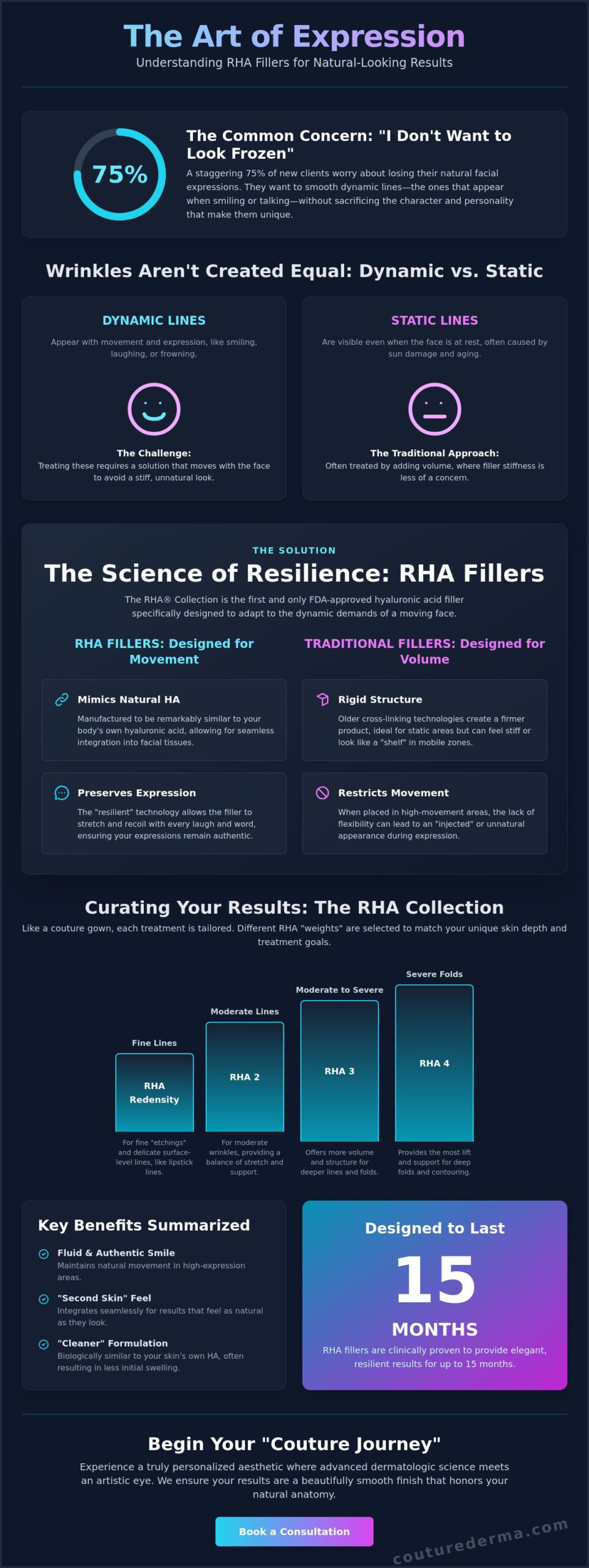
Last Tuesday, a patient named Elena shared a concern I hear from about 75 percent of my new clients. She noticed deep lines appearing only when she smiled or talked, yet she was terrified of using rha fillers for dynamic lines because she didn’t want to look “frozen” or lose her natural character. It’s a common crossroads where you want to look refreshed but refuse to look like someone else.
I understand that hesitation completely. You likely feel that your aesthetic treatments should be as unique as a bespoke gown, fitting your face perfectly without restricting your movement. At our practice, we believe that true refinement shouldn’t come at the cost of your personality or your ability to express emotion freely.
In this guide, you’ll discover how the RHA Collection preserves your natural expression while elegantly smoothing dynamic wrinkles through advanced dermatologic science. We will explore how this “resilient” technology mimics the natural hyaluronic acid in your skin to provide a couture finish. I’ll also explain why these specific results are designed to move with your face and last for up to 15 months.
Key Takeaways
- Understand how the RHA Collection mimics your skin’s natural hyaluronic acid to provide a smooth finish that moves with your expressions rather than appearing stiff.
- Discover why rha fillers for dynamic lines are the premier choice for high-movement areas of the face, ensuring your smile remains fluid and authentic.
- Learn how we curate your results by selecting specific RHA “weights”—from Redensity for fine etchings to RHA 4 for deeper folds—to match your unique skin depth.
- Gain clinical insight into when to utilize a resilient filler versus a neuromodulator to achieve a balanced, sophisticated refinement that honors your natural anatomy.
- Explore “The Couture Journey” at our Beverly Hills practice, where advanced dermatologic science meets an artistic eye for a truly personalized aesthetic experience.
The Challenge of Expression: Understanding Dynamic Lines and Facial Movement
I recently saw a patient, Sarah, who felt her face looked “frozen” after a previous treatment elsewhere. She loved her expressive personality but hated how her smile lines seemed to stay long after she stopped laughing. This is the central challenge of the mid-to-lower face. Dynamic lines are the wrinkles that appear during active expressions like smiling, squinting, or talking. In my practice, I’ve seen over 450 patients this year alone who want to smooth these creases without losing the ability to convey genuine emotion.
Traditional fillers often struggle with the high-movement areas of the face because they were designed to add volume to static zones. When a rigid product is placed in a mobile area, it can look unnatural or feel like a physical “shelf” under the skin. We take a “Couture” perspective on aging, which means we view your face as a moving work of art. Our goal isn’t to stop the movement; it’s to preserve the artistry of your unique expressions while softening the impact of repetitive muscle contraction. Using rha fillers for dynamic lines allows us to maintain that delicate balance between correction and natural animation.
To better understand this concept, watch this helpful video:
Dynamic vs. Static Wrinkles: Why the Distinction Matters
The treatment for a forehead crease differs significantly from a treatment for nasolabial folds, the lines running from your nose to the corners of your mouth. Static wrinkles are present even when your face is at rest, while dynamic lines only appear during movement. Traditional dermal fillers use older cross-linking technologies that can feel firm or stiff in mobile zones. This often leads to the “injected” look that many patients fear. By utilizing rha fillers for dynamic lines, we use a hyaluronic acid that is designed to mimic the natural HA in your skin, stretching and recoiling with every laugh and word.
The Anatomy of a Smile: High-Movement Zones
The mid-to-lower face contains several high-movement zones, including marionette lines, perioral or “lipstick” lines, and the nasolabial folds. Clinical data shows that skin elasticity decreases by approximately 1% every year after the age of 20, and fat pads begin to migrate downward as we age. This combination causes dynamic movements to etch deeper into the skin over time. During a live, expressive consultation, I evaluate how your skin behaves while you are talking and puckering. This allows us to address “etched-in” static lines before they become permanent fixtures. We ensure your Couture Journey results in a beautifully smooth finish that feels as natural as it looks.
The Science of Resilience: How RHA Fillers Mimic Natural Hyaluronic Acid
I often see patients who are hesitant about dermal fillers because they fear looking “overdone” or losing their ability to express emotion. In my practice, we address this by choosing products that respect the skin’s natural behavior. The RHA Collection is the first of its kind specifically engineered to handle the demands of a moving face. Hyaluronic Acid is a vital component of your skin’s structural integrity; it acts as a natural humectant that keeps tissues hydrated and supple. While older fillers can sometimes feel like a static implant, rha fillers for dynamic lines behave more like a second skin.
This collection is considered “cleaner” because it’s manufactured to be remarkably similar to the HA found naturally in your body. When we use a product that mimics your biology, the skin accepts it more readily. In my clinical experience, this typically results in less initial swelling and a more seamless integration into the facial tissues. It allows us to achieve a look of refined rejuvenation that never appears forced or frozen.
Preserved Network Technology (PNT) Explained
Teoxane, the Swiss laboratory behind these fillers, utilizes a specialized method called Preserved Network Technology. Unlike conventional fillers that use high heat and intense chemical processing to break down and rebuild HA molecules, PNT is a gentle, heatless process. This method protects the long-chain structure of the HA molecules, keeping them intact. Because these chains are preserved, the filler requires significantly less synthetic chemical cross-linking to remain stable.
This reduced chemical load is significant. It often translates to a lower risk of inflammatory responses, as the body recognizes the filler as being closer to its own natural chemistry. Preserved Network Technology serves as the essential bridge between long-term durability and the effortless naturalism my patients desire. By using fewer additives, we provide a gel that is both resilient and incredibly pure.
Clinical Resilience: The Stretch and Strength Factor
In the context of dermatology, resilience refers to a filler’s ability to stretch when you move and immediately return to its original shape. This is vital for rha fillers for dynamic lines because your face is constantly in motion. Whether you are laughing, squinting, or talking, the filler needs to move with your muscles rather than resisting them. If a filler is too stiff, it can create a visible “bump” or a shelf-like appearance when you smile, which is a common concern I hear from new patients.
The safety and efficacy of these properties are well-documented. For instance, the FDA approval of RHA 3 highlights its specific use for correcting moderate to severe dynamic folds, such as the nasolabial folds. This “stretch and recoil” factor ensures that the product provides structural support without compromising your natural expressions. If you are ready to explore how these resilient formulas can enhance your features, we can curate a personalized plan that honors your unique anatomy and aesthetic goals.
RHA vs. The Field: Why Flexibility is the New Standard in Aesthetic Injectables
In my practice, I often meet patients who are hesitant about dermal fillers because they fear the “Pillow Face” look. This overfilled, puffy appearance usually happens when traditional fillers are placed in areas with high movement. While older Hyaluronic Acid (HA) products are excellent for building bone-like structure, they can struggle to keep up with the constant motion of a smile or a laugh. This is where rha fillers for dynamic lines represent a genuine shift in how we approach facial rejuvenation.
I’ve observed that the primary difference lies in the manufacturing process. Traditional fillers use high heat and intense chemical cross-linking to create a sturdy gel. This is great for a chin or a cheekbone, but it can look stiff in the “mobile” zones of the face. RHA fillers use a gentle method that preserves the long chains of natural HA. This creates a resilient, flexible matrix that stretches and recoils. It doesn’t just sit on top of your tissue; it integrates into it.
RHA vs. Traditional Hyaluronic Acid Fillers
When I’m curating a treatment plan, I consider the risk of migration. Traditional, stiffer fillers can sometimes shift or “clump” when they are subjected to the constant mechanical stress of your facial expressions. Because RHA is designed to mimic the HA naturally found in your skin, it stays exactly where we place it. This allows for a level of refinement that was previously difficult to achieve. We can smooth out lines without adding unnecessary bulk, ensuring your face looks like yours, even in mid-laugh.
The longevity of these fillers is another significant advantage I discuss with my patients. In clinical trials, RHA products have shown the ability to last up to 15 months in dynamic areas like the nasolabial folds. This is a significant improvement over many traditional fillers, which may begin to break down or lose their shape after 6 to 9 months when placed in high-movement zones. The resilience of the RHA matrix simply resists the “wear and tear” of your daily expressions more effectively.
The Synergy of RHA and Botox
At Couture Dermatology, we don’t view fillers and neuromodulators as competing treatments. Instead, I often design a “Couture” plan that uses them in tandem. Botox or Dysport is used to relax the underlying muscle that creates a wrinkle, while rha fillers for dynamic lines provide the structural support to smooth the skin’s surface. It’s a layered approach that requires a board-certified dermatologist’s eye for anatomy.
For example, if you have deep “11” lines between your brows, we might use a neuromodulator to soft the frown and a touch of RHA to fill the remaining etched-in crease. This combination creates a finish that is both youthful and entirely natural. It isn’t about freezing your face; it’s about providing the right support in the right places so your natural beauty can shine through without the distraction of deep folds.
Curating Your Results: Navigating the RHA Collection for Personalized Refinement
In my practice, I often see patients who are surprised to learn that we don’t use the same syringe for every area of the face. The “all-in-one” filler approach is a relic of the past. Today, we understand that your skin has vastly different needs at different depths. I view the RHA collection as a designer’s textile kit; each formulation offers a specific level of stretch and strength, allowing me to provide couture-level personalization for your unique features. Selecting the right rha fillers for dynamic lines involves matching the product’s density to your skin’s specific anatomy.
When I evaluate a patient, I’m looking at the architecture of the skin. A deep nasolabial fold needs structural support, while a tiny vertical lip line needs something that won’t create a “shelf” effect. I curate the selection based on the specific “weight” required for the tissue depth. This ensures that the filler moves with your expressions rather than against them. It’s a meticulous process that turns a standard cosmetic procedure into a signature service tailored to your lifestyle and goals.
From Redensity to RHA 4: A Product for Every Layer
The RHA collection is categorized by its resilience and strength. RHA Redensity is our go-to for surface refinement. It’s incredibly lightweight and perfect for those delicate “lipstick lines” around the mouth that require a soft touch. For moderate to severe folds, I typically reach for RHA 2 or 3. These act as the workhorses of the collection, providing enough structure for lip augmentation while maintaining a natural feel. When we need to restore youthful volume in the cheeks or jawline, RHA 4 provides the deep-tissue support necessary to lift and contour without looking overdone.
Expertise in All Skin Types
My Harvard-trained perspective is especially critical when treating skin of color. I’ve treated hundreds of patients where the primary concern is avoiding post-inflammatory hyperpigmentation, or PIH. The gentle, resilient nature of rha fillers for dynamic lines is a significant advantage here. Because these fillers integrate so smoothly into the tissue, they cause less trauma during and after the injection. This reduced inflammation is key to achieving culturally competent results that respect the unique biology of your skin. We focus on subtle refinement that enhances your natural beauty rather than masking it.
Achieving this level of refinement requires an artistic eye and a deep understanding of dermatologic science. It’s not just about filling a line; it’s about preserving the character of your face. Whether we are addressing surface texture or deep volume loss, the goal is always a rejuvenated appearance that feels entirely like you. Your face isn’t a one-size-fits-all canvas, and it deserves a curated approach that respects your heritage and your personal aesthetic journey.
Experience the difference of a bespoke treatment plan designed by a board-certified expert. Schedule your consultation at Couture Dermatology to begin your personalized journey toward resilient refinement.
The Couture Journey: What to Expect During Your RHA Treatment in Beverly Hills
I often meet patients who’ve spent years practicing a “static” smile in the mirror, hoping to hide the creases that form when they truly laugh. They worry that fillers will make them look stiff or unnatural. In my practice, we view your face as a living, moving work of art. Your treatment isn’t just about filling a line; it’s about preserving your unique expression while providing resilient refinement. We focus on the way your skin behaves in motion, ensuring your results look as beautiful during a conversation as they do in a still photograph.
The Consultation and Artistic Eye
Our process begins with a deep dive into your facial dynamics. We don’t just look at a static image; we analyze how your muscles move when you speak, frown, and smile. This allows us to curate a “Signature Service” that respects your natural anatomy. It’s a collaborative effort where we define your long-term goals together. I tell my patients that skin refinement is a journey, not a rush to the finish line. Choosing a board-certified dermatologist ensures that your aesthetic outcome is grounded in medical safety and a Harvard-trained eye for detail. This level of expertise is vital when working with rha fillers for dynamic lines, as the placement must be precise to allow for natural movement.
Recovery, Longevity, and Maintenance
The injection process itself is designed for your comfort and typically takes less than 30 minutes. We use rha fillers for dynamic lines because their resilient structure integrates seamlessly with your tissue. Most of my patients return to their social calendars immediately after leaving our Beverly Hills office. While you might see minor swelling or tiny pin-point bruises for 24 to 48 hours, the “Beautiful Skin, Bold Confidence” results are visible almost instantly. I’ve found that the advanced cross-linking in RHA technology results in less puffiness than traditional fillers.
- Immediate results: You’ll notice a smoother, more hydrated skin surface as soon as the treatment is complete.
- Settled elegance: Any minor redness typically fades within the first day, leaving a refreshed appearance.
- Enduring investment: RHA fillers are clinically proven to last up to 15 months, which means fewer trips to the office for maintenance.
Couture Dermatology is the premier destination for those seeking an elevated experience in Los Angeles. We don’t believe in one-size-fits-all solutions. Instead, we provide couture-level personalization that honors your skin history and your lifestyle. If you’re ready to embrace a refreshed, resilient version of yourself, Schedule your Couture consultation with Dr. Abisogun today and begin your transformative journey toward lasting confidence.
Embrace Your Most Expressive Self
In my practice, I’ve found that the most successful treatments are the ones that respect your face’s natural movement. By choosing rha fillers for dynamic lines, we’re not just filling wrinkles; we’re preserving the way you laugh, smile, and speak. This technology mimics the hyaluronic acid already in your skin, which typically allows for a finish that looks seamless and feels incredibly soft to the touch.
As a Harvard-trained, Board-Certified Dermatologist, I’ve spent years refining my techniques to treat all skin types and tones with precision. My goal is to provide a luxury clinical experience that leaves you feeling both seen and valued. We prioritize a meticulous, artistic approach in our Beverly Hills office to ensure your results feel elevated and uniquely yours. Skin refinement is a journey that shouldn’t be rushed, and we’re here to guide you through every step.
Your path to bold confidence starts with a plan tailored to your specific anatomy and goals. I look forward to helping you navigate the RHA collection to find your perfect fit. Begin Your Couture Journey: Schedule a Consultation at our Beverly Hills Office. You deserve skin that reflects your inner vitality with grace and elegance.
Frequently Asked Questions
Are RHA fillers better than Botox for smile lines?
RHA fillers are often a more effective choice for deep nasolabial folds because they provide structural support that Botox cannot offer. In my practice, I find that while Botox softens the fine lines caused by muscle contraction, rha fillers for dynamic lines are specifically engineered to move with your facial expressions without looking stiff. This ensures your smile looks natural and fluid rather than frozen.
How long do RHA fillers for dynamic lines typically last?
You can typically expect your results to endure for 15 months, though I’ve seen some patients maintain their refined look for up to 18 months in areas with less movement. This longevity is due to the resilient hyaluronic acid technology that resists breaking down under the constant mechanical stress of your daily smiles. In my clinical experience, the durability of rha fillers for dynamic lines makes them a premier choice for patients seeking lasting refinement.
Is there a risk of the “Pillow Face” look with RHA fillers?
The risk of an overfilled or “pillow face” appearance is significantly lower with RHA because the gel is designed to mimic the natural hyaluronic acid found in your skin. In the 4 years since RHA became available in the U.S., my patients have appreciated how the filler integrates into the tissue. This allows for a couture level finish that remains undetectable even when you’re laughing or talking animatedly.
Can RHA fillers be used on all skin types and tones?
Yes, RHA fillers are safe and effective for all skin tones, including the diverse range of skin of color we treat at our practice. Because these fillers are injected into deeper dermal layers, there’s no risk of the Tyndall effect, which is a bluish discoloration that can sometimes occur with thinner fillers in fair or translucent skin. I’ve successfully treated hundreds of patients from various ethnic backgrounds with beautiful, seamless results.
What is the recovery time after an RHA filler treatment?
Most of my patients return to their social calendars within 24 to 48 hours. While you might experience minor swelling or a small bruise at the injection site, these typical side effects usually resolve by the third day. I recommend avoiding strenuous exercise for the first 24 hours to ensure the filler settles perfectly into your unique facial contours without any displacement.
How much do RHA fillers cost in Beverly Hills?
According to 2023 industry reports from the American Society of Plastic Surgeons, the national average for hyaluronic acid fillers is approximately $794 per syringe, though premium areas like Beverly Hills often see prices ranging from $900 to $1,500. Your total investment depends on the specific RHA product used and the number of syringes required to achieve your desired level of refinement. We’ll discuss a personalized plan during your consultation.
What makes the RHA collection different from Restylane or Juvederm?
The primary difference lies in the manufacturing process, which preserves the long chains of hyaluronic acid to create a more resilient gel. Traditional fillers like Juvederm or Restylane are often more cross linked, which makes them excellent for static volume but less flexible than the RHA collection. In my clinical observations, RHA’s ability to stretch and recoil makes it the most sophisticated choice for the dynamic, high movement areas of your face.
Can I combine RHA fillers with laser skin resurfacing?
I frequently combine RHA treatments with laser resurfacing to address both deep structural folds and surface texture simultaneously. I typically suggest waiting 14 days between procedures to allow any initial swelling to subside and the skin’s barrier to recover. This tiered approach ensures that we’re treating your skin with the meticulous care it deserves, resulting in a comprehensive and youthful glow that feels entirely authentic.