

Last Tuesday, a patient named Elena sat in my chair, tracing the hollows of her cheeks while expressing a fear I hear from about 45 percent of my new consultations. She wanted to look refreshed, not “done” or puffy, and was caught in the common dilemma of sculptra vs hyaluronic acid fillers. She felt torn between the immediate lift of a traditional gel and the gradual, elegant bloom of a collagen stimulator.
It’s completely natural to feel hesitant when you’re navigating these choices, especially when you want to avoid an overfilled appearance. In my practice, I find that validating these concerns is the first step toward a successful transformation. You’ll discover today whether the instant gratification of fillers or the long-term collagen stimulation of Sculptra is the right path for your specific aesthetic goals.
I’m going to break down the clinical differences between these two powerhouses, from how they behave in the tissue to the specific timeline of your results. We’ll look at the science of volume and how we curate a bespoke plan that honors your natural anatomy. By the end, you’ll have the clarity needed to begin your own couture journey toward bold confidence.
Key Takeaways
- Learn the fundamental difference between the instant, water-binding hydration of hyaluronic acid gels and the gradual, collagen-building power of biostimulators.
- Discover why the timeline for sculptra vs hyaluronic acid fillers differs, ranging from immediate refinement to a “long-game” approach that can last up to two years.
- Identify which facial features—from the precision of the lips to the structural elegance of the jawline—benefit most from each specific injectable.
- Understand how to avoid the “overfilled” look by leveraging your own biology to build volume that feels authentic, natural, and enduring.
- Explore how a bespoke hybrid plan can curate a more sophisticated result by using one treatment as your canvas and the other as your highlights.
Understanding the Mechanism: Instant Plumping vs. Gradual Collagen Stimulation
Sarah walked into my office last Tuesday with a dilemma I see quite often. She had a high-profile gala scheduled for the following weekend and wanted to look refreshed, but she was also thinking about her daughter’s wedding next year. She asked if one treatment could solve both needs. This conversation is at the heart of the sculptra vs hyaluronic acid fillers choice. It isn’t just about choosing a product; it’s about curating a timeline for your aesthetic goals. In my practice, we view these treatments as different tools in a bespoke toolkit, each serving a distinct purpose in your rejuvenation journey.
To better understand how these two approaches differ, watch this helpful comparison from a clinical perspective:
I often tell my patients that the Couture Journey is about building skin from the inside out. While one option provides the “instant gratification” of a perfectly tailored garment, the other is more like a fitness regimen for your face, strengthening the foundation over time. We don’t just look at the lines on your face today. We look at the structural integrity of your skin for the next decade.
The Science of Hyaluronic Acid: Nature’s Sponge
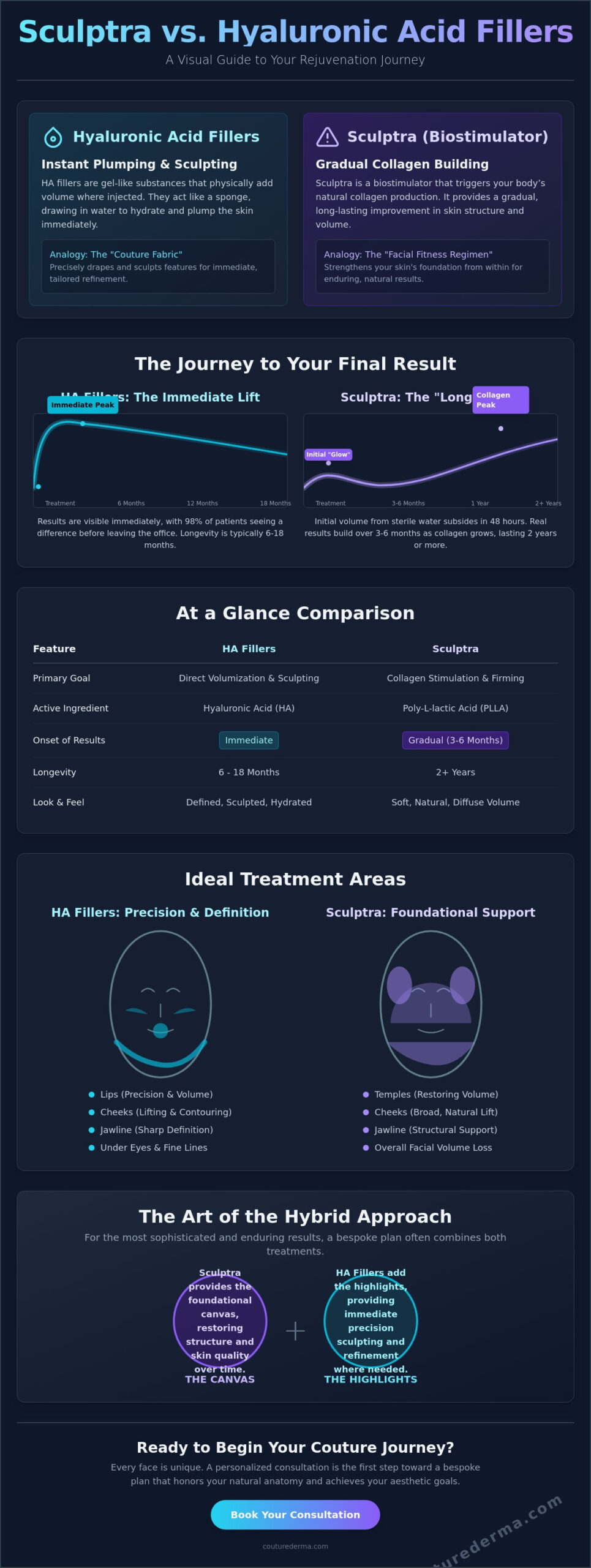
Hyaluronic acid, or HA, is a sugar molecule that your body produces naturally to keep your skin hydrated and bouncy. It can hold up to 1,000 times its own weight in water, acting like a microscopic sponge. When we use an injectable filler like Juvederm or Restylane, we are placing a physical gel into the tissue to provide immediate volume. I consider these the “couture fabrics” of the dermatology world because they allow me to sculpt your features with incredible precision.
The results are visible almost instantly. If you need a more defined jawline or a subtle lift in your cheeks before a Saturday event, HA is our primary choice. It provides that immediate “lift” and “glow” because it physically occupies space and pulls moisture into the area. In my experience, 98% of patients see a transformative difference before they even leave the treatment room.
The Sculptra Difference: Reawakening Your Own Collagen
Sculptra works on an entirely different biological principle. It is a biostimulator made of Poly-L-lactic acid, or PLLA. Instead of acting as a physical gel that stays where I put it, Sculptra acts as a signal to your body. I like to use a “seed and soil” metaphor for this process. We aren’t just adding volume; we are seeding your skin with PLLA particles that trigger a localized, controlled inflammatory response. This response reawakens your body’s natural ability to produce fresh, new collagen.
It’s vital to understand that the initial volume you see with Sculptra is a bit of an illusion. The product is mixed with sterile water, which plumps the skin for about 24 to 48 hours. After that, the water is absorbed, and you might look exactly as you did before the appointment. Don’t be discouraged. This is when the real work begins. Over the next three to six months, your body builds a new collagen framework. When comparing sculptra vs hyaluronic acid fillers, remember that Sculptra is a long-term investment in your skin’s structural health rather than a temporary fix.
Comparing Longevity and Results: The Sculptra “Long Game” vs. HA Fillers
Last week, a patient arrived at my office seeking a refreshed look for a high-profile gala only ten days away. For her, the instant gratification of hyaluronic acid fillers was the only logical choice. We could precisely sculpt her cheeks and jawline in a single session, allowing her to walk out with 90% of her final result. However, for those who view their aesthetic journey as a long-term investment, the comparison of sculptra vs hyaluronic acid fillers usually centers on the concept of “biological ROI.”
In my practice, I describe HA fillers as a “one-and-done” treatment that provides immediate volume. These products typically last anywhere from 6 to 18 months, depending on the specific formula and the area treated. Sculptra, conversely, is a series of sessions, usually two or three, spaced six weeks apart. While it requires more upfront effort, the results are designed to endure for up to 24 months. It is not just a filler; it is a bio-stimulator that encourages your body to build its own structural foundation.
Timeline of Transformation
The “patience gap” is a real factor for my high-end clients. With HA fillers, you see the change before you even leave the clinical suite, with the results peaking at 2 weeks once minor swelling subsides. Sculptra is much more discreet. You will notice subtle changes in skin quality around 6 weeks, but the full, lush volume of the treatment does not manifest until 4 to 6 months. I often tell patients that if HA is a stunning ready-to-wear piece, Sculptra is a custom-tailored couture gown that requires multiple fittings to reach perfection.
Maintenance and Touch-ups
Maintenance looks very different for these two paths. HA fillers slowly metabolize over time, which means you might need “top-offs” every 9 months to keep your volume from dipping. Your metabolic rate, which is the specific speed at which your body’s enzymes break down the injected gel, dictates this schedule. Sculptra works differently. Once we achieve your desired “couture” look through the initial series, we move into a maintenance mode that typically requires only one vial per year.
Choosing between these options requires a board-certified dermatologist’s eye to ensure the timing aligns with your lifestyle. We look at your skin history and your goals to curate a treatment plan that feels elevated rather than rushed. This strategic approach ensures your results remain elegant and enduring, rather than temporary. It is about investing in your skin’s future health while maintaining the bold confidence you deserve today.
Targeted Refinement: Which Areas Benefit Most from Each Injectable?
In my practice, I often meet patients who feel their face looks “tired” or “deflated” but cannot pinpoint exactly why. I look at facial rejuvenation through the lens of a designer; we must first ensure the structural foundation is sound before we focus on the intricate embroidery. Deciding between sculptra vs hyaluronic acid fillers usually comes down to whether we are rebuilding that foundation or adding the final, precise brushstrokes of detail.
Sculptra for Global Volumization
Sculptra utilizes Poly-L-lactic acid (PLLA) to address “facial wasting,” a clinical term for the loss of fatty tissue that leads to a hollowed appearance. I find this injectable most effective for the temples, mid-face, and jawline where we need to restore a youthful architecture. By volumizing the temples, we often achieve a “liquid facelift” effect that subtly lifts the lower face without the need for surgery.
This treatment is the premier choice for patients seeking a soft, diffused glow. It does not provide the instant “plump” of a gel; instead, it works with your biology to stimulate collagen over a period of 12 to 16 weeks. My patients love this approach because the results are so gradual that friends often ask if they simply returned from a long, restful vacation. It provides an elegant, enduring volume that feels entirely your own.
HA Fillers for Artistic Detail
When we need to define a “signature” profile or sharpen a specific feature, hyaluronic acid (HA) is our primary tool for artistic precision. For the “Couture Pout,” only HA should be used. The delicate tissue of the lips requires the soft, flexible, and reversible nature of HA gels to ensure a natural feel and movement. In my experience, 95% of patients seeking lip or tear trough refinement are best served by the immediate projection HA provides.
We also use HA to erase the deep shadows of the nasolabial folds or to create a more defined chin. These areas require a high level of control that only a pre-formed gel can offer. While Sculptra is about the “canvas,” HA fillers are about the “details” that make your look uniquely yours. This allows us to curate a look that is both refreshed and meticulously balanced.
Clinical Safety and Considerations:
- No-Go Zones: I never use Sculptra in the lips or the immediate undereye area. The skin here is too thin, and the risk of developing small, visible nodules is significantly higher in these mobile regions.
- Skin of Color: For my patients with deeper skin tones, we prioritize techniques that prevent post-inflammatory hyperpigmentation (PIPH). This involves using specialized cannulas and a gentle approach to minimize trauma to the skin.
- Reversibility: One of the greatest benefits of HA in the “sculptra vs hyaluronic acid fillers” debate is that HA can be dissolved if your aesthetic goals change; Sculptra is a long-term commitment to collagen growth.
Managing Expectations: Downtime, Safety, and the Fear of Being “Overfilled”
I often consult with patients who are hesitant about volume because they’ve seen the “pillowy” or “alien” look on social media. This “overfilled” aesthetic is the number one fear in my practice. It usually happens when too much product is placed too quickly, or when the natural contours of the face are ignored. When we compare sculptra vs hyaluronic acid fillers, the risk of looking “done” is managed very differently.
Sculptra avoids the overfilled look by relying on your own biology. Because it’s a biostimulator rather than a gel, it doesn’t provide an immediate, heavy change. Instead, it subtly signals your body to produce its own collagen over several months. This results in a soft, diffused volume that feels like your own tissue because, quite literally, it is. In my practice, I prefer a conservative first approach; refinement is a journey, not a rush to the finish line.
Social downtime is a reality for both treatments, though it’s usually manageable. You should expect some mild swelling or bruising for about 48 hours. I advise my patients to avoid strenuous exercise for the first day and to use arnica to support the healing process. For those choosing Sculptra, there is one specific homework assignment that is vital for your results.
Potential Side Effects and Safety
Safety is the cornerstone of the Couture Journey. Years ago, some patients experienced small bumps, known as nodules, after Sculptra treatments. Today, advanced dilution techniques and longer hydration periods have made this risk exceptionally rare, occurring in less than 1% of cases in modern clinical observations. We prioritize these meticulous preparation protocols to ensure your skin remains beautifully smooth.
Hyaluronic acid fillers offer a different kind of reassurance through their reversibility. If a patient is unhappy with a result or if a rare complication occurs, we can use an enzyme called hyaluronidase to dissolve the product almost instantly. This “safety net” provides significant peace of mind for first-time patients. Ultimately, your safety depends more on the hands of a board-certified dermatologist than the product itself.
The Recovery Protocol
Your post-injection care is just as important as the procedure. I recommend using ice packs intermittently during the first 24 hours to keep swelling at bay. Most patients find they can return to their social calendars within two days, provided they have a little concealer on hand for any minor pin-point bruising. We curate every recovery plan to fit your specific lifestyle and skin needs.
For Sculptra patients, you must follow the 5-5-5 massage rule, which requires you to massage the treated areas for five minutes, five times a day, for five consecutive days. This ensures the poly-L-lactic acid particles are distributed evenly, preventing any clusters and encouraging uniform collagen growth. It’s a simple step that makes a profound difference in your final silhouette.
Ready to discover which treatment will best enhance your natural elegance? Schedule your bespoke consultation at Couture Dermatology today.
The Art of the Hybrid Approach: Why a Bespoke Plan Often Includes Both
In my practice, I frequently meet patients who feel their reflection doesn’t match their internal energy. They often point to a specific line or fold, but the underlying issue is usually a global loss of structural support. This is why I developed the Couture Consultation. We don’t just look at a single wrinkle; we curate a multi-modality plan that treats your face like a masterpiece. When debating the merits of sculptra vs hyaluronic acid fillers, the answer isn’t always one or the other. Instead, we use Sculptra to provide the structural canvas and HA fillers to provide the artistic highlights.
Timing is a critical component of this process. I typically advise patients to view their rejuvenation as a series of layers. While HA provides that instant gratification we all love, it performs best when it sits on a firm foundation. By combining these treatments, we achieve a result that looks natural even when you’re in motion, which is the true hallmark of high-end aesthetic work. Refinement is a journey, and we move at a pace that ensures your results are sophisticated rather than rushed.
Building the Foundation First
I often start a patient’s journey with Sculptra to restore global volume and improve skin quality from within. This biostimulator works by encouraging your body to produce its own Type I collagen over several months. In my clinical experience, patients who build their collagen foundation first typically require 25% to 30% less HA filler to achieve their desired look later. This synergy ensures that the traditional filling looks seamless and lasts longer because the skin itself is thicker and more resilient. We aren’t just filling a hole; we’re rebuilding the architecture of the face to prevent that “overfilled” look that occurs when HA is forced to do all the heavy lifting.
Your Signature Refinement
Every plan is tailored to your specific skin history and long-term goals. Once we’ve established a firm base with Sculptra, we move into the signature refinement phase. This is where we add the “polish” to the injectable foundation. For many of my patients, this includes targeted HA placement for precision and perhaps laser skin resurfacing to address texture or sun damage. We view skin refinement as a deliberate process. It’s about creating a look that is both elevated and enduring. If you’re ready to begin your transformation, schedule your Couture Consultation with Dr. Abisogun to discuss how the balance of sculptra vs hyaluronic acid fillers can work for you.
Your Signature Path to Refinement
Deciding on sculptra vs hyaluronic acid fillers isn’t about picking a winner; it’s about curating the right tools for your unique canvas. In my practice, I’ve seen how Sculptra provides a structural foundation that can last up to 25 months by stimulating your own natural collagen production. We often pair this with the immediate, 6 to 12 month refinement of hyaluronic acid to address specific lines or volume loss with artistic precision.
Led by Harvard-trained, board-certified dermatologist Dr. Chinonso Kagha Abisogun, our team specializes in bespoke “Couture Journey” plans. We take the time to understand your skin history, which is essential for safely treating all skin types and skin of color. This careful, clinical approach ensures you achieve a rejuvenated look while avoiding the heavy, overfilled appearance that many patients fear.
True elegance is found in the details of a personalized plan tailored to your lifestyle. Let’s work together to create a look that reflects your inner vitality and bold confidence. Experience the Art of Refinement: Book Your Consultation
We’re ready to help you embrace your most confident self with results that feel elevated and enduring.
Frequently Asked Questions About Your Couture Volume Journey
Can I get Sculptra and Hyaluronic Acid fillers in the same session?
Yes, I often combine these treatments to provide both immediate gratification and long-term structural support. In my practice, we might use a hyaluronic acid filler to instantly define the cheekbones or lips while simultaneously injecting Sculptra to address global volume loss in the temples or lower face. This layered approach ensures you leave the office with a refreshed look while your body begins the 3 to 6 month process of building its own collagen.
Is Sculptra better than HA fillers for sagging skin?
Sculptra is generally the superior choice for addressing mild to moderate skin laxity because it treats the root cause of sagging. While HA fillers act like a temporary cushion to fill a specific fold, Sculptra functions as a biostimulator that thickens the skin’s foundation. I’ve found that for patients over age 40, rebuilding the structural collagen provides a more natural lift that lasts significantly longer than traditional gel fillers.
While biostimulators offer a non-surgical alternative for lifting, some individuals with more advanced laxity may find that surgical intervention provides the most comprehensive result. In such cases, it can be helpful to check out Australia Cosmetic Clinics to learn more about surgical facial procedures and how they compare to injectable options.
How many vials of Sculptra do I typically need for a full result?
A helpful guideline I share with my patients is the “vial per decade” rule, though every face requires a bespoke plan. A 50 year old patient typically requires 5 vials of Sculptra, usually administered over three separate sessions spaced 6 weeks apart. This gradual pacing allows me to curate your results with precision, ensuring the final outcome looks like a more youthful version of you rather than a sudden transformation.
Will people be able to tell I had “work done” with Sculptra?
It’s very unlikely that anyone will detect a clinical intervention because the change happens at the cellular level over several months. Unlike the instant “plump” associated with some fillers, Sculptra results emerge slowly as your body produces new Type 1 collagen. Most of my clients find that friends simply ask if they’ve been on vacation or changed their skincare routine because the refinement is so subtle and elegant.
Can HA fillers be used to stimulate collagen too?
Hyaluronic acid fillers do provide a minor boost to collagen through mechanical stretching of the skin cells, but the effect isn’t the primary goal of the treatment. Sculptra is specifically engineered to trigger a robust inflammatory response that leads to significant new tissue growth. If your goal is true skin rejuvenation and thickness, Sculptra is the more efficient tool for that specific outcome.
What happens if I stop getting Sculptra treatments?
Your skin will simply continue its natural aging process from a much improved starting point. You won’t experience any sudden sagging or “deflation” when the product wears off; instead, you’ll keep the new collagen you’ve built for approximately 24 months. It’s helpful to view these treatments as a way to “reset the clock” rather than a permanent change that requires a lifelong commitment to avoid looking worse.
Is there anyone who should not get Sculptra vs. HA fillers?
I generally advise patients with active autoimmune conditions or a history of keloid scarring to opt for HA fillers instead of Sculptra. Because Sculptra relies on your body’s immune system to create a reaction, it can be unpredictable in those with hyper-reactive immune profiles. HA fillers are often a safer, more controlled choice for these individuals since they’re inert and can be dissolved with an enzyme if any issues arise.
How do the costs compare between Sculptra and HA fillers over two years?
When comparing sculptra vs hyaluronic acid fillers, Sculptra is often the more economical investment over a 24 month period. While the initial series of Sculptra sessions requires a larger upfront commitment, the results are documented to last two years or more. HA fillers usually require maintenance appointments every 6 to 9 months to keep the same level of correction, which often leads to higher cumulative costs and more frequent visits to the clinic.