
Discovering an unexpected growth on your skin can spark a wave of concern, quickly followed by a search for answers that often leaves you more confused than comforted. Is it harmful? Is it contagious? This uncertainty frequently distills into one essential question: am I dealing with a skin tag vs wart? The distinction is crucial, not just for your peace of mind, but for determining the most appropriate and effective path forward for your skin’s health and elegance.
At Couture Dermatology, we believe that clarity is the first step toward bold confidence. In this definitive guide, our board-certified dermatologist demystifies these common growths, providing the expert insight you deserve. We will guide you through their unique causes, appearances, and textures, empowering you to understand your skin on a deeper level. Consider this your first step on a journey to reassurance, learning about the refined, safe, and effective removal options that can restore your skin’s beautifully smooth finish.
Key Takeaways
- Understand the fundamental distinction: skin tags arise from friction, while warts are the result of a viral infection.
- Learn to identify key visual cues, from the soft, stalk-like shape of a skin tag to the firm, rough texture of a wart.
- Move beyond guesswork in the skin tag vs wart debate by recognizing how each growth feels to the touch and where it typically appears.
- Discover the elegant, professional removal options available and learn when a dermatologist’s diagnosis is essential for your peace of mind.
At First Glance: A Visual Guide to Skin Tags and Warts
Discovering a new growth on your skin can be unsettling, and it is a common experience to feel uncertain when differentiating between two of the most frequent benign lesions. The distinction in the skin tag vs wart debate, however, is quite clear once you understand their unique characteristics. While both are typically harmless, their origins and behaviors are entirely different. This guide is curated to bring you clarity and peace of mind, empowering you with the knowledge to understand your skin’s journey.
For a closer look at the characteristics of a skin tag, our experts recommend this insightful overview:
Quick Comparison Table: Skin Tag vs. Wart
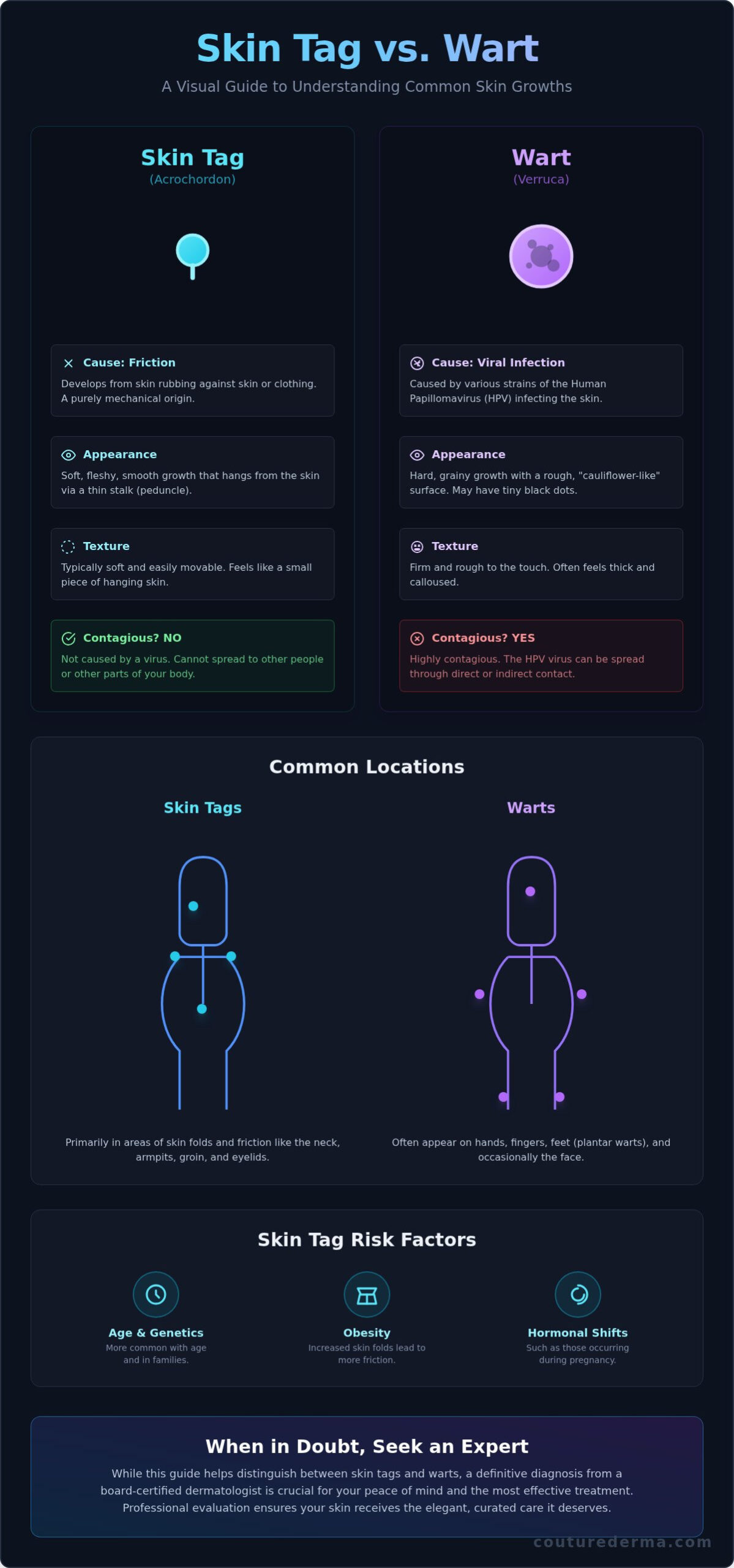
| Feature | Skin Tag (Acrochordon) | Wart (Verruca) |
|---|---|---|
| Cause | Skin friction | Human Papillomavirus (HPV) |
| Appearance | Soft, fleshy, connected by a stalk | Hard, rough, grainy, “cauliflower-like” |
| Location | Skin folds (neck, armpits, groin) | Hands, fingers, feet, face |
| Contagious? | No | Yes, highly |
What Is a Skin Tag (Acrochordon)?
A skin tag, known clinically as an acrochordon, is a soft, noncancerous growth that gently hangs from the skin. It is connected by a delicate stalk called a peduncle and often resembles a tiny, deflated balloon. Typically matching your skin tone or appearing slightly darker, these growths are born from friction and most often grace areas where skin rubs against skin-such as the elegant lines of the neck, under the arms, within the groin, or even on the eyelids.
What Is a Wart (Verruca)?
In contrast, a wart, or verruca, presents as a much firmer, rougher growth. Its signature grainy, “cauliflower-like” surface is a direct result of its origins; this distinct texture is a hallmark of the viral infection cause of warts, specifically certain strains of the human papillomavirus (HPV). You may also notice tiny black dots, which are simply clotted blood vessels. Warts commonly appear on the hands, fingers, and the soles of the feet.
The Underlying Cause: Friction vs. Viral Infection
To truly understand the skin tag vs wart distinction, we must look beyond the surface to their fundamental origins. One is a story of simple mechanical stress; the other, a more complex narrative of a viral infection. This core difference is not merely academic-it is the very foundation upon which we curate an effective and elegant treatment plan, guiding your journey toward clear, refined skin.
How Skin Tags Form: A Matter of Friction
Skin tags, known medically as acrochordons, are best understood as small, soft outpouchings of your own skin. They are harmless collections of collagen fibers and blood vessels that develop in response to persistent friction. You will most often find them in areas where skin gracefully folds or rubs against itself or clothing, such as the neck, underarms, groin, and eyelids. While certain factors can make them more likely to appear, their cause is purely mechanical. Common risk factors include:
- Age and genetics
- Obesity or weight gain
- Hormonal shifts, such as during pregnancy
It is essential to know that skin tags are entirely benign. They are not contagious to others and will not spread on your own body.
The Viral Origin of Warts: Understanding HPV
In elegant contrast, warts have a biological, internal origin. These growths are caused by various strains of the human papillomavirus (HPV), an infection within the skin itself. The virus finds entry through minuscule cuts or breaks in your skin’s protective barrier, prompting the rapid, abnormal growth of cells that forms the rough texture of a wart. This viral foundation explains why warts are contagious and can spread both to other people and to different parts of your own body through contact. Because their appearance can sometimes mimic other conditions, a professional dermatologist diagnosis for warts is essential for a safe and effective treatment journey. We offer the reassuring clarity that the HPV strains causing common skin warts are different from those associated with more serious medical conditions, allowing us to focus solely on restoring your skin’s beautifully smooth finish.
A Deeper Comparison: Texture, Location, and Sensation
To truly understand the difference between a skin tag and a wart, we must move beyond a simple glance and engage our sense of touch. The story of each growth is told not just in how it looks, but in how it feels, where it chooses to reside on the body’s canvas, and the sensations it elicits. This discerning approach is central to a couture-level diagnosis and the first step toward achieving flawless skin refinement.
Feel and Appearance: Soft and Smooth vs. Hard and Rough
A skin tag, or acrochordon, typically feels soft, pliable, and smooth. It is attached to the skin by a thin stalk (a peduncle) and can be moved or wiggled quite easily. Imagine a tiny, deflated balloon of skin. A wart, in contrast, is firm, hard, and often has a rough, hyperkeratotic surface that can feel like sandpaper or even resemble a tiny cauliflower. While this distinction is often clear, some growths, like filiform warts, can project from the skin on stalks, mimicking a skin tag. This is precisely why an expert, artistic eye is invaluable for an accurate diagnosis.
Common Locations on the Body
Location provides another elegant clue in the skin tag vs wart mystery. Skin tags are creatures of friction. They flourish in areas where skin frequently rubs against skin or clothing, such as:
- The neck and collar area
- Armpits (axillae)
- The groin
- Under the breasts
- On the eyelids
Warts, however, are caused by the human papillomavirus (HPV) and can appear anywhere the virus finds an entry point, often through a small cut. They are most commonly found on the hands, fingers, face, and the soles of the feet (plantar warts), where exposure to the virus is more frequent.
Pain and Discomfort Levels
For the most part, skin tags are asymptomatic and painless. Discomfort only arises when they are repeatedly irritated by jewelry or clothing, or if the stalk becomes twisted, cutting off its blood supply. Should this occur, exploring professional skin tag removal and treatment ensures a safe and aesthetically pleasing result. Warts can be more unpredictable. While many are simply a cosmetic concern, they can become tender to the touch. Plantar warts, located on the pressure-bearing soles of the feet, are notorious for causing significant pain with every step, feeling like a stone in your shoe.
When to Seek a Dermatologist’s Expertise: The Couture Approach to Diagnosis
While understanding the general differences between skin growths is an empowering first step, the journey to true skin confidence requires certainty. The primary concern for many is understandable: could this small spot be something more serious? This is where self-assessment reaches its limit and the value of a board-certified dermatologist becomes clear. A professional consultation isn’t just about getting an answer; it’s about beginning a bespoke journey to skin health, guided by an expert dedicated to your well-being.
Why Self-Diagnosis Isn’t Enough
An online search can offer possibilities, but it cannot provide a definitive diagnosis. Some serious conditions, including certain types of skin cancer, can masquerade as a harmless tag or wart. A dermatologist uses advanced tools, like a dermatoscope, to examine the growth’s underlying structure. This level of detail is crucial for an accurate assessment. Furthermore, incorrect self-treatment can lead to scarring, infection, or incomplete removal, which often results in the growth returning. Just as a dermatologist about acne can cut through conflicting advice to deliver a precise, science-backed plan, expert guidance on skin growths ensures you receive the most accurate and effective care.
Signs It’s Time to Schedule a Consultation
Your skin communicates its needs, and certain changes warrant immediate professional attention. We recommend scheduling a visit with us if a growth:
- Changes in color, size, or shape.
- Begins to bleed, itch, or cause pain.
- Is one of many new growths that have appeared in a short period.
- Is located in a cosmetically sensitive or bothersome area, such as your face, neck, or eyelids.
What to Expect During Your Appointment
Your consultation is the foundation of your couture-level care. It is a calm, unhurried experience where you feel seen and heard. We begin with a thorough examination of the growth in question and an overall assessment of your skin health. We will discuss your medical history, listen to your concerns, and answer every question. The result is a definitive diagnosis-ending the uncertainty of skin tag vs wart-and a curated treatment plan tailored to your unique skin, lifestyle, and aesthetic goals.
This is where clarity begins and confidence is built. Begin your journey to clear skin with a personalized consultation.
Treatment Paths: Curated Solutions for Flawless Skin
Once you have a professional diagnosis, the path to clear, unblemished skin becomes a matter of expert execution. While understanding the key differences in the skin tag vs wart debate is the first step, the final chapter is written with a bespoke treatment plan. The decision to remove these growths is often personal, driven by a desire for physical comfort or the pure elegance of a smooth, uniform skin texture. At Couture Dermatology, we view removal not as a mere procedure, but as an act of skin refinement.
Elegant Removal of Skin Tags
Skin tags, with their simple structure, respond beautifully to swift and precise in-office treatments. Our approach is designed for efficacy and comfort, with minimal interruption to your lifestyle. Your curated options include:
- Cryotherapy: A flash-freezing technique using liquid nitrogen to flawlessly remove the tag.
- Scissor Excision: A meticulous method where the tag is snipped away at its base with sterile, surgical precision.
- Electrocautery: The application of targeted heat to remove the growth and delicately seal the skin for a beautifully smooth finish.
Effective Treatments for Warts
Due to their viral nature, warts require a more strategic approach to ensure complete removal and prevent recurrence. Our treatments are rooted in advanced dermatologic science to deliver enduring results. We may recommend:
- Cryotherapy: A powerful freezing treatment that destroys the wart tissue and the underlying virus.
- Prescription Agents: Potent, professionally administered topical solutions, such as salicylic acid, that gently peel away the wart layers over time.
- Laser Treatment: An advanced therapy that uses focused light to target the blood vessels feeding the wart, effectively starving it.
Patience is key, as multiple sessions are often part of a thoughtful plan to achieve complete and lasting clearance.
The Dangers of At-Home Removal
We strongly advise against DIY removal kits and “home remedies.” The allure of a quick fix often leads to undesirable consequences that a professional can help you avoid. The risks are significant and can compromise the health and beauty of your skin:
- Permanent Scarring: Improper techniques can easily damage surrounding tissue, leaving a scar more noticeable than the original growth.
- Infection: Using non-sterile tools creates a high risk of introducing bacteria, leading to painful and serious skin infections.
- Incomplete Removal: Especially with warts, failing to remove the entire viral lesion will almost certainly result in regrowth.
- Misdiagnosis: Attempting to remove a growth that has not been professionally identified could mean ignoring a more serious skin condition.
Your skin deserves the certainty and artistry of expert care. Begin your journey toward beautifully refined skin by scheduling a consultation at couturederma.com, where every treatment is a step toward bold confidence.
Your Path to Flawless Skin Begins with Clarity
Understanding the distinction between these common growths is the first step toward skin refinement. While skin tags arise from simple friction and are typically soft and suspended, warts are caused by a viral infection, often presenting with a rougher, more embedded texture. Navigating the nuances of the skin tag vs wart debate on your own can be uncertain, but a professional diagnosis provides absolute clarity and peace of mind.
At Couture Dermatology in Beverly Hills, your skin’s health is our highest art. Under the guidance of Dr. Abisogun, a Harvard-trained, board-certified dermatologist, you will receive a definitive diagnosis and a bespoke treatment plan curated for your unique skin. We utilize advanced, precise removal technologies to ensure results that are both effective and elegant, restoring the smooth, clear canvas you deserve.
Schedule your personal consultation with Dr. Abisogun for a definitive diagnosis. Your couture journey to beautifully smooth skin and bold confidence starts here.
Frequently Asked Questions
Can a skin tag turn into a wart, or vice versa?
This is a common question, but we can reassure you that a skin tag cannot transform into a wart, nor can a wart become a skin tag. These two growths have entirely separate origins. A skin tag is a benign overgrowth of your own skin, while a wart is caused by the human papillomavirus (HPV). A precise diagnosis from a board-certified dermatologist is the essential first step in curating the correct treatment plan for your skin’s unique needs.
Are skin tags a sign of a more serious health problem like diabetes?
While skin tags themselves are harmless, their appearance can sometimes be associated with metabolic conditions like insulin resistance or diabetes. Think of it not as a direct sign, but as a subtle indicator that it may be wise to take a holistic view of your well-being. During your consultation, we consider all aspects of your health to ensure your skin journey is both beautiful and supportive of your overall vitality, and can advise if a check-in with your primary physician is recommended.
Do over-the-counter wart removal products actually work?
Over-the-counter solutions can offer some success for simple warts, but their results are often unpredictable and carry a risk of irritation, scarring, or incomplete removal. True skin refinement requires precision. For a beautifully smooth finish and to ensure the growth is treated effectively without harming surrounding tissue, we recommend a professional assessment. Our curated treatments provide a safer, more elegant, and enduring solution, tailored specifically to your skin for a flawless result.
If I have one wart, will I get more?
Because warts are caused by the contagious human papillomavirus (HPV), it is possible for them to spread to other areas of your body through direct contact. This is known as autoinoculation. Prompt and precise treatment is the most effective strategy to manage this. By addressing the initial wart with an expert-led approach, we can significantly reduce the likelihood of further spread, helping you maintain the clear, unblemished skin you deserve as part of your ongoing couture journey.
Is it possible to prevent skin tags or warts from forming?
While preventing skin tags, which are often linked to genetics and friction, can be challenging, you can take elegant steps to minimize wart formation. Since warts are viral, we advise mindful practices like wearing sandals in communal areas and avoiding contact with existing warts. Understanding the skin tag vs wart distinction is key, as it empowers you to take the most effective preventative measures for beautifully clear skin. For both, maintaining a healthy lifestyle is always beneficial.
Does insurance cover the removal of skin tags or warts?
Insurance coverage often depends on whether the removal is deemed a medical necessity or an aesthetic refinement. If a skin tag or wart is causing irritation, bleeding, or pain, it may be covered. However, removals performed for purely cosmetic reasons are typically not. Our dedicated client coordinators are happy to provide you with the necessary documentation and diagnostic codes to help you clarify your specific benefits with your insurance provider, ensuring your journey with us is seamless and transparent.