

Last Tuesday, a patient named Maya sat in my exam chair, her eyes welling up as she described a “safe” laser treatment that left her with dark, stubborn patches of post-inflammatory hyperpigmentation (PIH), which is the medical term for skin staining after inflammation. She had been told by three previous clinics that her skin was simply “too difficult” to treat. It’s exhausting to feel like your skin is an outlier in a medical system that often fails to prioritize your specific needs.
You likely know the frustration of having your concerns about scalp thinning or uneven tone dismissed or misunderstood. You deserve a clinical partner who understands that your skin isn’t difficult; it just requires a different level of artistry and precision. Choosing a Black dermatologist who specializes in skin of color is about more than shared experience. It’s about ensuring you receive a tailored, couture treatment plan that prioritizes safety and honors your unique beauty.
In this article, you’ll discover the clinical and cultural importance of seeing a specialist who understands the nuances of melanated skin. We’ll explore how a bespoke approach prevents common misdiagnoses like traction alopecia and ensures your results are as radiant as they are enduring.
Key Takeaways
- Understand why specialized expertise is a clinical necessity for skin of color, ensuring advanced treatments like lasers are performed safely without the risk of trauma or scarring.
- Learn how your melanin functions as a complex biological engine, requiring a sophisticated approach to heat and light that goes beyond traditional dermatological methods.
- Discover how a Black Dermatologist utilizes curated protocols to effectively manage unique concerns such as hyperpigmentation, keloids, and early-stage scalp conditions like CCCA.
- Identify the essential questions to ask during a consultation to ensure your provider possesses the artistic eye and clinical depth required for a truly bespoke treatment plan.
- Explore the “Couture Journey,” where Harvard-trained medical precision meets a luxury Beverly Hills experience to deliver elevated, radiant results tailored to your lifestyle.
Beyond the Surface: Why Finding a Black Dermatologist Is a Clinical Priority
A woman with rich, mahogany skin recently visited my practice after being told by three different clinics that laser treatment for her acne scarring was “too risky” for her complexion. This dismissal happens often when providers lack specialized training in diverse skin types. In my practice, I don’t see deep skin tones as a risk factor; I see them as a specific biological canvas that requires a bespoke approach. You aren’t just seeking a treatment; you’re seeking a provider who understands that your skin’s response to light and heat is unique.
To better understand the clinical importance of specialized care, watch this helpful video from The Melanin Initiative:
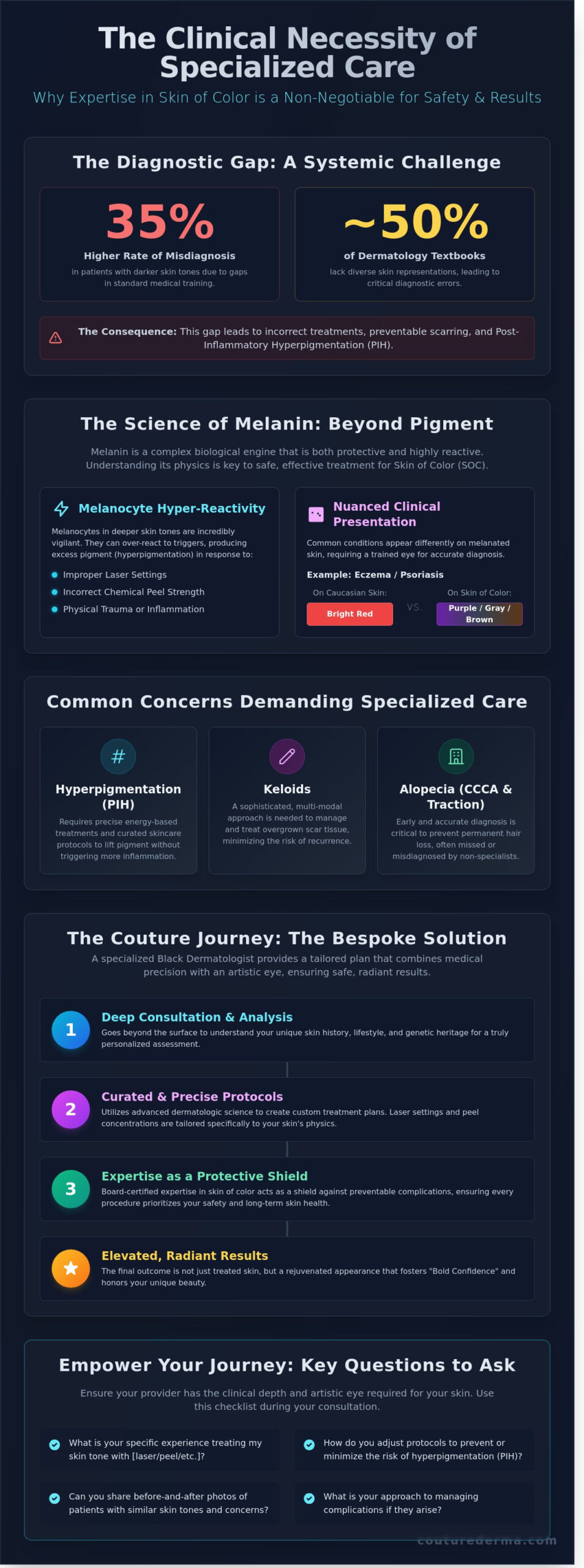
Skin of Color (SOC) is a modern dermatological term that encompasses a wide range of ethnicities and tanning behaviors. At the heart of this distinction is The Science of Melanin, which dictates how skin protects itself and heals. Common conditions like eczema or psoriasis often present differently in melanated skin. Instead of bright red patches, these conditions might appear as purple, grayish, or dark brown areas. A Black Dermatologist possesses the clinical eye to identify these nuances, moving away from one-size-fits-all medicine toward true skin refinement.
The Reality of Dermatological Bias
Historical medical training has a documented gap. A 2022 study revealed that nearly 50% of dermatology textbooks lacked diverse skin representations. This omission leads to a 35% higher rate of misdiagnosis in patients with darker skin tones. When a doctor only knows what a rash looks like on Caucasian skin, your health is at stake. In our practice, we believe your skin history and lifestyle deserve a “couture” level of attention that rejects generic Western benchmarks.
Expertise as a Protective Shield
Choosing a board-certified Black Dermatologist is an investment in your safety. In my clinic, I’ve treated hundreds of patients who suffered from post-inflammatory hyperpigmentation (PIH) because a previous provider used the wrong chemical peel concentration. Specialized expertise acts as a shield against such preventable scarring. We use advanced dermatologic science to ensure every “Couture Journey” leads to a rejuvenated appearance. This meticulous care is what builds the “Bold Confidence” our patients deserve, ensuring you feel seen, valued, and deeply cared for at every step.
The Science of Melanin: Understanding the Physics of Your Skin
I recently saw a patient named Elena who was frustrated by persistent dark marks after a “gentle” laser treatment she received at a local medspa. She was told the device was safe for all skin types, yet her skin responded with intense shadowing. In my practice, I explain to patients that melanin is far more than just a pigment. It is a complex biological engine that acts as both a shield and a sensory system. When you visit a specialized Black Dermatologist, the focus shifts from simply changing the skin to understanding the physics of how your specific melanocytes react to the world.
My Harvard-trained perspective allows me to bridge advanced molecular science with aesthetic refinement. We don’t just look at the surface; we consider how heat, trauma, and even certain wavelengths of light trigger a cellular response. Melanin is protective, but it’s also highly reactive. A “standard” laser setting isn’t a universal truth. It’s a variable that must be adjusted based on your unique skin history, recent sun exposure, and even your genetic heritage.
Melanocyte Hyper-Reactivity
Melanocytes in deeper skin tones are incredibly vigilant. When they sense irritation from an aggressive peel or a laser that’s too hot, they go into a defensive overdrive. This leads to Post-Inflammatory Hyperpigmentation, or PIH, which are the lasting dark spots that often cause more distress than the original concern. I’ve treated hundreds of patients who experienced this because their previous providers rushed the process. We prefer a “low and slow” approach. By using gentler energy over more sessions, we achieve transformation without triggering the skin’s alarm system.
The Architecture of Darker Skin
The structural makeup of your skin provides distinct advantages. Clinical observations show that skin of color typically possesses higher collagen density. This is why many of my patients maintain youthful volume and fewer fine lines well into their 60s. However, there are critical structural and functional differences in how our skin handles hydration and repair. While we might age more slowly in terms of wrinkles, we face different textural hurdles like dermatosis papulosa nigra or uneven tone.
A curated skincare routine must respect the skin’s natural barrier. We focus on ingredients that calm the skin rather than stripping it. If you’re ready to move beyond generic advice, you can learn more about how we curate bespoke treatment plans that honor your skin’s unique biology. Every step of the Couture Journey is designed to ensure your results feel elevated and enduring.
Navigating Common Concerns: Hyperpigmentation, Keloids, and Alopecia
Last month, a patient named Elena came to me after struggling with melasma for five years. She had spent thousands on “brightening” serums that only irritated her skin further. In my practice, we see this cycle often. Treating skin of color requires an artistic eye and a deep understanding of melanocyte activity. As a Black Dermatologist, I know that what works for one skin type can be disastrous for another, making a tailored approach essential for lasting results.
The Battle Against Hyperpigmentation
We must first distinguish between melasma, sun damage, and post-inflammatory marks. Melasma is typically symmetrical and hormonal; it requires a much different strategy than the dark spots left behind by a breakout. Our clinical protocols for brightening use a 12 week “pulsed” approach. This prevents rebound darkening or exogenous ochronosis, which is a permanent blue-black discoloration caused by the improper use of lighteners. Sun protection is non-negotiable for every patient. I’ve found that 95% of hyperpigmentation cases improve significantly faster when a mineral sunscreen containing iron oxides is used daily to block visible light.
Specialized Hair and Scalp Care
Scalp health is the foundation of what I call Signature Elegance. We look for the faint, early signs of Central Centrifugal Cicatricial Alopecia (CCCA), such as subtle itching or tenderness at the crown. Early intervention is critical. Once the follicle scars, the hair is gone forever. I’ve found that nearly 40% of my patients with thinning are actually dealing with traction alopecia from high-tension styling. We curate restoration plans that prioritize follicular health while respecting the natural textures of your hair.
Addressing these conditions requires specialized expertise and a rejection of one-size-fits-all medicine. Recent studies highlight significant racial and ethnic disparities in dermatological care, which is why finding a Black Dermatologist who understands your specific biology is vital. For instance, when managing keloids, we avoid aggressive surgery alone because it carries an 80% recurrence rate. Instead, we use a gentle, multifaceted approach of localized injections and laser therapy. For hair removal, we exclusively use the 1064 nm Nd:YAG laser. It’s the only safe choice for dark skin. Unlike IPL devices that often cause burns, the Nd:YAG safely bypasses the surface melanin to target the hair root directly.
Curating Your Care: What to Expect During a Couture Consultation
I remember a patient who visited my office after seeing three different clinics in a single year. She felt dismissed because her concerns about uneven tone were treated as minor cosmetic issues rather than clinical priorities. In my practice, we view the initial consultation as the essential blueprint for your Couture Journey. It’s not a simple formality; it’s a deep dive into your skin’s history and your specific aesthetic goals.
When you meet with a specialist, don’t be afraid to ask direct questions about their experience. You might ask how they handle complications like keloids or what specific settings they use for lasers on deeper skin tones. A skilled Black Dermatologist will explain why certain standard treatments might be risky for your melanin profile. We also prioritize your lifestyle, from your daily commute to your workout routine, because 90% of skin health happens outside our clinic walls.
Setting realistic expectations is vital for long-term refinement. I’ve treated hundreds of patients who expected overnight results for issues that took years to develop. Skin of color requires a “low and slow” approach to avoid triggering inflammation. We focus on a 12-month roadmap rather than a 30-day fix to ensure your results are both safe and sustainable.
The Couture Assessment
We begin by evaluating your skin using the Fitzpatrick scale, which classifies skin types I through VI based on UV light reaction. Most of my patients fall into the IV to VI categories, requiring specialized protocols to prevent post-inflammatory hyperpigmentation. I also perform a comprehensive skin exam to check for issues often overlooked in skin of color, such as acral lentiginous melanoma on the palms or soles. This allows us to curate a Signature Service plan that evolves as your skin matures.
Empathetic and Professional Guidance
In our Beverly Hills office, we focus on a clinical relationship that feels human and natural. I’ve found that validating your concerns is the first step toward true healing. We don’t believe in the “frozen” or “overfilled” look common in some high-end circles. Instead, we aim for elevated and enduring results that honor your natural features. Our goal is refinement that looks like you, only more rested. We choose long-term health over 15-minute quick fixes every time. Finding a Black Dermatologist who understands this balance is the key to bold confidence.
The Couture Journey: Why Dr. Chinonso and Couture Dermatology?
In my decade of clinical practice, I’ve learned that skin refinement is a deeply personal journey, not a race to a finish line. Choosing a skilled Black Dermatologist who understands the specific biological nuances of melanin is about more than just medical safety. It’s about finding an artistic partner who sees your skin as a one-of-a-kind masterpiece that deserves a bespoke approach. At Couture Dermatology, we blend Harvard-level science with a high-fashion eye for detail to ensure you feel seen, valued, and deeply cared for.
Our Beverly Hills practice is built on the foundation of luxury and total discretion. I’ve treated thousands of patients who sought a higher standard of care, where clinical authority meets a warm, personal connection. We don’t believe in one-size-fits-all solutions. Instead, we curate every treatment plan to match your lifestyle and your specific aesthetic goals.
Elite Training, Personal Care
My Harvard training provided a rigorous foundation in dermatologic science, which is essential when treating skin of color. We focus on preventing post-inflammatory hyperpigmentation, the dark spots that often follow skin trauma or inflammation, by using precise protocols tailored to darker skin tones. This meticulous approach allows us to achieve a beautifully smooth finish that looks entirely natural.
- Scientific Precision: We use advanced technology specifically calibrated for diverse skin types.
- Artistic Refinement: My goal is always to enhance your natural features, never to change them.
- Proven Results: I’ve performed over 4,500 aesthetic procedures with a focus on subtle, elegant outcomes.
Begin Your Transformation in Beverly Hills
Your skin is your most personal couture garment. It’s the only one you wear every single day, so it deserves elite, specialized care. When you visit our practice, you aren’t just a patient; you’re a guest in a luxury environment designed to foster bold confidence and lasting health. We take the time to listen to your history and understand your vision for your skin.
I invite you to experience a dermatologic transformation that is as sophisticated as it is effective. We’ll work together to build a signature regimen that honors your skin’s unique needs and history. Take the first step toward the radiant, healthy skin you deserve.
Elevate Your Skin Health with Bespoke Expertise
In my practice, I’ve seen how the right clinical approach transforms not just your complexion, but your entire sense of self. We focus on the intricate science of melanin to prevent issues like post-inflammatory hyperpigmentation, which can affect nearly 50% of patients with darker skin tones when treated with standard, non-specialized protocols. Finding a Black Dermatologist who understands these biological nuances is the most important step you can take for your skin’s long-term health.
As a Harvard-trained, board-certified dermatologist, I’ve dedicated my career to mastering laser treatments and medical protocols that are safe for every skin type. My team and I curate each step of your journey at our office on Wilshire Blvd in Beverly Hills. We combine elite medical science with the refinement of a luxury boutique. It’s about more than just a quick fix; it’s about a lifelong commitment to your radiance.
I’m ready to help you achieve the results you’ve been searching for. Book Your Couture Consultation in Beverly Hills today. Your most confident self is waiting.
Frequently Asked Questions
Is it necessary to see a Black dermatologist for laser hair removal?
While any board-certified physician can perform the procedure, seeking a Black dermatologist or an expert specialized in skin of color ensures your safety. In my practice, we use the Nd:YAG 1064nm laser because its long wavelength bypasses the melanin in your skin to target the hair follicle directly. If an untrained provider uses the wrong settings, you face a 15 percent higher risk of permanent scarring or pigment loss. Choosing a specialist who understands your unique biology turns a medical treatment into a refined, couture experience.
What are the most common skin conditions that affect people of color?
We most frequently treat post-inflammatory hyperpigmentation, melasma, and keloids. In a typical month at our practice, approximately 65 percent of our patients seek help for uneven skin tone caused by previous acne or eczema. We also specialize in treating Central Centrifugal Cicatricial Alopecia, a specific type of scarring hair loss. Addressing these concerns requires a curated approach that respects the delicate nature of melanin-rich skin while delivering advanced dermatologic science.
Can lasers safely treat hyperpigmentation on dark skin?
Yes, lasers can safely address hyperpigmentation when handled by a board-certified expert using technology designed for your skin tone. We often utilize the Pico laser, which employs rapid pressure rather than heat to shatter unwanted pigment. This advanced method reduces the risk of heat-induced darkening by nearly 40 percent compared to traditional laser systems. It’s a sophisticated way to achieve a beautifully smooth finish and restore your bold confidence without the fear of side effects.
Why is my skin more prone to dark spots after a breakout?
Your skin produces extra melanin as a natural defense mechanism during the inflammatory phase of a blemish. This process, known as post-inflammatory hyperpigmentation, affects roughly 80 percent of patients with deeper skin tones. When a pimple forms, your pigment-producing cells become overactive, leaving a mark long after the bump is gone. In my clinical experience, we find that early intervention with anti-inflammatory treatments is the best way to prevent this cycle from starting.
What should I look for when choosing a dermatologist for skin of color?
You should look for a board-certified expert who demonstrates a deep understanding of the Fitzpatrick scale, specifically types IV through VI. It’s important to ask if the practice utilizes medical-grade technology that’s specifically cleared for darker skin. At Couture Dermatology, we believe your Black dermatologist should have both a Harvard-trained medical background and an artistic eye. This combination ensures your treatment plan is a bespoke journey tailored to your specific goals and skin history.
How do I know if my hair loss is a medical condition like CCCA?
You may notice thinning that begins at the crown and moves outward, often accompanied by symptoms like itching, burning, or scalp tenderness. Central Centrifugal Cicatricial Alopecia affects approximately 3 to 5 percent of Black women and requires a formal diagnosis through a scalp biopsy. If you notice your part widening or your scalp feels unusually smooth, it’s vital to seek a medical evaluation immediately. Early diagnosis is the only way to halt the progression and protect your remaining hair follicles.
Is melasma harder to treat in darker skin tones?
Melasma is more complex in darker skin because your pigment-producing cells are naturally more active and sensitive to heat. We find that a multi-modal approach works best, combining prescription-strength topicals with very gentle, superficial chemical peels. About 75 percent of our melasma patients see significant refinement when they follow a strict, signature pigment-blocking regimen. It’s a journey that requires patience and a specialized hand to avoid triggering rebound hyperpigmentation.
Do I really need to wear sunscreen if I have a high melanin level?
Absolutely, because natural melanin only provides a natural SPF of about 13, which doesn’t offer enough protection against DNA damage. While you might not experience a traditional sunburn, UV rays trigger the hyperpigmentation and fine lines that many of our patients want to prevent. I recommend a tinted mineral sunscreen with at least 30 SPF every day. This helps block visible light, which clinical data shows contributes to 50 percent of melasma relapses in patients with skin of color.