
Just last week, a patient in my office preparing for her daughter’s wedding asked me the one question I hear almost daily: “Dr. Chinonso, how long will I really need to hide?” She wasn’t just asking about redness; she was voicing a deep-seated fear of a difficult, unpredictable recovery that could interfere with one of the most important moments of her life.
It’s a completely valid concern. The internet is filled with dramatic photos and conflicting advice, creating anxiety around what should be a transformative journey toward refined, radiant skin. That’s why I’ve curated this clinical timeline. My goal is to demystify the laser resurfacing recovery time by giving you the exact, day-by-day healing schedule we provide to our patients at Couture Dermatology, based on my experience as a Harvard-trained dermatologist.
In this guide, we’ll walk through what you can realistically expect from Day 1 to Day 14. I’ll also share the precise aftercare protocols we use to accelerate healing and ensure you emerge with the beautifully smooth finish you deserve. Beautiful skin, bold confidence.
Key Takeaways
- Learn to distinguish between your skin’s clinical healing and when you’ll feel “socially presentable” to confidently plan your schedule post-treatment.
- Follow a detailed, day-by-day clinical timeline to demystify the laser resurfacing recovery time and know exactly what to expect as your skin refines.
- Discover the “Golden Rule” of our couture post-care protocol, a simple technique proven to help moist wounds heal significantly faster than dry ones.
- Understand why a successful, predictable recovery is actually designed during your initial consultation, long before the laser treatment begins.
Navigating the Social Downtime of Laser Skin Resurfacing
In my Beverly Hills practice, the first question a patient asks about laser resurfacing is almost never about the technology itself. It’s about their life. “Doctor, how long will I have to hide?” they’ll ask, calendar in hand. They want to know exactly when they can return to board meetings, charity luncheons, and family photos without feeling self-conscious. This concern is completely valid; planning for a period of social retreat is just as critical as the treatment itself.
To help you visualize this journey of skin refinement, the video below offers a clear day-by-day look at the healing process after a CO2 laser treatment.
Understanding the laser resurfacing recovery time begins with recognizing that “downtime” isn’t a single, fixed number. It’s a personal timeline influenced by the intensity of your treatment, your skin’s unique healing capacity, and your personal comfort level with being seen during the recovery stages. Clinically, laser recovery time is the period required for the epidermis to re-epithelialize and for initial erythema, or redness, to subside. But for my patients, the more practical definition is when they feel confident facing the world again.
The Patient Scenario: Planning for the Big Event
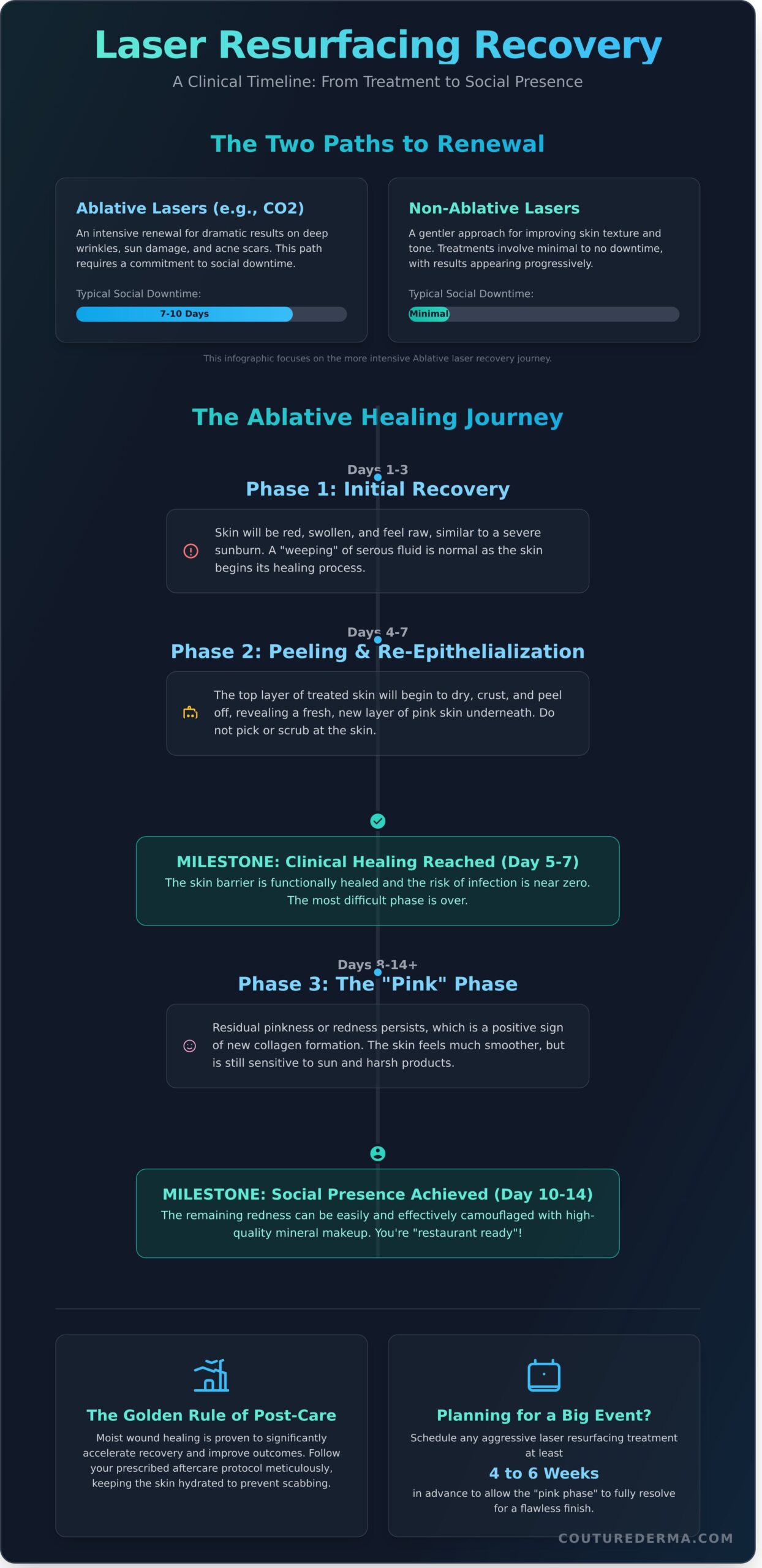
If you have a significant event like a wedding or a gala on the horizon, I advise scheduling any aggressive resurfacing treatment at least four to six weeks prior. The initial healing, which involves peeling and crusting, is typically over within 7 to 10 days. However, what follows is the “pink phase,” a period of residual pinkness or redness that can linger for several weeks. While this is a positive sign of new collagen formation, it’s also a tell-tale sign of a recent procedure. We must also manage the psychological aspect of recovery; it’s a journey where your skin will look worse before it reveals its stunning, refined results.
Clinical Healing vs. Social Presence
It’s crucial to distinguish between the two key milestones of your recovery. These are separate phases, and understanding them helps set realistic expectations for your social calendar. The fundamental technology behind this process is fascinating; The Science of Healing with light energy allows us to trigger this incredible regenerative response in the skin.
- Clinical Healing: This is when your skin barrier is functionally healed. The top layer has fully regrown, you are no longer weeping or raw, and the risk of infection has dropped to near zero. For most of my patients, this milestone is reached between days 5 and 7.
- Social Presence: This is when you feel “restaurant ready.” The residual redness has faded to a point where it can be easily and effectively camouflaged with a high-quality mineral makeup. This point varies, but many patients feel confident by day 10 to 14.
The good news is that modern fractional lasers, which treat the skin in a pixelated pattern, have significantly compressed the overall laser resurfacing recovery time compared to the fully ablative lasers of the past. This couture-level technology allows us to achieve dramatic results with a much more manageable and predictable period of social downtime.
The Science of Healing: Ablative vs. Non-Ablative Recovery Paths
At its core, every laser treatment is a dialogue with your skin. We create a highly controlled, precise micro-injury to awaken your body’s most powerful repair mechanisms. Think of it as commissioning a couture-level restoration. This process signals your cells to produce fresh collagen and elastin, rebuilding the skin from within for a beautifully smooth finish.
The path this restoration takes, however, depends entirely on the type of laser we choose. This choice is the single most important factor determining your laser resurfacing recovery time and overall experience. The two primary paths are ablative and non-ablative, and they couldn’t be more different.
CO2 and Erbium: The Intensive Renewal Path
For a dramatic transformation of deep-set wrinkles, significant sun damage, or atrophic acne scarring, a fully ablative laser like the CO2 remains our gold standard. But this level of renewal requires a commitment. In my practice, we advise patients to plan for 7 to 10 days of true social downtime.
The first 48 hours are the most intense. Because we’ve removed the outermost layer of skin (the epidermis), your skin will “weep” a clear fluid called serous fluid. This is a normal, healthy part of the healing cascade. It requires diligent aftercare with specific ointments to create a protective barrier while new skin forms. For many patients, successfully Navigating Social Downtime is about being mentally and logistically prepared for this specific experience.
Erbium lasers offer a slightly gentler ablative path. They are excellent for more superficial texture concerns and typically involve a shorter healing period of 5 to 7 days, with less weeping and redness than a CO2 treatment.
Fractional Non-Ablative: The Weekend Refinement
What if you need visible improvement without the intensive downtime? This is where fractional non-ablative lasers like Fraxel or Clear + Brilliant truly shine. Instead of treating 100% of the surface, these devices create thousands of microscopic thermal columns deep in the skin, leaving the surrounding tissue completely untouched.
These “bridges” of healthy skin accelerate the healing process dramatically. Around day three post-treatment, you’ll likely feel a distinct “sandpaper” texture. Don’t be alarmed; this is actually a fantastic sign. You’re feeling the MENDs (Microscopic Epidermal Necrotic Debris), which is the treated tissue being pushed out and replaced by healthy, new cells below.
This efficient process is why I often recommend it for my busy professional clients. You can have the treatment on a Friday and, with only 48 to 72 hours of mild redness and swelling, be ready for your Monday morning meetings looking refreshed and luminous.
Regardless of the path, both laser types use thermal energy to achieve their long-term goals. This heat is the primary trigger for new collagen production, the process that firms and smooths your skin over the next 3 to 6 months. It’s also why you might experience some prolonged pinkness. This isn’t a complication; it’s a visible sign that your skin is actively rebuilding. The choice between an intensive renewal and a weekend refinement is deeply personal, and it’s a conversation we curate during every initial skin consultation.
A Day-by-Day Journey: From Treatment to Skin Refinement
I’ve treated hundreds of patients, and I can tell you that the most common source of anxiety during recovery isn’t pain; it’s the unknown. Knowing the daily milestones and what to expect transforms the experience from a source of stress into a fascinating process of renewal. Your journey is unique, but it generally follows a predictable path of healing. Think of it in three distinct acts: the initial inflammation, the shedding of old skin, and the final reveal of your refined complexion.
The total laser resurfacing recovery time can vary based on the intensity of your treatment, but this day-by-day guide will give you a clear roadmap for the crucial first two weeks.
The First 48 Hours: Managing Inflammation
Immediately after your procedure, your skin will feel hot, tight, and look intensely red, much like a significant sunburn. This is the body’s natural inflammatory response, and our goal is to manage it for your comfort. I always recommend my patients sleep with their head elevated on two or three pillows for the first two nights. This simple step uses gravity to dramatically reduce the swelling you’ll likely see in the morning. Cold compresses will be your best friend, but never apply ice directly to your fragile, treated skin. Instead, use soft gel packs wrapped in a clean, thin towel for 15 minutes at a time. You may also notice some “oozing” of a clear or yellowish fluid. This is serous fluid, a normal part of healing. However, if you see thick, opaque pus or notice a foul odor, it’s a sign to call our office immediately.
The Peeling Phase: Resisting the Urge to Pick
Around day three, you’ll enter the “bronzing” phase. Your skin may develop a grid-like pattern and a dark, flaky texture as the treated layers prepare to shed. The urge to pick or scrub these flakes away can be intense, but you must resist. Forcing the skin to peel before it’s ready can tear the delicate new tissue forming underneath, leading to permanent scarring and post-inflammatory hyperpigmentation (PIH). Instead, we teach a gentle “soaking” technique. Using a sterile gauze or a very soft cloth with the cleansing solution we provide, you can gently press and hold against the skin to soften the flakes, allowing them to release naturally. This is also when we typically transition you from a heavy, occlusive ointment to a lighter, breathable barrier cream rich in ceramides to support the new skin. This general timeline is also outlined in resources like the Mayo Clinic’s guide to laser resurfacing recovery, which provides a helpful overview of the healing stages.
Special Considerations for Skin of Color
At Couture Dermatology, our expertise in treating diverse skin tones is central to our philosophy. For patients with melanin-rich skin, the laser resurfacing recovery time isn’t just about healing; it’s about meticulously preventing hyperpigmentation. In my practice, we curate a pre-conditioning protocol for 4-6 weeks before the laser treatment, often using a topical like hydroquinone or a retinoid. This protocol works to temporarily “quiet” your melanocytes, the cells that produce pigment, making them less likely to overreact to the laser’s energy. During recovery, our focus remains on preventing PIH. We also utilize what we believe will be the gold standard by 2026 for laser safety in skin of color: low-energy, multi-pass techniques that deliver heat more gently, ensuring a safe, effective, and beautifully even result.
Elevating Your Recovery: The Couture Post-Care Protocol
Following a laser resurfacing treatment, your skin’s journey is only just beginning. True refinement isn’t achieved by the laser alone; it’s realized in the days and weeks that follow. Think of recovery not as passive waiting, but as an active, curated process of skin nourishment. The protocol we design for you is as bespoke as the treatment itself, created to support your skin’s architecture as it rebuilds, stronger and more luminous than before.
The single most important principle of this phase is what I call the “Golden Rule” of occlusion. Based on landmark studies from the 1960s, we know that keeping the treated area consistently moist with a prescribed ointment helps new skin cells regenerate up to 50% faster than if the area were left to dry out and form a hard scab. This occlusive barrier creates the perfect environment for cellular migration, dramatically improving your outcome and reducing the overall laser resurfacing recovery time.
During the first 7 days, sun avoidance is non-negotiable. This is different from simply wearing sunscreen. Your new skin is exceptionally vulnerable and lacks its protective outer layer, making it susceptible to hyperpigmentation. Sunscreen, even mineral-based formulas, can be too irritating for this fragile stage. Your best defense is physical: stay indoors during peak hours and wear a wide-brimmed hat if you must go out. We will guide you on exactly when it’s safe to reintroduce a high-SPF, mineral-based sunscreen.
Finally, we press pause on all “active” skincare. Your beloved Vitamin C serums, retinoids (like Retin-A), and exfoliating acids (AHAs/BHAs) must be set aside until your skin barrier is fully restored, typically around the 10- to 14-day mark. Applying these potent ingredients too soon can cause intense inflammation, compromising your results and extending your healing period.
The Essentials: Cleansing and Hydration
Your skincare will be elegantly simple. We’ll have you switch to a gentle, non-foaming, pH-balanced cleanser that cleans without stripping away the lipids your skin desperately needs. Think of ceramides and fatty acids in your post-care moisturizer as the “mortar” holding your new skin cells, the “bricks,” together. For the intense, sunburn-like heat of the first 24 hours, I often prescribe specific thermal water mists to provide immediate, cooling relief.
Lifestyle Adjustments for Optimal Results
How you live directly impacts how you heal. We require you to avoid strenuous exercise, saunas, and hot yoga for at least one week. Inducing sweat can trap moisture under the new, delicate skin, leading to a “heat rash” known as miliaria or even blistering. Makeup is also off-limits until the initial peeling is complete, usually around day 7. When you are cleared, we exclusively recommend a high-quality mineral powder, as it’s breathable and far less irritating than liquid foundations. To support the healing from within, focus on hydration and protein intake, which provide the essential building blocks for the new collagen your body is working so hard to produce.
Your aftercare is the final, critical step in your treatment journey. To ensure your results are nothing short of spectacular, it’s vital that your protocol is tailored to your specific treatment and skin. If you are ready to begin your skin transformation, schedule a consultation to receive your personalized post-treatment plan and discover the couture difference.
Why Your Recovery Journey Starts with a Couture Consultation
Many patients believe that a successful recovery begins the moment the laser turns off. In my practice, we know the opposite is true. An elegant, predictable healing process isn’t an afterthought; it’s a result that is meticulously designed and “baked in” from our very first conversation. The quality of your outcome is directly tied to the quality of the plan we build together.
This is where my background becomes your greatest asset. My Harvard training wasn’t just about learning the science of lasers; it was about developing a framework for sophisticated problem-solving. We don’t just choose a laser; we select a precise energy level and depth tailored to your unique skin anatomy and, just as importantly, your lifestyle. A professional who needs to be on a Zoom call in five days requires a completely different strategy than a patient who can dedicate a full two weeks to healing at home.
We call this process “The Couture Journey.” It’s a truly collaborative approach where we map your treatment against your real-world obligations. Before a single pulse of light touches your skin, we’ll review your social and professional calendar. This deep understanding allows us to strategically plan your procedure, ensuring the required laser resurfacing recovery time aligns perfectly with your life, not the other way around.
Your journey doesn’t end when you leave our clinic. The first 72 hours are the most critical phase of healing, and you won’t be navigating them alone. We don’t just hand you a sheet of instructions and wish you well. Our team stays in constant contact, proactively checking in to answer questions, assess your progress, and provide the reassurance you need. It’s this level of attentive, personalized care that transforms a clinical procedure into a luxury experience.
Bespoke Treatment Mapping
In our practice, there are no “standard” settings. Your treatment is tailored to your skin’s specific thickness, pigment, and goals. We often integrate adjunctive therapies like Platelet-Rich Plasma (PRP), using your body’s own growth factors to potentially shave days off your laser resurfacing recovery time. We also prepare your skin for several weeks in advance with a curated skincare regimen, ensuring it’s in optimal condition for the most graceful healing process possible.
Your Signature Transformation Awaits
Laser resurfacing is more than a procedure; it’s an investment in your long-term confidence and the enduring health of your skin. The downtime is a temporary and necessary step on the path to profound refinement. Think of it not as an inconvenience, but as the quiet, focused time your skin needs to reveal its most radiant potential. The results are not just seen; they are felt for years to come.
Curate your transformation-schedule a consultation with Dr. Abisogun today.
Your Journey to Refined Skin Starts Here
The path to beautifully renewed skin is a predictable one when you know what to expect. We’ve seen that while an ablative laser might require 7 to 10 days of dedicated social downtime, a non-ablative treatment often allows a return to your schedule within 48 hours. The most crucial element, however, isn’t just the technology; it’s the meticulously planned post-care that follows.
Ultimately, your personal laser resurfacing recovery time is unique. It’s shaped by the laser we select and your skin’s specific needs, which is why a generic approach simply won’t deliver couture-level results. In my practice, I personally design these post-care protocols. As a Harvard-trained, Board-Certified Dermatologist, my expertise in treating all skin types, including skin of color, ensures your journey is safe, supported, and yields elegant results.
The first step is a conversation, a true collaboration to map out your goals. Begin your Couture Journey-Book your Beverly Hills consultation.
The radiant, confident skin you envision is not just a possibility; it’s a destination we can reach together.
Your Laser Resurfacing Recovery Questions, Answered
Can I go back to work the day after laser skin resurfacing?
No, I advise all my patients to plan for dedicated downtime. Returning to work the next day is not realistic. Your skin will be red, swollen, and require diligent aftercare that isn’t feasible in a work environment. For more intensive CO2 treatments, we typically recommend 5-7 days of social downtime. A lighter fractional laser may only require 2-3 days, but your skin’s healing journey must be your top priority during this initial phase.
How do I sleep after a CO2 laser treatment to reduce swelling?
You should sleep with your head elevated on two, or even three, pillows for the first 72 hours after your procedure. This simple adjustment uses gravity to help drain excess fluid from the facial tissues, significantly minimizing the swelling you’ll see each morning. In our practice, we also find that a gentle, cool compress applied for 10-15 minutes before you go to bed can provide additional comfort and further reduce puffiness.
Is it normal for my skin to look darker or “bronzed” on day three?
Yes, it’s perfectly normal for your skin to adopt a bronzed or grid-like pattern around the third day. This is a positive sign that the treatment is working. What you’re seeing are microscopic epidermal necrotic debris, or MENDs, which is the treated skin tissue preparing to flake away. This process reveals the fresh, healthy, and beautifully smooth skin that is regenerating just beneath the surface. It’s a key milestone in your skin’s refinement.
When can I resume my regular skincare routine, including Retinol?
You can reintroduce a gentle, non-foaming cleanser and a simple, hydrating moisturizer after about 7-10 days, once the peeling has subsided. However, you must wait at least 4-6 weeks before resuming active ingredients like Retinol, vitamin C, or any exfoliating acids. Your new skin barrier is delicate, and reintroducing these potent products too soon can cause significant irritation, setting back your healing and compromising your beautiful results.
Will laser resurfacing hurt during the recovery phase?
You shouldn’t experience sharp pain, but you can expect a sensation similar to a significant sunburn for the first 24 to 48 hours. This feeling of heat and tightness is a normal part of the inflammatory healing response. For over 90% of our patients, this discomfort is managed very effectively with the post-care cooling ointments we provide and intermittent cool compresses. We are always available to ensure your recovery is as comfortable as it is effective.
How long does the redness last after a fractional laser treatment?
The most intense, sunburn-like redness typically resolves within the first 3-5 days. After this, it’s common to have a lingering pinkness, which can persist for 2 to 6 weeks, depending on the intensity of the treatment and your skin’s unique healing capacity. This pink glow is a sign of healthy circulation and new collagen formation. The complete laser resurfacing recovery time includes this final phase where the color gradually returns to normal.
Can I wear makeup to cover the peeling during recovery?
No, you must avoid applying any makeup until your skin has completely finished its initial peeling phase, which is typically 7-10 days after your treatment. Applying concealers or foundations to an open, healing wound can trap bacteria, leading to a high risk of infection and even scarring. Allowing your skin to breathe and heal without interference is essential. Once I’ve cleared you at your follow-up appointment, we can discuss a suitable mineral makeup.
What are the red flags I should look for during my healing process?
Your healing should be a predictable progression, so it’s important to watch for any signs that deviate from the norm. Please contact our practice immediately if you experience escalating pain after day two, see any yellow or green-tinged discharge, develop significant blisters, or run a fever above 100.4°F (38°C). These are potential signs of infection. We provide every laser patient with a 24/7 contact number to ensure your peace of mind throughout your entire laser resurfacing recovery time.