

Last Tuesday, a patient walked into my Beverly Hills office wearing foundation so heavy it felt like a shield. She was exhausted from treating dark spots on skin of color with products that simply didn’t work; she was terrified that a professional treatment might leave a permanent scar. I see patients who feel this way every single day. You want to feel confident going makeup free, but the marks left by acne or the sun feel like they’ve become a permanent part of your identity. It’s frustrating when it feels like the world of dermatology has overlooked your needs; in fact, a 2025 worldwide survey of 48,000 adults found that 50% of respondents deal with at least one pigmentary disorder.
But here’s the thing: you deserve a treatment plan that fits you like a bespoke gown. You can safely reclaim your radiance and achieve a clear, even complexion without the fear of damage. In this guide, I’ll show you how to fade hyperpigmentation using a clinical, personalized protocol designed specifically for melanin rich skin. We’ll look at how your melanocytes (cells that produce skin pigment) respond to care; for instance, I often tell patients to wait 20 minutes after cleansing before applying tretinoin to avoid irritation. We’ll also cover which professional treatments actually deliver results and how we use a couture approach at our practice to help you reclaim your natural glow.
Key Takeaways
- Understand why your melanocytes (cells that produce skin pigment) overreact to minor injuries and how to calm this response before it leads to permanent marking.
- Discover which tyrosinase inhibitors (ingredients that block pigment production) are most effective for treating dark spots on skin of color without causing the irritation that triggers new spots.
- Learn why the specific wavelength of a laser matters more than the brand name and why choosing the wrong technology can actually worsen hyperpigmentation.
- Find out why standard SPF isn’t enough for melanin-rich skin and how iron oxides in tinted sunscreens provide the essential shield you need against visible light.
- Shift your perspective from seeking a quick fix to embracing a collaborative, transformative journey that prioritizes the long-term health and harmony of your complexion.
Understanding Why Dark Spots Hit Differently on Melanin-Rich Skin
I see patients who feel like their skin is working against them. They’ve tried every “brightening” serum at the mall, but the marks just won’t budge. Here’s the truth: your skin isn’t broken; it’s actually highly protective. When we talk about Understanding Hyperpigmentation, we’re looking at a biological defense mechanism that is simply dialed up too high. In my practice, I’ve found that treating dark spots on skin of color requires moving away from the “one size fits all” textbook approach because melanin-rich skin follows its own unique set of biological rules.
To better understand how we manage these unique challenges safely, watch this helpful video:
The Science of Reactive Melanocytes
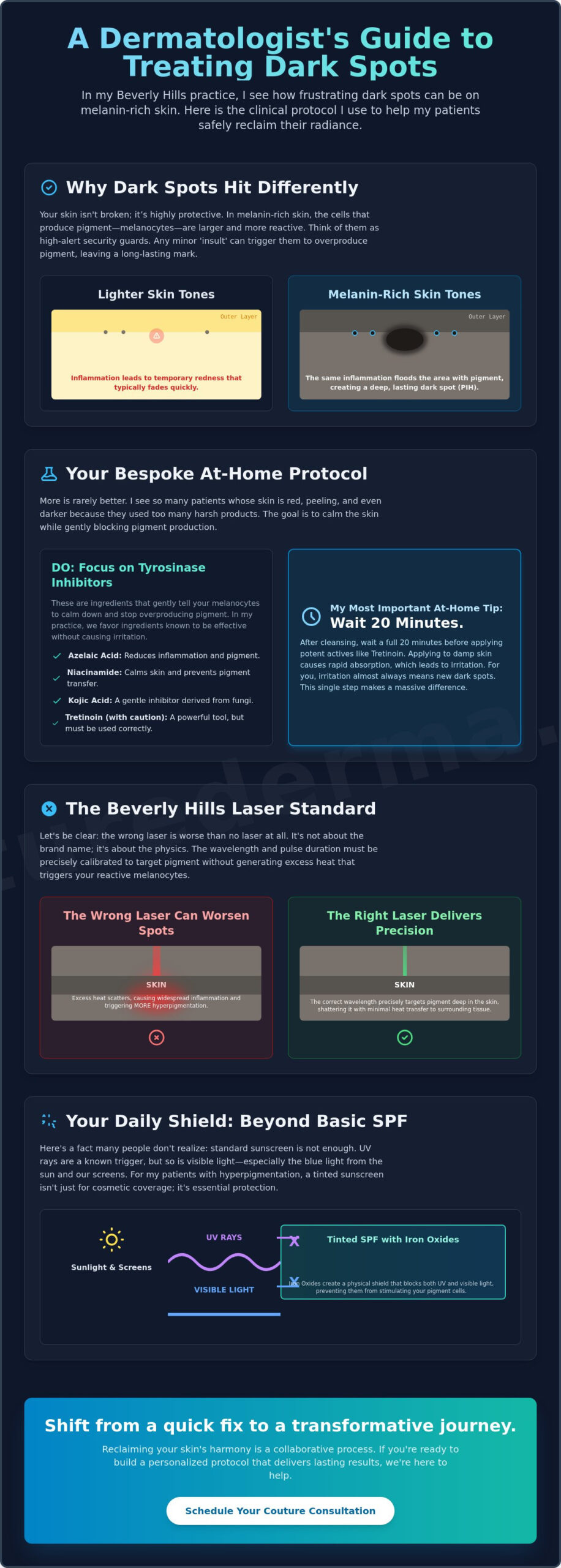
Your skin contains melanocytes (cells that produce skin pigment). In darker skin tones, these cells are larger, more active, and more numerous than in lighter tones. Think of them as high-alert security guards. Any “insult” or injury, whether it is a breakout or a scratch, triggers an inflammatory cascade. This process floods the area with pigment, creating what we call post-inflammatory hyperpigmentation (PIH). While lighter skin might turn red and fade quickly, Fitzpatrick types IV through VI often develop deep, long-lasting shadows that can take months or even years to resolve without a professional, expert-vetted protocol.
Common Triggers in My Practice
It is not just acne that causes trouble. I often see spots resulting from simple friction, like aggressive scrubbing, or from using harsh, “clinical-strength” products that weren’t designed with your tone in mind. Let’s be honest: if a product makes your skin peel, sting, or burn, it is likely triggering more pigment. This is why what a dermatologist wants you to know about acne is so critical; treating the initial inflammation is the only way to stop the mark before it starts. In my practice, treating dark spots on skin of color often begins with identifying these subtle daily habits that keep the skin in a state of high alert.
We also need to distinguish between PIH and melasma. Melasma is typically hormonal and appears as symmetrical patches, usually on the cheeks or forehead. In contrast, PIH follows the exact shape of a previous injury. Identifying the difference is the first step in our couture approach. Here is an actionable tip: if you notice a new dark spot, stop using all exfoliating acids for 48 hours to let the skin barrier stabilize before starting any targeted treatment. This short pause prevents the “inflammatory cascade” from worsening the shadow.
Designing Your Bespoke Topicals: Ingredients That Transform
Let’s be honest; not every “brightening” cream belongs on your face. I see patients who walk into my Beverly Hills office with a bag full of “kitchen sink” products containing every acid under the sun. They’re often frustrated because their skin is red, peeling, and somehow darker than when they started. When treating dark spots on skin of color, more is rarely better. In my practice, I prioritize a “layering” strategy that focuses on tyrosinase inhibitors (ingredients that block pigment production) while keeping the skin calm and hydrated.
Here is a specific protocol that makes a massive difference: Wait 20 minutes after cleansing before applying any active treatment. It sounds simple, but it’s crucial. Damp skin is like a sponge; it absorbs products much faster. While that sounds good, for potent actives, it often leads to deep irritation. For melanin rich skin, that irritation quickly turns into new shadows. By waiting for your skin to be completely dry, you control the absorption and protect your barrier from unnecessary stress.
The Gold Standard Brighteners
Hydroquinone is frequently discussed as the ultimate solution, but I tell my patients it is a sprint, not a marathon. In my practice, we typically use it for a three month cycle to “kickstart” the clearing process. Using it longer without supervision risks ochronosis (permanent blue black staining), which is incredibly difficult to treat. This is why I often pivot to alternative powerhouses. Kojic Acid, Azelaic Acid, and Tranexamic Acid are fantastic for long term use. They are particularly effective for under-eye brightening where the skin is delicate. For more foundational advice, you can explore dermatologist-recommended treatments for dark spots from the American Academy of Dermatology.
The Tretinoin Protocol for Darker Tones
Retinoids (Vitamin A derivatives) are the workhorses of any even tone routine. They speed up cell turnover, which essentially “lifts” the pigment trapped in the deeper layers of your skin. However, the “textbook” way of using them often fails skin of color by being too aggressive. I always suggest a “low and slow” approach. Try the “sandwich method” to minimize risk. Apply a thin layer of a basic moisturizer first, then a pea sized amount of tretinoin, and then another layer of moisturizer on top. This doesn’t make the product less effective; it just makes it safer for your tone. If you are ready to move beyond over the counter trial and error, you can book an appointment with our team to design your custom protocol.
The Beverly Hills Laser Standard: Safe Interventions for Darker Tones
In my Beverly Hills practice, I often hear that laser is “not for us.” Many patients with melanin rich skin believe that these treatments will inevitably cause burns or permanent scarring. Let’s be honest; for a long time, the industry didn’t prioritize diverse skin tones. But that is a myth we need to dismantle. When treating dark spots on skin of color, the issue isn’t the laser itself; it’s the wavelength and the expertise of the person behind the device. A “bargain” laser at a strip mall might use a wavelength that targets pigment too aggressively, which can lead to a “rebound” darkening that is much harder to treat than the original spot.
In our practice, I use the Fotona laser because it allows for extreme precision. It targets the excess pigment without overheating the surrounding healthy skin. This “color-blind” approach is the gold standard for safety. It’s vital to look at clinical treatment options for skin of color to see how far medical technology has come. Here is an actionable tip: before booking, always ask your provider if their laser is safe for your Fitzpatrick type (a scale used to classify skin coloring and response to UV light). If they can’t explain the specific wavelength they’re using for your tone, it’s a sign to look elsewhere.
Why Not All Lasers Are Equal
We generally categorize lasers as ablative or non-ablative. Ablative lasers remove the outer layer of skin, which is often too risky for darker tones. Non-ablative lasers, like the ones we prefer, work by heating the underlying tissue without damaging the surface. I avoid high-heat lasers because they can trigger the “inflammatory cascade” we discussed earlier, leading to new post-inflammatory hyperpigmentation (PIH). I see patients who have been burned by aggressive settings elsewhere, and we often have to pivot to acne scar refinement protocols to fix the texture and tone simultaneously.
The Advantage of Personalized Technology
Sometimes the dark spot isn’t just pigment; it’s preceded by redness or “feeding” blood vessels. In my practice, I might use a “cold” laser like the Vbeam to address that vascular component first. Or, I might pair a very light chemical peel with a gentle laser session to lift surface pigment while the laser works deeper down. We call this a “graceful progression.” It is a collaborative, transformative journey that values safety over speed. Here is another tip for your recovery: apply a thick layer of a bland, fragrance free moisturizer for 72 hours after any laser session. Keeping the skin barrier hydrated prevents the dryness that can lead to itching and further pigment production. Treating dark spots on skin of color isn’t a hurried task; it’s an artisanal process that requires patience and the right tools.
Your Daily Protocol: Protecting the Transformation Year-Round
Living in Los Angeles means year-round sun. But it is the light you cannot feel that often does the most damage. I see patients who are incredibly diligent about their bespoke serums but forget that the sun during a long commute in LA traffic is just as potent as the sun at the beach. If you are treating dark spots on skin of color, your protection must be absolute. It’s not just about avoiding a burn; it’s about preventing the “silent” triggers that keep your melanocytes (cells that produce skin pigment) in a state of high alert.
Let’s be honest: your phone and computer screen are part of the problem. Blue light, also known as high-energy visible light, has been shown to worsen melasma and stubborn dark spots in melanin-rich tones more significantly than in lighter skin. This is where the “Iron Oxide” secret comes into play. Most standard sunscreens only block UV rays. But iron oxides, which are the minerals that provide the tint in tinted sunscreens, are the only ingredients that provide a physical shield against visible light. Here is an actionable tip: reapply your SPF every two hours if you are sitting near a window or driving. The glass in your car or office blocks UVB, but UVA and visible light pass right through, silently undoing your progress.
The Non-Negotiable SPF Rule
I often hear from patients who hate sunscreen because of the dreaded “white cast.” I get it. No one wants to look like they’re wearing a chalky mask. However, for stubborn pigment, chemical sunscreens might not be enough. I prefer physical blockers like Zinc Oxide and Titanium Dioxide because they reflect light and heat rather than absorbing it. Heat itself can trigger pigment production in sensitive skin. Look for “micronized” formulas or tinted versions that blend seamlessly into deep skin tones while providing that essential iron oxide protection.
Managing the Beverly Hills Environment
Our environment adds another layer of complexity. Heat and pollution contribute to oxidative stress, which is damage caused by unstable molecules that can darken existing spots. To counter this, I recommend integrating antioxidants like Vitamin C or Ferulic Acid into your morning routine. These act as a second line of defense, neutralizing the damage that your SPF might miss. For patients dealing with both texture and tone issues, we often look at acne scar refinement as a parallel path to ensure the skin’s surface is as smooth as it is even. If you are ready to stop the guesswork and start a professional regimen, schedule your couture skin analysis today.
The Couture Consultation: A Collaborative Path to Radiance
Aesthetic improvement is a gradual progression rather than a hurried task. In my practice, I see patients who have spent years feeling overlooked by mainstream dermatology, often arriving with a mix of frustration and cautious hope. Treating dark spots on skin of color is an artisanal process that requires a partner who understands the delicate balance between correction and protection. When you join us for a Couture consultation, we do more than perform a standard skin exam. We engage in a deep-dive conversation about your history, your daily environment, and the specific outcomes that will make you feel most confident in your own skin.
Let’s be honest: your skin is as unique as a custom-made garment. It deserves a plan that accounts for how your specific tone reacts to the world around it. Here is an actionable tip for your first visit: bring your current skincare products with you so we can tailor your new routine from the ground up. By reviewing what you’re already using, we can identify hidden irritants and keep the effective ingredients that your skin already loves. This collaborative approach ensures that your treatment plan isn’t just medically sound, but also fits seamlessly into your actual lifestyle.
Beyond the Surface: The Emotional Shift
There is a profound self-assurance that comes from finally having a protocol that works. I’ve watched patients move from a place of “covering up” with heavy foundations to “glowing through” with nothing but a bit of tinted SPF. This transformation isn’t just about the physical fading of a mark; it’s about the emotional freedom of knowing your skin is in expert hands. By combining my elite, academic training with 15 years of clinical experience in Beverly Hills, I provide a level of safety and precision that allows you to reclaim your radiance without the fear of setbacks.
Your Custom-Fit Treatment Plan
We typically map out a six-month plan to ensure your results are both sustainable and natural-looking. Just like a master tailor makes multiple adjustments to ensure a perfect fit, we monitor your progress and refine your treatments as your skin evolves. Or, we might pivot our focus if we see your barrier needs more support during a change in season. Your skin is a lifelong investment, and you deserve meticulous care that honors its complexity. We are here to guide you through this collaborative, transformative journey, ensuring that every step brings you closer to the clear, even complexion you’ve always deserved.
Reclaiming Your Radiance with Precision Care
Reaching your skin goals is a collaborative, transformative journey that requires both clinical rigor and an artistic touch. We have discussed why your melanocytes react the way they do, how to layer your actives safely, and why the right laser wavelength is the difference between a burn and a breakthrough. Treating dark spots on skin of color isn’t a task for generic advice or bargain treatments; it requires a partner who understands the nuance of melanin rich skin. It’s about moving from the frustration of slow fading marks to the confidence of a clear, even complexion.
As a Harvard trained dermatologist with specialized expertise in skin of color, I am here to ensure your protocol is a perfect fit. At our bespoke Beverly Hills clinic, we combine scientific authority with a couture sensibility to help you move beyond covering up. It’s time to stop the guesswork and start a plan that honors your unique tone. Book your bespoke skin consultation with Dr. Abisogun today to begin your transformation. You deserve to feel recognized and meticulously attended to, and with the right expert care, your most radiant skin is well within reach.
Common Questions About Melanin-Rich Skin
Is hyperpigmentation on skin of color permanent?
No, in most cases it isn’t permanent, but it can be extremely stubborn. PIH (post-inflammatory hyperpigmentation) eventually fades as the skin naturally renews itself. However, without professional intervention, deep pigment can take years to lift. In my practice, I see patients who have carried marks for a decade. When treating dark spots on skin of color, we use targeted protocols to speed up that “graceful progression” toward an even tone.
Can I use Vitamin C and Retinol together for dark spots?
Yes, but you shouldn’t apply them at the exact same time. Vitamin C is best used in the morning to fight oxidative stress and boost your SPF. Retinol (a Vitamin A derivative) should be reserved for your nighttime routine because it’s light-sensitive. Using both in a single routine is a powerful way of treating dark spots on skin of color, provided you don’t irritate the skin barrier.
Why do my dark spots get darker before they get better?
This often happens because the pigment is being pulled to the surface. As your cell turnover increases from treatments like tretinoin or chemical peels, the “trapped” melanin moves toward the outer layer of skin. It might look more intense for a week or two, but this is a sign the treatment is working. Don’t panic; just keep the skin hydrated and the barrier protected during this phase.
Is laser hair removal safe for dark skin tones?
It is absolutely safe as long as the provider uses the right wavelength. In our Beverly Hills practice, we use the Nd:YAG laser, which bypasses the melanin in your skin to target the hair follicle directly. “Bargain” lasers often use wavelengths that can’t distinguish between hair and skin, which is how burns happen. Always ask if the technology is specifically “color-blind” before starting your treatment.
How long does it take for hydroquinone to work?
You will typically start seeing visible results within four to six weeks. However, I tell my patients that hydroquinone is a sprint, not a marathon. We usually limit use to a three month cycle to avoid the risk of ochronosis (permanent blue black staining). If the spots haven’t cleared by then, we pivot to other tyrosinase inhibitors like Kojic Acid or Azelaic Acid to maintain the progress safely.
Do dark spots on skin of color eventually turn into skin cancer?
No, simple hyperpigmentation or PIH does not turn into cancer. But here is the catch: it can be hard to tell the difference between a harmless dark spot and a melanoma (a serious skin cancer) without a professional eye. I see patients who ignore new marks because they assume it’s just more hyperpigmentation. Any spot that changes shape, size, or color needs a clinical exam immediately.
What is the best sunscreen for dark skin that won’t look ashy?
Look for tinted mineral sunscreens or “micronized” zinc formulas. These are specifically designed to blend into deeper skin tones without leaving a white cast. The tint usually comes from iron oxides, which are essential for blocking blue light from your phone. In my practice, I often recommend brands that prioritize “invisible” finishes so you actually enjoy wearing your protection every single day while preventing new spots.