

Last week, a patient sat in my chair at Couture Dermatology & Laser Beverly Hills, visibly trembling as she asked, “what are the risks of laser treatments and will I regret this?” She had spent hours scrolling through “laser burns” on social media, and honestly, I don’t blame her for feeling anxious. It’s your face, after all; the stakes couldn’t be higher when you’re seeking a transformation.
I understand that fear of hyperpigmentation (dark spots) or long weeks of downtime can make you hesitate. But here’s the thing: most of those “horror stories” happen when a treatment isn’t properly tailored to the person’s unique skin biology. In my practice, I’ve seen how a medical, high-detail approach turns that anxiety into a sense of calm confidence. As a quick tip, always stop using any retinol or exfoliating acids five days before your appointment to prevent unnecessary irritation.
And that’s exactly what we’re diving into today. You’ll learn the difference between normal healing and genuine risks, why your skin tone matters for laser selection, and how we use specialized technology like the Fotona laser to keep you safe. By the end, you’ll have a clear, realistic map for your journey to radiant, healthy skin.
Key Takeaways
- Learn why the bespoke fit of a laser to your specific skin biology is the most important factor in preventing complications.
- Understand what are the risks of laser treatments when it comes to diverse skin tones and how we safely protect your natural pigment.
- Discover the crucial difference between a healthy inflammatory response that builds collagen and actual risks like infection.
- Get a look at the Couture Protocol, including the vital four-week preparation phase that ensures your skin is ready for a safe transformation.
- Find out why a detailed medical history review during your consultation is the ultimate “measure twice, cut once” step for your safety.
The Truth About Laser Risks: Why Precision Matters More Than the Machine
Let’s be honest. When you’re at a dinner party and someone mentions laser resurfacing, the conversation usually shifts to horror stories about burns or permanent scarring. In my practice at Couture Dermatology & Laser Beverly Hills, I hear these anxieties every single day. People want to know what are the risks of laser treatments before they commit their skin to a machine, and they deserve a straight answer. Here is the clinical reality: risks exist on a spectrum, and most of them are entirely preventable when the treatment is tailored to your specific biology.
Think of a laser like a high-end designer gown. If the fit is off by even a fraction of an inch, it doesn’t matter how beautiful the fabric is; it just won’t work. In the field of laser medicine, the technology is the fabric, but the fit is how we calibrate that power to your skin’s unique thickness, pigment levels, and healing capacity. In a place like Beverly Hills, where we deal with year-round UV exposure, that fit becomes even more critical. Sun-sensitized skin reacts differently to heat, making a bespoke approach the only way to ensure a safe transformation.
To better understand this concept, watch this helpful video:
Expected Side Effects vs. Real Complications
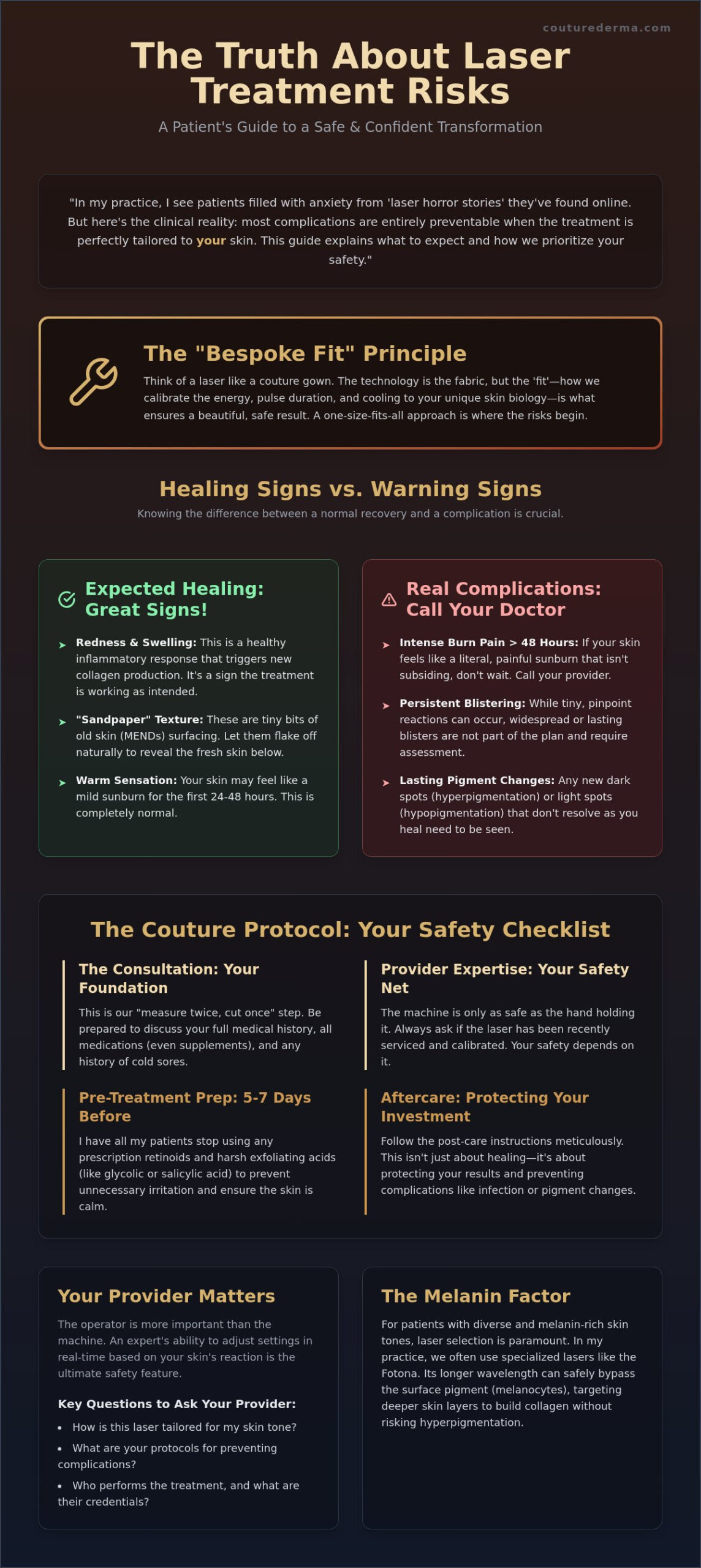
I often tell my patients that looking like a “pink glazed donut” for a few days is actually a great sign. We have to distinguish between expected side effects, which mean the treatment is working, and genuine complications. Erythema (redness) and edema (swelling) are your body’s natural inflammatory response to the laser energy. This response is what actually triggers the production of new collagen and elastin. You might also notice a “sandpaper” texture on your skin during the first week of fractional healing. These are microscopic epidermal necrotic debris (tiny bits of old skin) making their way out to reveal the fresh layer underneath.
But a real complication is different. A true burn, persistent blistering, or a change in pigment that doesn’t resolve is not part of the plan. And here is a specific tip for your recovery: if your skin feels like a literal, painful sunburn for more than 48 hours after your procedure, don’t wait for it to get better. Call your provider immediately so they can assess the healing process.
The Role of the “Operator” in Laser Safety
The machine is only as safe as the hand holding it. I see patients who come to me with “laser stripes” or grid patterns on their face, which are often the result of using uncalibrated machines or incorrect overlapping techniques. In a medical setting, we don’t just “turn on” the laser. We adjust the pulse duration, the energy level, and the cooling settings based on how your skin reacts in the first thirty seconds of the session. This is where board-certified expertise becomes your safety net.
But safety also requires your participation. For example, if you are using a prescription retinoid, you must stop it at least five to seven days before any laser treatment. Or, if you have a history of cold sores, we will prescribe an antiviral medication to start the day before. These small, meticulous steps are what separate a “standard” procedure from a Couture transformation. Another actionable tip: always ask your provider when their laser was last serviced and calibrated; a well-maintained machine is a safer machine.
Common Side Effects: What Really Happens Beneath the Surface
In my practice, I often tell patients that the redness they see in the mirror immediately after a session is actually a controlled biological conversation. When we perform Laser Resurfacing, we’re intentionally creating “micro-injuries” to wake up your skin’s repair system. This inflammatory response is what sends a signal to your fibroblasts (cells that create connective tissue) to start churning out fresh collagen. But if that inflammation isn’t managed or if the settings are too aggressive, that’s when we start talking about what are the risks of laser treatments in a more serious light.
One risk that surprises many is a flare-up of dormant viruses. If you’ve ever had a cold sore, the heat from a laser can wake up that virus, even if you haven’t had an outbreak in years. In our practice, I see patients who are prone to these issues, so we proactively prescribe a short course of antivirals. It’s a simple step that prevents a painful complication. You might also experience a “purge” where underlying congestion comes to the surface as small whiteheads. This isn’t a traditional breakout; it’s just your skin’s way of rapidly shedding old debris.
And here’s a specific protocol I recommend to every patient: Wait 20 minutes after cleansing before applying any post-laser actives or moisturizers. Damp skin is more permeable, which can cause products to penetrate too deeply and lead to stinging or irritation on newly treated areas. If you’re feeling unsure about how your skin is reacting, it’s always best to schedule a detailed skin assessment with us.
Hyperpigmentation and Hypopigmentation
Pigment changes are the most common concern I hear about. Hyperpigmentation (dark spots) occurs when the heat triggers your melanocytes (cells that produce skin pigment) to overreact. This is usually temporary but can take months to fade. On the other hand, hypopigmentation (loss of pigment) is a more difficult risk to treat because it means the pigment-producing cells have been damaged. These issues are often preventable with the right pre-care, such as using pigment-inhibitors for several weeks before your appointment.
The Risk of Scarring and Texture Changes
True scarring from a laser is rare in expert hands, but it can happen if pulses are “stacked” too closely together. This causes bulk heating, where the tissue gets too hot to heal properly. We use the Fotona laser specifically because its pulse control is incredibly precise, allowing us to deliver energy without over-heating the surrounding skin. If you’re dealing with existing texture issues, we often use these same precise tools for Acne Scar Refinement to safely smooth the skin’s surface without adding new risks.
The Melanin Factor: Navigating Laser Risks for Diverse Skin Tones
I often meet people who have been told by other clinics that their skin is “too dark” for lasers. It’s a frustrating misconception that I hear all the time in my Beverly Hills practice. At Couture Dermatology, we specialize in all skin types, specifically those categorized as Fitzpatrick IV through VI. The truth is that the real issue isn’t your skin; it’s the lack of understanding of how melanocytes (cells that produce skin pigment) react to heat. When we talk about what are the risks of laser treatments for diverse tones, we aren’t saying the technology is dangerous. We’re saying it requires a more meticulous, tailored approach to protect your natural glow.
The myth that “lasers aren’t for Black or Brown skin” needs to be retired. It’s about the wavelength, not the skin color. In my practice, I’ve seen how the right settings can safely treat acne scars or wrinkles without causing harm. But here’s the thing: preparation is your best defense. I typically have my patients with deeper skin tones use a tyrosinase inhibitor (a cream that calms pigment-producing cells) for two to four weeks before their session. This simple step significantly lowers the chance of your skin overreacting to the laser energy. It’s like prepping a canvas before you start to paint.
Post-Inflammatory Hyperpigmentation (PIH)
When patients ask me about what are the risks of laser treatments, I always start with Post-Inflammatory Hyperpigmentation, or PIH. This is the top concern for my patients with deeper skin tones. PIH happens when the skin’s defense mechanism goes into overdrive after being heated, leaving behind dark patches that can last for months. To prevent this, cooling is non-negotiable for safety. We use advanced cooling systems that protect the surface layer while the laser works deeper down. This prevents the surface heat from triggering those sensitive pigment cells. If you’re nervous about potential side effects of laser treatments, always ask your provider to perform a “test patch” in a hidden area like behind the ear first.
Choosing the Right Wavelength for Safety
Choosing the right tool is like choosing the right needle for a delicate silk. Some lasers target pigment directly, which is risky for dark skin because the laser can’t always tell the difference between a dark spot and your natural skin tone. This can lead to permanent light spots or even scarring. Instead, we often use the 1064nm Nd:YAG wavelength. It bypasses the surface pigment and targets the deeper layers of the skin where the real transformation happens. It’s the gold standard for inclusive technology, especially when paired with the precision of our Fotona system, because it treats the condition without disturbing the melanin on the outer layer of skin. We’re committed to ensuring that every patient, regardless of their background, can experience these life-changing results safely.
The Couture Protocol: Minimizing Your Risk Before and After
In my practice, I tell patients that the laser session itself is only fifty percent of the transformation. The other fifty percent happens in your bathroom, both before and after you visit us in Beverly Hills. When people ask what are the risks of laser treatments, they’re often worried about outcomes that are entirely avoidable with a strict, medical-grade protocol. We call this the Couture Protocol, a four-week preparation phase designed to ensure your skin is at its most resilient before we introduce any light-based energy.
During this window, we’re essentially training your skin to heal. One of the biggest mistakes I see is patients trying to “deep clean” or “prep” their skin by over-exfoliating right before a procedure. Here is my first tip: swap your physical scrubs and exfoliating brushes for a bland, ointment-based moisturizer for the first five days post-treatment. Your skin needs a protective barrier, not a battle, to recover properly without complications. If you’re using a thick ointment, apply it in a thin, even layer to avoid trapping too much heat in the skin during the first twenty-four hours.
The Pre-Treatment Checklist
Preparation is about removing variables that could lead to irritation or poor healing. I see patients who forget that their nightly skincare routine contains powerful actives that can make the skin too sensitive for a laser. Follow these three essential steps to keep your journey on track:
- Step 1: Discontinue all retinoids and Vitamin A derivatives at least five to seven days before your appointment.
- Step 2: If you have any history of cold sores, start your prescribed antiviral medication. We don’t want a dormant virus waking up while your skin is regenerating.
- Step 3: Avoid sunbeds and direct tanning. And let’s be honest, the Beverly Hills sun counts too; even a “healthy glow” from a weekend at the pool can increase your risk of a surface burn.
The Golden Rules of Aftercare
Once the treatment is done, the goal is to create a “moist environment.” Gone are the days of letting a wound “air out” to heal. In my practice, I’ve found that skin heals significantly faster and with less risk of scarring when it’s kept hydrated with specific, dermatologist-approved balms. This is especially true for delicate areas; you can find more specific recovery tips in our guide to Under Eye Brightening. You might notice “peppering” or “bronzing,” which looks like tiny dark coffee grounds on the skin. This is completely normal. Whatever you do, never pick at these spots. Let them shed naturally to avoid permanent texture changes or “ghosting” marks.
If you’re ready to start your own journey with a team that prioritizes your safety at every step, book your bespoke consultation today and let’s create your personalized plan together.
Why a Bespoke Consultation is Your Best Defense
When you’re curious about what are the risks of laser treatments, the most effective safety tool isn’t a cooling device or a specific wavelength; it’s the conversation we have before the laser ever touches your skin. In my practice, I treat the consultation as a “measure twice, cut once” phase. This is where we look at the fine details of your biology to ensure the treatment fits you perfectly. I see patients who are eager to jump straight into a procedure, but taking this time to pause is what prevents complications down the road. It’s a collaborative process where your goals and my clinical expertise meet to form a safe path forward.
This comprehensive approach to planning ensures that every aspect of your aesthetic goals is addressed with care. If you are also exploring options for hair restoration, you can visit The Hair Clinic to discover their specialized therapeutic and surgical solutions for hair loss.
During this review, I look deeply into your medical history to identify any hidden red flags. For instance, if you’ve taken Accutane (a powerful acne medication) in the last six to twelve months, your skin’s ability to heal is fundamentally changed. We also discuss your history of scarring and any previous reactions to light based therapies. Here is a practical tip for your first visit: bring a physical list or take photos of every single skincare product you currently use. Even “natural” oils or certain herbal supplements can affect how your skin responds to heat; knowing these details allows me to adjust our protocol for your safety.
The Harvard-Trained Advantage
My approach is rooted in the rigorous training I received during my time at Harvard and throughout my fifteen years as a board-certified dermatologist. This elite academic background isn’t just about a title; it’s about a deep understanding of skin physiology that allows for more refined outcomes. When a provider understands the “why” behind a laser’s interaction with tissue, they can navigate risks with far more precision. This level of care ensures that we aren’t just performing a procedure; we are crafting a result that respects your skin’s health. You can book a consultation with Dr. Abisogun to start your own journey toward lasting confidence.
Moving Beyond Generic Treatments
Let’s be honest; many med-spas offer “one-size-fits-all” laser settings that treat every face the same way. But your skin is as unique as your fingerprint, and it deserves better than a generic approach. At Couture Dermatology, we look at the whole picture of your facial harmony. Sometimes, achieving your goals means combining a laser treatment with other subtle refinements like Jawline Contouring to create a balanced, natural look. Safe, effective laser treatment isn’t a luxury; it is the standard of care you deserve. In Beverly Hills, where the sun is a constant factor and expectations are high, we believe in a process that is intentional and focused on long-term health rather than a quick fix. We are here to ensure your transformation is as safe as it is beautiful.
Your Journey to Radiant Skin Starts with Safety
We’ve covered a lot of ground today, but here’s the thing: your skin’s transformation should never be a gamble. By now, you understand that what are the risks of laser treatments depends entirely on the precision of the provider and the preparation of the patient. Whether it’s choosing the right wavelength for deeper skin tones or following a strict pre-treatment protocol, every detail matters. In my practice, I’ve seen how this meticulous, high-detail approach turns fear into a feeling of absolute self-assurance.
You don’t have to navigate these choices alone. With my Harvard-trained expertise and our specialized focus on all skin tones, we bring Beverly Hills clinical excellence to every bespoke plan. We’re here to guide you through a collaborative, transformative journey that prioritizes your long-term health and aesthetic harmony. It’s time to move past the anxiety and toward the glowing, clear complexion you deserve. To take that first step, begin your tailored transformation at Couture Dermatology today. Let’s work together to reveal your most radiant self with the calm confidence you’ve been looking for.
Common Questions About Laser Safety
Can laser treatments cause permanent skin damage?
Permanent damage is extremely rare when you’re in the hands of a board-certified expert. In most cases, issues like scarring or permanent pigment loss occur due to improper device calibration or ignoring a patient’s medical history. In my practice, we mitigate these risks by performing a thorough skin assessment first. We ensure your skin is healthy enough to regenerate before we ever start the transformation process.
Is it normal to have scabs after a laser treatment?
You shouldn’t see traditional, thick scabs, but you might notice “peppering” or “bronzing” after fractional treatments. These are microscopic bits of old skin, often called MENDs, rising to the surface. It’s a sign your skin is successfully renewing itself. Here’s the thing: never pick at these spots. Let them fall off naturally while keeping the area hydrated with a bland moisturizer to ensure smooth healing.
How long does the redness last after laser resurfacing?
Redness typically lasts anywhere from twenty-four hours to a full week, depending on the intensity of your session. For lighter treatments, you might just look slightly flushed for a day. But with deeper resurfacing, that “sunburned” look often persists for five to seven days. In my practice, I see patients who find that using a cold compress and staying out of the Beverly Hills sun significantly speeds up this recovery phase.
Can I get a laser treatment if I have dark skin?
Yes, you can absolutely have a laser treatment if you have dark skin, provided the correct wavelength is used. We specialize in treating all skin types, from Fitzpatrick I to VI, by using inclusive technology like the 1064nm Nd:YAG. This specific laser bypasses surface pigment to avoid damaging your natural skin tone. It’s all about the tailor-fit; we adjust the energy levels to keep your melanocytes (pigment cells) calm and safe.
What happens if I go in the sun right after a laser session?
Going in the sun immediately after a session is one of the quickest ways to trigger Post-Inflammatory Hyperpigmentation (dark spots). Your skin is incredibly vulnerable and photosensitive during the healing phase. Even a short walk in the Beverly Hills sun can cause a surface burn or lasting pigment changes. I tell my patients to wear a broad-spectrum SPF 30 or higher and a wide-brimmed hat for at least two weeks post-treatment.
Are there any medications that make laser treatments risky?
Several medications can increase what are the risks of laser treatments by making your skin more sensitive to light or heat. For example, if you’ve taken Accutane in the last six months, your skin might not heal correctly. Other common culprits include certain antibiotics like doxycycline or even topical retinoids. In our practice, I review your entire medication list during the consultation to ensure we don’t proceed until it’s clinically safe for your skin.
How do I know if my laser provider is qualified?
A truly qualified provider should be a board-certified dermatologist or have extensive medical training in a clinical setting. Don’t be afraid to ask how many times they’ve performed your specific procedure and what their protocol is for managing complications. I always suggest looking for a provider who understands the “why” behind the technology. In my practice, we combine fifteen years of experience with elite academic training to ensure every transformation is handled with precision.
Can laser treatments cause more acne?
Laser treatments don’t typically cause traditional acne, but they can trigger a temporary “purge.” As the laser heat speeds up cell turnover, underlying congestion might rise to the surface as small whiteheads. This usually clears up within a few days as your skin regenerates. If you’re prone to breakouts, we often adjust our post-care protocol to include lighter, non-clogging moisturizers that keep your pores clear while you heal from the procedure.