
Just last Tuesday, a patient sat in my office, her eyes alight with excitement for her upcoming CO2 laser treatment. But beneath the anticipation, I could sense a familiar flicker of anxiety. “Dr. Chinonso,” she said, “I’ve seen the incredible before-and-afters, but the week of recovery? That’s what truly worries me.”
Her concern is one I hear from nearly every patient who walks through our doors. It’s completely understandable to feel apprehensive about the healing process, especially when you don’t know exactly what to expect after laser resurfacing. The internet is filled with dramatic photos and conflicting advice, which can easily create more fear than clarity.
That’s why I’ve curated this guide. My goal is to demystify the entire recovery journey, transforming your uncertainty into calm confidence. Together, we will walk through the day-by-day healing timeline, detail the precise skincare protocol we use in our practice, and reveal how to protect your investment for those beautiful, signature results.
Key Takeaways
- Navigate the distinct phases of your recovery journey with confidence, from managing peak swelling in the first few days to understanding the critical peeling process that follows.
- Master our signature “Cleanse, Hydrate, Protect” protocol to care for your delicate new skin and ensure your treatment investment yields a beautiful result.
- Gain a clear understanding of what to expect after laser resurfacing, including the crucial difference between “healed” skin and your final, refined outcome at the 3-month mark.
- Discover specialized techniques for skin of color to safely manage recovery and prevent post-inflammatory hyperpigmentation (PIH) for an even, luminous finish.
The First 48 Hours: Understanding the “Sunburn” Sensation
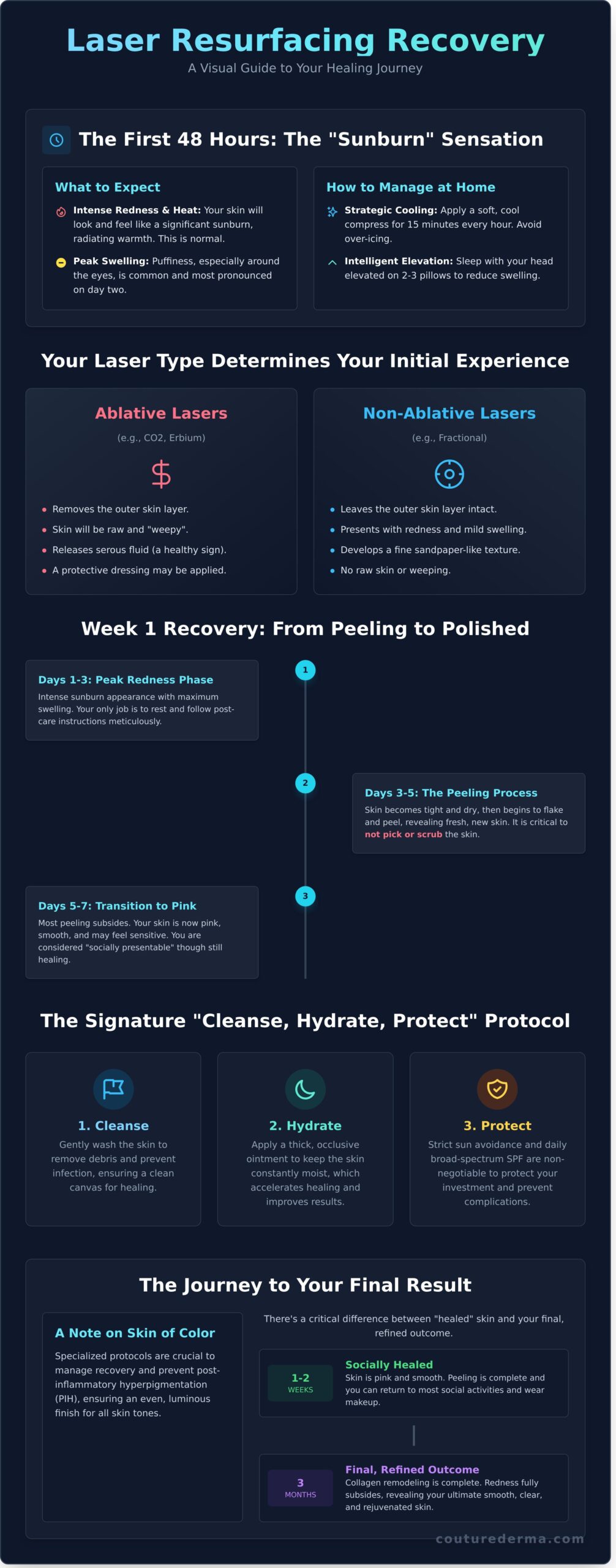
The moment you leave our Beverly Hills practice after a laser resurfacing treatment, your skin’s refinement journey has officially begun. I often describe this initial feeling to my clients as a controlled, deep sunburn. It’s an intentional, therapeutic response, not a complication. You will feel significant heat radiating from the treated areas, and your skin will appear intensely red. This is the precise, targeted energy from the laser initiating a powerful healing cascade that will ultimately build new, pristine collagen.
To help you visualize and prepare for this initial recovery phase, my colleague Dr. Tansavatdi offers a clear overview of the essential post-care steps.
This initial 48-hour window is, without question, the most critical period for your recovery. The meticulous care you take now directly influences the quality of your final result. Think of it as preparing the canvas. We’ve created the blueprint for rejuvenation; your aftercare is what brings the masterpiece to life. It’s essential to manage your expectations during this time. You will look significantly more “done” before the beautiful refinement begins. This is a normal and necessary part of understanding what to expect after laser resurfacing.
Ablative vs. Non-Ablative: The Immediate Difference
Your immediate experience will vary based on the type of laser we curated for your skin. For ablative lasers like CO2 or Erbium, which remove the outer skin layer, you can expect the skin to be raw and “weepy” as it releases serous fluid. This is a healthy sign of healing, and we may apply a protective dressing. The principles of healing are an evolution from older methods like Dermabrasion techniques, but with far more precision. For non-ablative or fractional lasers, the skin remains intact, presenting with redness, mild swelling, and a texture that feels like fine sandpaper within a day or two. In our practice, we also take a couture approach to pain management, ensuring you are comfortable with a bespoke plan before you even leave the office.
Managing Heat and Swelling at Home
Your primary goal at home is to calm the skin and manage swelling. This is where simple clinical strategies make a world of difference. We provide you with specific instructions, but these two pillars are universal:
- Strategic Cooling: The key to cold compresses is timing, not extreme temperature. Applying a soft, cool compress for 15 minutes every hour is far more effective than leaving an ice pack on for long periods. Over-icing can constrict blood vessels too much, which can hinder the very healing process we are trying to support.
- Intelligent Elevation: The simplest trick to reduce what we call “social downtime” in Beverly Hills is to keep your head elevated above your heart. Sleep with two or three pillows for the first two nights. This uses gravity to help drain fluid away from the face, noticeably decreasing puffiness by morning.
It’s vital to distinguish normal healing from a potential issue. The feeling of intense warmth and tightness is expected. However, if you experience pain that escalates instead of subsides, notice a yellowish discharge, or develop a fever over 100.4°F, you should contact our office immediately. We are your partners throughout this entire journey.
A Day-by-Day Recovery Timeline: From Peeling to Polished
The first two weeks after your laser treatment are a meticulously choreographed healing process. Understanding this timeline is the most critical part of knowing what to expect after laser resurfacing. It’s a journey of transformation, not an instant fix, and each phase is a sign that your skin is diligently working to reveal a more refined, luminous version of itself.
Days 1-3: The Peak Redness Phase
Immediately following your procedure, your skin will feel warm and look like you have a significant sunburn. This is completely normal. During these first 72 hours, you’ll experience the peak of redness and swelling. For many of my patients, the swelling is most pronounced around the eyes, often on the morning of day two. This is simply your body’s robust inflammatory response, which is the essential first step in the healing cascade. Your only job is to rest and meticulously follow your bespoke post-care protocol of gentle cleansing and ointment application.
Days 4-7: The “Ugly Duckling” Phase
This is when the real work begins to show. Your skin will start to feel tight, dry, and begin to flake and peel. It’s not the most glamorous stage, but it is perhaps the most important. This shedding is your body sloughing off the old, damaged epidermal layers to make way for the fresh, new skin underneath. This process is well-documented, and you can review a similar day-by-day recovery timeline from the American Society of Plastic Surgeons that outlines these universal stages. Resisting the urge to pick is paramount.
Navigating the Peeling Phase Without Picking
That flaky skin is what I call a “biological bandage.” It protects the vulnerable new cells underneath. Picking it off prematurely can lead to scarring or hyperpigmentation, undoing the beautiful work of the laser. If you have social obligations, I advise scheduling at least 5-7 days of private downtime. If a piece of skin is hanging, use a small, sterile pair of scissors to snip it. Never, ever rip it.
Days 8-14: The “Pink Glow” Phase
By the end of the first week, the majority of peeling has typically subsided, revealing a layer of brand new, baby-smooth skin. It will be noticeably pink, almost glowing. This is your first true glimpse of the final result. This new skin is incredibly delicate and has zero tolerance for sun exposure. A mineral-based, broad-spectrum SPF of 50 or higher is non-negotiable from this point forward.
The Pinkness Period: How Long Does It Last?
This residual pinkness is a wonderful sign. It indicates healthy blood flow and increased circulation as your skin continues its deep healing and collagen remodeling. In my practice, patients with fairer skin (Fitzpatrick types I-II) may remain pink for 4-6 weeks, while those with deeper skin tones often see it resolve faster. I typically clear my Couture clients to begin wearing mineral makeup around day 10, once the skin’s surface is fully intact.
Weeks 2-6: The Internal Remodeling Phase
While you look much more “back to normal” on the surface, a profound transformation is happening within the dermal layers. This is the internal remodeling phase, where your body ramps up the production of new, high-quality collagen. Think of it as the “couture” tailoring of your skin’s foundation, a process that continues for up to six months. This long-term refinement is where the artistry of the procedure truly shines, and it’s a key part of the bespoke treatment plans we design to deliver enduring elegance.
The Couture Post-Care Protocol: Protecting Your Skin Investment
Think of your skin after a laser treatment as a piece of couture silk. It’s delicate, precious, and requires specialized, gentle handling to preserve its integrity. You wouldn’t toss a bespoke gown into a machine washer, and you must not treat your newly resurfaced skin with your old, aggressive routine. Your results are directly tied to your diligence in the first 10 to 14 days post-procedure.
At Couture Dermatology, I instill a simple but powerful mantra in every patient: Cleanse, Hydrate, Protect. This three-step philosophy is the foundation of your recovery and a crucial part of what to expect after laser resurfacing. During this initial healing phase, less is truly more. We pause all active ingredients; this means no retinols, no vitamin C serums, and absolutely no exfoliating acids for at least ten days. Your skin’s barrier is rebuilding, and these products will only create irritation and compromise the healing process.
The most critical element is creating a protective barrier. We use occlusive ointments to form a “second skin” over the treated area. This traps moisture, prevents scabbing, and creates the ideal humid environment for new epithelial cells to migrate and rapidly heal the surface, a process we call re-epithelialization. This step alone can cut down your social downtime significantly.
Curated Ingredients for Rapid Healing
To support this healing, we focus on ingredients that rebuild your skin’s architecture. Ceramides and Hyaluronic Acid are the essential building blocks of a resilient skin barrier, acting like the mortar between your skin cell “bricks.” In my clinical experience, while classic petrolatum is a fantastic occlusive, some patients find it heavy. Modern, medical-grade silicone-based balms can offer a more elegant feel while still providing that necessary protective seal. I often recommend a specific thermal spring water spray to be used throughout the day; its mineral composition is clinically shown to soothe the mid-day heat and reduce redness.
The Non-Negotiable Rules of Sun Protection
If post-care has one cardinal rule, it is this: you must become relentless about sun protection. For the first month, your skin is exceptionally vulnerable. I insist on a physical, mineral-based sunscreen containing only zinc oxide. Chemical sunscreens work by absorbing UV radiation and converting it to heat, which is the last thing your healing skin needs. A physical block literally shields your skin.
Even the best sunscreen isn’t enough. This is why I have what I call the “Beverly Hills Wide-Brim” rule. A hat with at least a four-inch brim is more effective than any cream because it provides a physical shadow over your face. Any UV exposure in the first 30 days can permanently “bake in” discoloration. This is especially critical for my patients with skin of color, as they are more susceptible to post-inflammatory hyperpigmentation. A core part of our protocol is focused on preventing hyperpigmentation, which requires absolute adherence to sun avoidance. Your diligence here is what separates a good result from a truly flawless, couture-level refinement.
Navigating Recovery for All Skin Tones: Preventing Hyperpigmentation
As a board-certified dermatologist specializing in skin of color, I can tell you that laser recovery is not a “one size fits all” process. The beautiful, resilient nature of melanated skin also means it responds to the controlled injury of a laser with a unique sensitivity. The primary concern we must manage is Post-Inflammatory Hyperpigmentation, or PIH.
PIH is essentially an overproduction of melanin triggered by inflammation. For my patients with deeper skin tones, understanding this risk is a critical part of knowing what to expect after laser resurfacing. This is precisely why our “Couture” pre-conditioning protocols are so essential. We don’t just treat your skin; we prepare it for weeks beforehand to calm your pigment-producing cells, making the post-care journey safer and the results more luminous.
During your healing, it’s vital to watch for specific signs that go beyond typical redness. Be mindful of:
- A dusky or purplish hue appearing after the initial pinkness fades.
- Itching that persists beyond the first 48-72 hours.
- Any areas that begin to look darker than your natural skin tone, even slightly.
These are early indicators that the skin’s inflammatory response may be shifting toward pigment production, and they require an immediate adjustment to your post-care plan.
The Role of Tyrosinase Inhibitors
In my practice, I often restart brightening agents, specifically tyrosinase inhibitors, much sooner for my patients of color, sometimes as early as 5-7 days post-procedure. These agents work by blocking the enzyme responsible for producing melanin. By reintroducing them early, we can get ahead of the inflammatory cascade. It’s a delicate dance of balancing the laser’s heat, which stimulates collagen, with the skin’s inherent tendency to produce pigment. This is why customizing the laser’s energy and density is an art form, ensuring safety without sacrificing that spectacular reveal.
First-Person Clinical Observations on Melanin
I’ve treated hundreds of patients with melanated skin, and I’ve consistently seen that a ‘slow and steady’ recovery yields the most vibrant, even-toned results. The myth that “lasers aren’t safe for me” is one I hear often. A more accurate statement is that the wrong laser protocol in inexperienced hands is unsafe. My Harvard-trained approach is rooted in a deep, physiological understanding of how melanin responds, allowing us to curate treatments that work with your skin, not against it.
I think of a patient who came to me last fall with deep-set melasma, convinced that lasers were not an option for her. We started with a six-week pre-treatment plan using a non-hydroquinone brightening serum. We then performed a very gentle fractional laser treatment. Her post-care was meticulously managed. Around day 9, she noticed a subtle darkening, a classic sign of impending PIH. We immediately introduced a mild topical steroid and a tyrosinase inhibitor. Within three weeks, the darkening resolved, and her melasma was 50% lighter than before we started. This is the couture-level personalization that makes all the difference.
Understanding how your skin will uniquely respond is the first step toward a safe and beautiful result. Schedule your couture consultation to create a laser resurfacing plan tailored specifically for your skin tone.
The Final Reveal: When to Expect Your Signature Results
The moment your skin is no longer pink and peeling feels like a victory, and it is. But I always tell my patients that this initial healing is the prelude, not the finale. The true artistry of laser resurfacing unfolds deep within the skin over the following months. Understanding this timeline is a crucial part of knowing what to expect after laser resurfacing and appreciating the journey to your final, refined result.
There’s a distinct difference between “healed” skin and your “final” outcome. Healed skin means the surface barrier is restored, typically within 7 to 14 days. Your final result, however, is driven by a process called neocollagenesis, or the creation of new collagen. The laser’s energy stimulates your body’s natural repair mechanisms, instructing them to build stronger, more organized collagen fibers. This process is gradual and methodical; it cannot be rushed.
The 3-month mark is often when my patients truly see the magic. By this point, your body has been diligently working, and the new collagen framework has matured enough to visibly improve skin texture, smooth fine lines, and create a luminous, firm appearance. Think of it as a couture garment being tailored. The initial weeks are for cutting the pattern and stitching the seams; the following months are for the detailed finishing work that creates a perfect fit. This refinement can even continue for up to six months post-treatment.
This is precisely why I insist on seeing my patients for follow-up appointments at specific intervals, typically at one month and three months. These visits are not just check-ins. They are a critical part of your Couture Journey, allowing me to assess your skin’s unique response and ensure your results are developing with elegance and precision.
Maximizing the Longevity of Your Laser Treatment
Your laser treatment is a profound investment in your skin’s foundation. To protect it, we must curate a long-term maintenance plan. The laser creates the perfect canvas; medical-grade skincare provides the daily protection and nourishment. A regimen including a potent vitamin C serum in the morning, a customized retinoid at night, and of course, a high-SPF mineral sunscreen every single day is non-negotiable. This synergy is what preserves the clarity and texture we work so hard to achieve.
Living in Beverly Hills also presents unique environmental stressors, from high sun exposure to air pollutants, which accelerate aging. A diet rich in antioxidants and proper hydration supports your skin’s cellular health from the inside out. As for repeating the journey, this is tailored to you. For a deep, ablative laser, we may not need another for 5-7 years. For lighter, non-ablative treatments, an annual session can become a beautiful part of your long-term skin strategy.
Your Next Steps with Couture Dermatology
I view our first consultation not as a single appointment, but as the beginning of a lifelong partnership in your skin health. My goal is to guide you through each stage, from preparation to the final reveal and beyond. The “Bold Confidence” we promise isn’t just about the final outcome. It’s born from a perfectly executed recovery, knowing you received couture-level care every step of the way.
When you’re ready to see what’s possible for your skin, I invite you to take the next step. Begin your Couture Journey-Book a consultation with Dr. Abisogun and let’s create a plan designed exclusively for you.
Embrace Your Refined Results
Navigating what to expect after laser resurfacing is a journey of patience. Remember that the initial period of redness and peeling, typically lasting 5 to 7 days, is the essential prelude to beautifully renewed skin. In my practice, I’ve seen that the single most important factor for a stunning outcome is meticulous post-care; it’s how you protect your investment and ensure your final reveal is flawless.
Your skin’s story deserves to be curated with unparalleled expertise. At Couture Dermatology, we combine the Harvard-trained artistry of Dr. Chinonso Kagha Abisogun with board-certified dermatologic precision. Our specialized care for all skin types and tones ensures your treatment is designed specifically for you, your history, and your goals.
When you’re ready to move from recovery to reveal, we are here to guide you. Curate your signature skin-Schedule a consultation at Couture Dermatology. The beautiful, bold confidence you envision is waiting.
Frequently Asked Questions About Laser Resurfacing Recovery
How long does the redness last after laser skin resurfacing?
The duration of redness is directly related to the intensity of your laser treatment. For a lighter fractional laser, you can expect a pink hue to last for 3 to 5 days. For a more comprehensive ablative laser, the redness may persist for 3 to 6 weeks, slowly evolving into a healthy glow. We design your treatment to align with your social calendar, ensuring the recovery timeline is one you are completely comfortable with.
Can I wear makeup immediately after my laser treatment?
No, it’s essential to let your skin breathe and heal without interruption. We advise waiting until the initial healing phase is complete, which is typically 7 to 10 days post-treatment. Applying makeup too early can trap bacteria and irritate your delicate new skin, which can compromise your results. Once you are cleared, we recommend a high-quality mineral makeup, as it’s less likely to clog your pores during this sensitive period.
Is it normal for my skin to look darker or “bronzed” after a fractional laser?
Yes, this is a completely normal and expected part of the healing process for many fractional lasers. This bronzed appearance is caused by the treated microscopic columns of skin making their way to the surface. This effect usually becomes visible 1 to 3 days after your procedure and will gently flake off within about a week, revealing the luminous, rejuvenated skin beneath. It’s a visible sign that the treatment is working beautifully.
What is the best moisturizer to use during laser recovery?
During the first 5 to 7 days, the best moisturizer is a simple, occlusive, and fragrance-free ointment. Our practice provides a curated post-procedure kit which includes a medical-grade healing ointment or a ceramide-rich cream. These products form a protective seal to keep the skin hydrated and shielded from the environment. You should avoid all products with active ingredients like retinoids or AHAs for at least 14 days post-treatment.
How soon can I return to my exercise routine after laser resurfacing?
I advise all my patients to refrain from strenuous exercise for a minimum of 7 days. Activities that cause excessive sweating or flushing can increase swelling and create an environment for bacteria, potentially leading to infection or irritation. Gentle walking is typically fine after 48 hours. Allowing your body this time to rest is a crucial step in your skin’s refinement journey, ensuring a calm and seamless recovery.
What should I do if I notice a blister or excessive crusting?
If you see any blisters or develop thick, heavy crusting, please contact our office right away. While light peeling is a normal part of the process, these specific signs could indicate a complication that requires professional medical attention. Please do not pick at or try to manage these issues on your own. Your Couture Journey includes our full support, and we are here to guide you through every stage to ensure a safe and beautiful outcome.
Will I need more than one laser resurfacing session to see results?
This is tailored to your specific skin goals and the type of laser used. A single, more intensive ablative laser session can create a dramatic transformation. However, for more gradual refinement with minimal downtime, a series of 3 to 4 non-ablative fractional treatments, spaced 4 to 6 weeks apart, often yields the most elegant and enduring results. Part of understanding what to expect after laser resurfacing is knowing that it’s a process, not a single event.
Can I go in the sun at all during the first month of healing?
You must practice strict sun avoidance for at least the first 4 weeks following your procedure. Your newly revealed skin is extremely sensitive to UV damage, and even 10-15 minutes of unprotected sun exposure can cause serious hyperpigmentation, potentially reversing your results. We require our patients to use a broad-spectrum mineral sunscreen of SPF 30 or higher every single day, reapplied every 2 hours, and to wear a wide-brimmed hat when outdoors.