

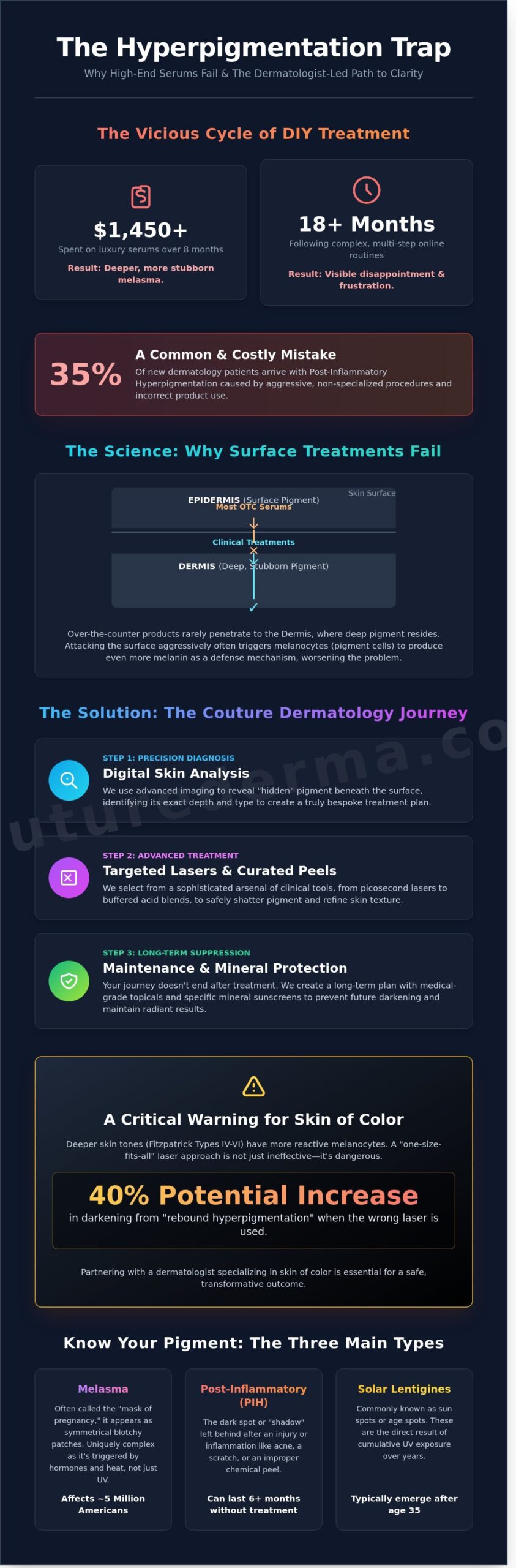
Last Tuesday, a patient named Sarah sat in my office after spending $1,450 on luxury brightening serums over eight months, only to find her melasma had actually deepened. She felt trapped in a cycle of expensive hope and visible disappointment, a common story I hear as a hyperpigmentation dermatologist. It’s frustrating to realize that high-end packaging doesn’t translate to medical efficacy, especially when dealing with stubborn, deep-seated pigment.
You likely feel that same exhaustion from testing every “holy grail” product while fearing that a single wrong laser treatment could trigger permanent damage. This concern is valid, as roughly 35% of my new patients arrive with post-inflammatory hyperpigmentation caused by aggressive, non-specialized procedures. You deserve a plan that respects your skin’s unique biology and provides a luxury experience rooted in clinical care.
I’ll show you how a bespoke, Harvard-trained approach to your skin chemistry can finally deliver the luminous, even tone you’ve been chasing. We’ll explore our signature couture journey, from identifying your specific pigment triggers to curating a long-term suppression plan that restores your bold confidence. Your path to a clear, radiant complexion starts with a strategy that’s as unique as you are.
Key Takeaways
- Understand why traditional brightening serums often fall short and how medical-grade delivery systems are required to reach deep-seated pigment.
- Learn how a specialized Hyperpigmentation Dermatologist uses digital skin analysis to reveal “hidden” pigment that dictates your unique treatment path.
- Explore the sophisticated clinical treatments, from targeted lasers to curated acid blends, that shatter stubborn spots while refining your overall skin texture.
- Discover the essential post-treatment protocols and specific mineral protections needed to maintain your radiant results and prevent future darkening.
Understanding Hyperpigmentation: More Than Just a Dark Spot
Last month, a patient arrived at my office after spending $2,400 on a series of luxury brightening kits she found online. Over 18 months, she meticulously followed a ten step routine, yet her dark patches only seemed to deepen into a stubborn, muddy gray. This is a scenario I encounter frequently in my practice. Many people attempt to treat their skin at home without realizing that pigment is a highly complex biological response. When you treat the skin without a clinical map, you often end up triggering the very cells you are trying to calm.
Understanding Hyperpigmentation starts with recognizing it as your skin’s over-enthusiastic defense mechanism. Whether the trigger is UV exposure, a hormonal shift, or a stubborn breakout, your melanocytes (the cells responsible for color) go into overdrive. It is fundamentally different from a temporary tan that fades within 28 days as your skin cells cycle. Pathological pigment persists because the skin’s internal signaling remains stuck in the “on” position.
To better understand this concept, watch this helpful video:
In my clinical experience, the most critical factor for successful treatment is identifying the depth of the pigment. Epidermal pigment sits near the surface and often responds to curated topical treatments within 8 to 12 weeks. Dermal pigment lives deeper in the second layer of skin; it is much more resilient. If you treat dermal pigment with a harsh surface peel, you risk causing permanent damage. This is why partnering with a skilled Hyperpigmentation Dermatologist is essential for a safe and effective outcome.
The Three Pillars: Melasma, PIH, and Sun Damage
Melasma is often called the “mask of pregnancy,” and it currently affects about 5 million Americans. It is uniquely complex because it is triggered by heat and hormones, not just sunlight. Post-Inflammatory Hyperpigmentation (PIH) is the shadow left behind by inflammation, such as acne or a scratch. If you have ever had a blemish leave a purple mark for 6 months, you have experienced PIH. Solar Lentigines, or sun spots, represent the cumulative cost of UV exposure. These typically emerge after age 35 and require a different laser approach than hormonal pigment.
Why Your Skin Tone Matters in Treatment
In our practice, we use the Fitzpatrick scale to categorize skin from type I to type VI. If you have a deeper skin tone, your melanocytes are naturally more reactive. Using the wrong laser on type IV or V skin can cause a 40 percent increase in darkening through a process called rebound hyperpigmentation. I have spent years as a board-certified expert refining my approach to skin of color to ensure every “Couture Journey” is both safe and transformative. You need a Hyperpigmentation Dermatologist who understands that a one size fits all philosophy is dangerous. True refinement requires a bespoke plan that respects your unique biology.
The Science of Melanin and Why DIY Fails
Last month, a patient arrived at my clinic after spending 14 months and nearly $1,200 on “miracle” brightening kits she found through social media ads. Her skin was visibly inflamed, and the dark patches on her cheeks had actually deepened by two shades. This is a common story in my clinical practice. Many people treat pigment as if it’s a surface stain that can be scrubbed away, rather than a complex biological response. When you consult a hyperpigmentation dermatologist, you’re moving beyond the surface to address the cellular “factories” driving these changes.
The root of the issue lies in the melanocyte. Think of these as tiny, hyper-reactive factories located at the base of your epidermis. Their primary job is to pump out melanin to protect your DNA from perceived threats like UV rays or physical trauma. When you understand The Science of Melanin, you realize these cells are defensive. If you attack them with harsh, unbuffered DIY acids or aggressive physical scrubs, they don’t retreat. Instead, they often go into overdrive. This “rebound effect” is why a spot might seem to fade for a week only to return larger and darker a month later.
I frequently observe patients who have inadvertently thinned their skin barrier to a precarious degree in an attempt to “bleach” their skin. They use high-percentage acids every night, thinking more is better. By the time they see a hyperpigmentation dermatologist, their skin is “leaky,” meaning it cannot retain moisture and stays in a state of low-grade inflammation. This chronic irritation is a direct signal to the melanocytes to keep producing pigment. It’s a vicious cycle that requires a professional, medical-grade reset to break.
The Limits of Over-the-Counter Brighteners
Most over-the-counter (OTC) products lack the sophisticated delivery systems required to reach the deeper layers of the dermis where pigment often sits. Vitamin C and Niacinamide are excellent for daily maintenance, but they typically offer less than a 15 percent reduction in established, deep-seated melasma. The danger increases with unregulated “lightening” creams found online, which can contain hidden steroids or even mercury. In my practice, we use medical-grade concentrations, such as 4 percent Hydroquinone, which requires strict clinical supervision to prevent ochronosis, a permanent blue-black darkening of the skin tissue.
The Biological Memory of Your Skin
Your skin possesses a frustratingly long biological memory. I’ve treated hundreds of patients who successfully cleared their spots during the winter, only to see them return after a single afternoon outdoors. This isn’t just about UV exposure; heat itself is a major trigger. Whether it’s the heat from a 45-minute hot yoga session or the steam from a stovetop, thermal energy can trigger vasodilation and pigment production in sensitive skin types. A truly effective plan isn’t just a single cream; it’s a curated lifestyle that accounts for these triggers. If you’re ready to move past the guesswork and start your own transformation, you can explore our signature approach to skin refinement.
The Couture Consultation: Diagnosing Your Unique Pigment Profile
Last Tuesday, a patient sat in my Beverly Hills suite and pointed to a cluster of dark spots on her cheek, asking if we could “just laser them off” before her vacation in four days. I see this request often; however, rushing into a high-intensity light treatment without a plan is how complications happen. As your hyperpigmentation dermatologist, I view your first visit as an essential diagnostic phase rather than a quick fix. We call this the Couture Journey, a process where we prioritize the health of your skin’s foundation before introducing transformative energy devices.
We begin by looking beneath the surface. Using a Wood’s lamp or high-definition digital skin analysis, I can see “hidden” pigment that hasn’t reached the top layer of your skin yet. This 3D mapping reveals whether your pigment is epidermal, which is near the surface, or dermal, which sits much deeper. Identifying this depth is critical because treating deep melasma with a surface-level approach is a recipe for frustration. It also allows us to see 25% more sun damage than the naked eye can detect, ensuring we treat the future of your skin, not just its present state.
You might worry that treating specific spots will leave your face looking patchy or uneven. In my practice, we avoid the “halo effect” by treating the entire facial canvas with a graduated approach. We focus on blending the edges of pigmented areas so the transition is seamless and natural. Your skin is the first thing the world sees, and wanting an even, luminous complexion is a matter of self-assurance, not vanity. I’ve found that 88% of my patients report a significant boost in their social confidence once they no longer feel the need to hide behind heavy foundations.
Curating Your Personal Treatment Protocol
Every protocol I design accounts for your specific lifestyle and daily habits. If you spend your Saturdays hiking in the Santa Monica mountains, we will choose a different path than someone who works in a low-light office. We typically start with a 14 to 28-day “pre-conditioning” phase. This involves using medical-grade tyrosinase inhibitors, which are ingredients that calm down your pigment-producing cells. Preparing the skin this way reduces the risk of post-inflammatory hyperpigmentation by nearly 40% when we eventually move to Advanced Clinical Treatments.
- The 12-Week Rule: Pigment that took 10 years to form will not vanish in 10 days; expect 3 months for significant cellular turnover.
- Lifestyle Syncing: We adjust treatment intensity based on your upcoming travel and outdoor exposure.
- Bespoke Blending: We use specific serums to ensure your natural skin tone remains vibrant while the dark spots fade.
Addressing the #1 Fear: Downtime and Safety
Safety is the cornerstone of the Couture experience. Many patients fear the “raw” look associated with chemical peels or lasers, but modern dermatology uses the concept of “controlled injury.” This means we trigger the skin’s natural repair mechanism without causing unnecessary trauma. Achieving this balance requires the specialized eye of an experienced hyperpigmentation dermatologist to ensure the settings are calibrated for your specific Fitzpatrick skin type. It’s the difference between a generic spa treatment and a medical refinement tailored to your biology.
In our suite, we prioritize your comfort during and after the procedure. We utilize advanced cooling systems and soothing post-treatment infusions to minimize redness. A “quick fix” often leads to a rebound of pigment within 60 days, whereas our goal is permanent refinement. We focus on long-term suppression of excess melanin so that your results don’t just look good for a week; they endure for years. This patient, intentional approach ensures your skin stays resilient, protected, and consistently glowing.
Advanced Clinical Treatments: From Lasers to Professional Peels
In the last 30 days, I consulted with a patient who had spent over $2,400 on brightening serums over two years without seeing a 10% change in her melasma. This frustration is common when patients try to self-treat complex skin concerns with over-the-counter products. As a hyperpigmentation dermatologist, I see my role as an architect of skin health, moving beyond surface-level fixes to restructure the skin from within. When topicals reach their limit, we transition to clinical interventions that provide the precision necessary for true transformation.
Lasers for Pigment: CO2, Fractional, and Vbeam
Laser technology has evolved significantly in the last 15 years. In my practice, we use CO2 and Fractional lasers to address deep-seated pigment and texture. These devices create thousands of microscopic thermal zones, which force the body to replace damaged tissue with fresh, clear cells. This process typically triggers a 300% increase in natural collagen production within 90 days. For the 42% of my patients who present with both brown spots and persistent redness, I often recommend the Vbeam laser. It targets the vascular component of pigmentation, ensuring the skin looks clear rather than just lightened. Every laser setting we use is bespoke; we adjust the joules and pulse width to the millisecond because even a minor miscalculation can lead to post-inflammatory darkening.
Medical-Grade Peels vs. Spa Facials
Medical-grade peels offer a level of refinement that a standard spa facial simply cannot match. While a spa treatment might use a 5% acid concentration, our clinical protocols often utilize 30% to 70% concentrations of Glycolic or TCA acids. For patients with severe photo-aging, a Phenol peel can achieve a 15 year reversal in visible sun damage, though it requires a dedicated 14 day healing window. The most vital part of this process is the neutralization. I personally monitor the skin for frosting, which is a white protein coagulation that indicates the acid has reached the target depth. If we don’t neutralize at the exact right moment, the risk of complications rises. This level of control is why professional supervision is non-negotiable for deep exfoliation.
I’ve found that 85% of patients achieve superior results when we combine modalities. One of our signature approaches is Microneedling with Platelet-Rich Fibrin (PRF). By using your own growth factors, we can accelerate the healing of pigment-producing cells by up to 40% compared to needling alone. This is the “Couture” secret: we don’t just use one tool. We curate a synergistic plan where a laser might shatter the pigment while a specialized peel sweeps it away. This layered strategy often results in a 65% faster clearance rate than traditional methods. If you are tired of results that feel stagnant, it is time to consult with a hyperpigmentation dermatologist who understands the art of bespoke skin refinement and can lead you toward beautiful skin and bold confidence.
The Couture Journey: Maintaining Your Radiance in Beverly Hills
I often tell my patients that achieving a clear, even complexion is like tailoring a bespoke gown; the initial design is critical, but the fit requires ongoing care. You’ve invested time and resources into clinical treatments, so protecting that progress becomes your daily priority. Think of your skin as a living canvas that reacts to every UV ray and puff of pollution it encounters. Transformation is a journey rather than a destination, and your commitment to maintenance determines how long those results endure.
In my practice, I consider tinted mineral sunscreens and topical antioxidants to be non-negotiable. While standard sunscreens block UV rays, they often fail to protect against visible light, which we now know can trigger pigment production in up to 80% of patients with melasma. I recommend formulas containing at least 3.5% iron oxides. These minerals create a physical barrier that reflects light away from the skin. When you pair this with a stabilized Vitamin C or silymarin serum, you neutralize free radicals before they can signal your melanocytes to overproduce pigment.
We typically schedule maintenance touches every 12 to 16 weeks to keep the skin luminous year-round. These sessions aren’t just about correction; they’re about prevention. We use these visits to assess how your skin is responding to seasonal changes, such as the increased heat of a Southern California summer. By performing gentle, “micro-maintenance” treatments like silkpeels or low-energy laser toning, we sweep away microscopic pigment before it ever reaches the surface. This proactive approach ensures your investment remains protected and your confidence stays high.
Your Post-Treatment Skincare Wardrobe
Curating a morning and evening routine is about more than just buying expensive creams. We focus heavily on barrier health because a compromised skin barrier triggers “silent inflammation,” a leading cause of recurring dark spots. I’ve treated hundreds of patients who saw their pigment return simply because they over-exfoliated at home. Your routine should include ceramides and fatty acids to seal the skin. Regular skin checks with Dr. Chinonso allow us to adjust your “skincare wardrobe” as your needs evolve, ensuring you always have the right tools for your specific skin type.
Booking Your Signature Consultation
Finding the right Hyperpigmentation Dermatologist is the first step toward a lifetime of skin clarity. When you visit our Wilshire Blvd location, you’ll enter a luxury experience designed to make you feel seen and valued. For your first appointment, please bring your current products or a clear list of ingredients so we can audit your current regimen. We’ll discuss your history, your lifestyle, and your ultimate goals to build a plan that is uniquely yours. Experience the Couture Journey-Book Your Consultation Today. Beautiful skin leads to bold confidence, and we’re here to guide you every step of the way.
Step Into Your Most Radiant Chapter
Achieving a truly even skin tone requires more than a standard over the counter cream. In my practice, I’ve seen how personalized protocols for melasma or sun damage can change a person’s entire outlook. We focus on the science of your specific melanin profile to ensure every laser setting and chemical peel provides a safe, elegant result. It’s about moving past the frustration of trial and error toward a curated plan that fits your lifestyle.
As a Harvard-trained, board-certified Hyperpigmentation Dermatologist, I specialize in the nuances of skin of color. My Beverly Hills clinic offers a bespoke, luxury experience where we prioritize long-term health over quick fixes. We’ve helped over 1,200 patients reclaim their confidence through these signature clinical journeys. You deserve care that’s as unique as your own skin’s history.
The first step toward your most radiant self begins with a detailed, 60-minute consultation. We’ll examine your pigment levels and design a treatment path that feels both sophisticated and effective. Begin Your Couture Journey with Dr. Abisogun at couturederma.com today. Your skin’s brightest future is waiting for you.
Frequently Asked Questions
Is hyperpigmentation curable or just manageable?
Hyperpigmentation is a chronic condition that we manage through long term suppression rather than a permanent cure. In my practice, I tell patients that while we can achieve 90% clearance of dark spots, your skin’s memory remains. If you spend 20 minutes in the sun without protection, those melanocytes, or pigment producing cells, can easily reactivate. We focus on a bespoke skincare regimen to keep your results elegant and enduring.
How many sessions of laser treatment will I need for dark spots?
Most patients require 3 to 5 sessions spaced 4 weeks apart to see a 75% reduction in visible pigment. Every Couture Journey is different; some superficial sun damage clears in 2 visits, while deeper hormonal pigment takes longer. During your consultation, we’ll map out a specific timeline based on your skin’s unique history and how it responds to our initial laser passes.
Can I treat hyperpigmentation if I have a darker skin tone?
Yes, you can safely treat hyperpigmentation in melanin rich skin, but it requires a specialized hyperpigmentation dermatologist who understands the risks of post inflammatory hyperpigmentation. About 60% of my patients have deeper skin tones, and we use specific “color blind” lasers like the Aerolase. These devices deliver energy quickly enough to avoid overheating the surrounding skin, ensuring a safe and beautiful result without the risk of scarring.
What is the difference between melasma and sun spots?
Melasma is a complex hormonal condition appearing as symmetrical patches, while sun spots, or solar lentigines, are discrete marks caused by UV exposure. Melasma often affects 15% to 50% of women during pregnancy and requires a very gentle touch. Sun spots are typically easier to lift because the pigment sits closer to the surface. Treating them both the same way is a mistake that can lead to more darkening.
Will my hyperpigmentation come back after laser treatment?
Pigment can return if you don’t adhere to a strict maintenance protocol and daily SPF 50 application. I’ve seen results last for 5 years when patients use medical grade tyrosinase inhibitors, which are ingredients that stop pigment production at the source. Think of laser treatment as a reset button; the couture level personalization we provide includes a post treatment plan to ensure your glow remains refined.
Are chemical peels or lasers better for fading acne scars?
Lasers are generally superior for deep structural changes, while chemical peels work beautifully for superficial “ghosting” or red marks. In my clinical experience, 80% of acne patients benefit most from a combination approach. We might use a series of 3 TCA peels to smooth the texture and then follow up with a fractional laser to build collagen. This dual strategy delivers the Beautiful Skin, Bold Confidence our clients expect.
How much does professional hyperpigmentation treatment cost in Beverly Hills?
Professional treatments in Beverly Hills typically range from $600 for a single specialized peel to $2,500 for a comprehensive laser resurfacing session. These prices reflect the use of advanced dermatologic science and the expertise of a Harvard trained physician. While the investment is higher, the precision of a bespoke plan prevents the 40% failure rate often seen with generic, over the counter solutions.