
The memory of a breakout can linger long after the blemish has faded, leaving behind an intricate tapestry of textures on the skin. If you have ever felt that your complexion is permanently altered, or questioned why your healing process resulted in a scar when another’s did not, you are not alone. This feeling of helplessness is a deeply personal concern, but true skin refinement begins with knowledge. Understanding the complex biological acne scarring causes is the first, most empowering step toward reclaiming your skin’s narrative and beginning a journey with a clear, illuminated path forward.
In this guide, we unveil the delicate science behind the skin’s healing response. We will explore why certain types of acne are more prone to leaving a mark and demystify the different forms those scars can take, from subtle depressions to raised tissue. Consider this your personal consultation, the essential first chapter in your couture journey to refined, smoother skin. By understanding the origins, you gain the clarity and confidence to pursue effective solutions and prevent future concerns, paving the way for the beautifully smooth finish you deserve.
Key Takeaways
- Discover that acne scars are not a sign of damage, but rather your skin’s unique attempt at healing, a process that begins deep within the dermis.
- Uncover the critical role of collagen in scar formation, determining whether your skin creates an indented (atrophic) or a raised (hypertrophic) texture.
- Delve into the intricate acne scarring causes, from the severity of the initial inflammation to the crucial role genetics plays in your skin’s healing signature.
- Embrace the first step of your Couture Journey: understanding that a precise diagnosis of your specific scar types is essential for curating an effective path to refinement.
The Foundation: How a Blemish Becomes a Permanent Scar
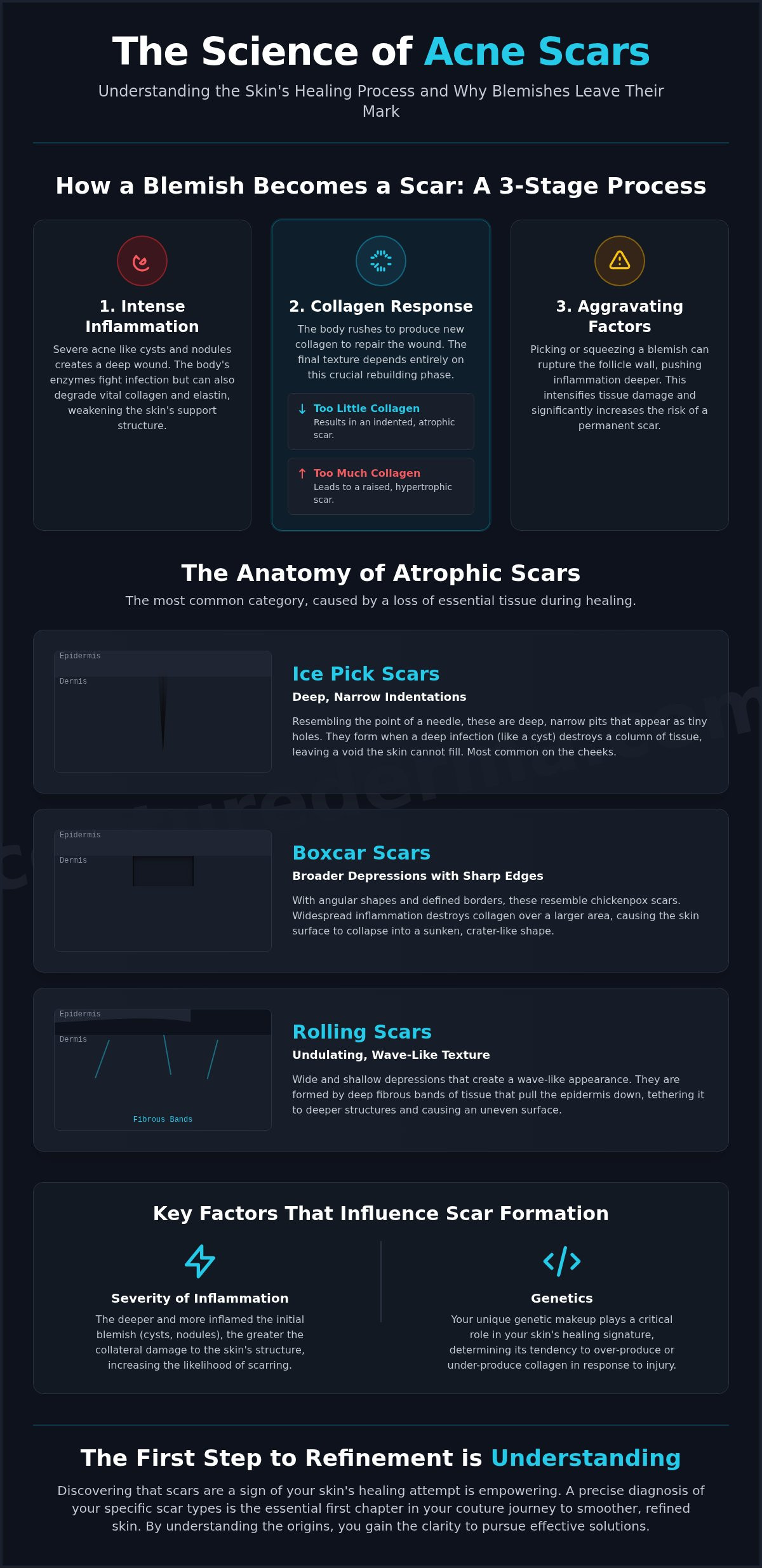
An acne scar is not a mark of damage, but rather a testament to your skin’s powerful, albeit imperfect, healing process. The story of every scar begins not on the surface, but deep within the dermis-the skin’s living layer. When a severe blemish forms, it creates a wound that triggers the body’s natural repair response. This critical moment is where the path to smooth skin or a permanent scar is decided, all based on how the body rebuilds its foundational collagen matrix.
Understanding this complex journey is essential to grasping the core mechanisms behind acne scarring. We’ll delve into each critical stage, beginning with the body’s inflammatory reaction.
The Inflammatory Response: More Than Just a Pimple
Severe acne, such as cysts and nodules, incites an intense inflammatory reaction deep within the skin. To combat the infection, your body deploys enzymes that can degrade not only bacteria but also vital structural proteins like collagen and elastin. This collateral damage weakens the skin’s underlying support network, creating a vulnerability that can lead to textural changes. This intense inflammation is one of the most significant acne scarring causes.
Collagen’s Role: The Architect of Scar Tissue
Collagen is the primary protein that gives your skin its structure, firmness, and resilience. When the dermis is injured, the body rushes to produce new collagen fibers to mend the area. Understanding how a blemish becomes a permanent scar hinges on this delicate rebuilding phase. The final appearance of the scar is determined by this response:
- Too little collagen results in a depressed, atrophic scar (like boxcar or ice pick scars).
- Too much collagen leads to a raised, hypertrophic or keloid scar.
Why Picking and Squeezing Intensifies Scarring
Many of our clients express concern that they may have caused their own scars. While it’s a common fear, understanding the “why” is key to future prevention. Applying pressure to a blemish can rupture the follicle wall, pushing bacteria and inflammation deeper into the dermis. This action intensifies tissue damage and disrupts the elegant, orderly healing process, significantly increasing the risk of a lasting mark. Recognizing this empowers you to protect your skin during future breakouts-a vital first step on your journey to skin refinement.
Atrophic Scars: When the Skin Loses Essential Tissue
When the skin’s healing process is disrupted after an inflammatory breakout, it can fail to regenerate enough collagen, leaving behind an indentation. These depressions are known as atrophic scars, the most common category of acne scarring. Think of them not as flaws, but as a map of your skin’s history-a story that, with expert guidance, can be beautifully revised. Understanding these variations is the first step in diagnosing the specific acne scarring causes behind your skin’s unique texture.
Each type of atrophic scar reflects a different healing response from deep within the dermis. This is why a bespoke approach is essential; the elegant solution for one scar type may be entirely ineffective for another. True skin refinement begins with this precise identification.
Ice Pick Scars: Deep, Narrow Indentations
Imagine the delicate point of a needle pressing into the skin’s surface-this is the signature of an ice pick scar. These deep, narrow pits appear as tiny, yet profound, holes. They typically form after a deep infection from a cyst or papule destroys a column of tissue, leaving a void the skin cannot fill. They are most often seen on the cheeks, where the skin is thinner and more delicate.
Boxcar Scars: Broader Depressions with Sharp Edges
With their angular shape and sharply defined borders, boxcar scars are broader depressions that resemble the scars left by chickenpox. They are caused when widespread inflammation destroys collagen over a larger surface area. This process, rooted in abnormal healing and dermal inflammation, leaves the skin without its foundational support, causing the surface to collapse into a sunken, crater-like shape.
Rolling Scars: Undulating, Wave-Like Texture
Rolling scars are distinct not for their sharp edges, but for the gentle, wave-like texture they create across the skin. These wide and shallow depressions are formed by fibrous bands of tissue that develop deep beneath the surface. These bands pull the epidermis down, tethering it to the deeper structures of the skin and resulting in an uneven, undulating appearance.
Recognizing the unique architecture of each scar is paramount. The journey toward a beautifully smooth, rejuvenated complexion is not about erasing the past, but about meticulously curating a treatment plan that rebuilds the skin’s elegant foundation, one scar at a time.
Hypertrophic & Keloid Scars: When the Skin Over-Heals
While some acne scars create depressions, others result from an over-enthusiastic healing response from the body. This is where, in its effort to repair a wound, the skin produces an excess of collagen, leading to raised, firm tissue. This overproduction is one of the more complex acne scarring causes, resulting in two distinct types of elevated scars: hypertrophic and keloid. Understanding the difference is the first step in curating a treatment plan designed for true skin refinement.
Hypertrophic Scars: Raised Tissue Within Boundaries
Hypertrophic scars are characterized by raised scar tissue that remains strictly confined to the boundaries of the original acne lesion. They commonly appear on areas like the jawline, chest, and back, where the skin is often under more tension. While some may gradually flatten over time, achieving a beautifully smooth finish often requires a bespoke treatment strategy to guide the skin’s healing process with elegance and precision.
Keloid Scars: An Overproduction of Collagen
Keloid scars represent a more significant overproduction of collagen. Unlike their hypertrophic counterparts, keloids extend far beyond the borders of the initial wound, creating a larger, more prominent scar that can continue to grow over time. Their texture is often firm, rubbery, or shiny, and they can be accompanied by physical discomfort, such as itching or pain, which sets them apart from other scar types.
Genetic Predisposition and Skin of Color
The tendency to develop these raised scars is not random; it is strongly linked to genetic factors. In fact, understanding the Key Factors That Influence Scar Formation reveals that individuals with more melanin are significantly more susceptible to keloiding. This is not a barrier to beautiful skin, but a call for specialized knowledge. Treating skin of color requires a deep, nuanced understanding of its unique healing properties to prevent further scarring or pigmentation issues. This is why seeking a board-certified dermatologist with proven expertise in treating all skin tones is not just a preference-it is essential for achieving safe, confident, and enduring results.
Key Factors That Influence Scar Formation
While we have explored the types of scars that can form, the more personal question is often, “Why did my skin scar when someone else’s didn’t?” The answer lies not in a single event, but in a delicate interplay between the nature of your acne and your body’s inherent healing capabilities. Understanding these key factors is the first step in curating a truly effective path toward skin refinement and restored confidence.
Two primary elements dictate whether a blemish fades without a trace or leaves a lasting mark. Recognizing their influence empowers you to take control of your skin’s future and achieve the beautifully smooth finish you deserve.
The Severity and Duration of Acne
The most significant predictor of scarring is deep, persistent inflammation. When a severe lesion like a cyst or nodule forms, it triggers an intense inflammatory response that can damage the skin’s foundational collagen and elastin. The longer this inflammation persists, the greater the risk of permanent textural change. This is why delaying treatment for inflammatory acne is one of the most critical acne scarring causes; proactive, expert care is essential to preserve the elegant architecture of your skin.
Your Unique Genetic Blueprint
Just as a couture garment is designed for a specific form, your skin’s healing process is dictated by your unique genetic code. Your DNA orchestrates your body’s inflammatory response and its ability to repair itself. Some individuals are genetically predisposed to an overzealous healing process, producing excess collagen that leads to raised hypertrophic or keloid scars. Others may produce too little, resulting in the depressed, atrophic scars. This genetic tendency explains why scarring can vary so dramatically, even among family members.
While you cannot alter your genetic blueprint, you can absolutely influence your outcome. By managing the severity and duration of acne, you mitigate the primary trigger for scar formation. This is the foundation of The Couture Journey: a partnership where we apply advanced dermatologic science to honor your skin’s individuality and guide it toward a clear, confident future. Begin your journey to refined skin with us.
The Couture Journey: From Understanding to Refinement
The path to beautifully smooth skin begins not with a treatment, but with a deep understanding. Throughout this guide, we have explored the complex world of acne scarring causes, from inflammatory responses to collagen damage. This knowledge is the essential first step, empowering you to move beyond temporary fixes and toward a lasting solution. Your skin has a unique history, and honoring that story is the foundation of true, enduring refinement.
The journey from a textured surface to a renewed complexion is a collaborative art, blending advanced dermatologic science with a meticulous, artistic eye. It is a process of transformation designed to restore not just your skin’s clarity, but your most bold and beautiful confidence.
Why a Professional Diagnosis Is the First Step
In an age of endless information, self-diagnosis can lead to ineffective treatments and profound frustration. A board-certified dermatologist moves beyond guesswork, meticulously identifying your specific scar types-be they atrophic, hypertrophic, or a combination-while assessing their depth and your unique skin quality. This expert evaluation forms the essential blueprint for a truly personalized treatment plan, ensuring every step is intentional and effective.
Curating Your Path to Smoother Skin
Once your skin’s needs are precisely understood, we can curate a bespoke treatment plan. This is where the connection between the various acne scarring causes and their solutions becomes clear. For instance, atrophic scars caused by lost collagen are meticulously treated with advanced laser resurfacing to stimulate new growth, while targeted injectables can restore lost volume. Collagen-stimulating treatments such as microneedling in Los Angeles offer a highly effective, bespoke approach to remodeling scar tissue and restoring the skin’s smooth, refined surface. For clients seeking comprehensive facial rejuvenation without needles or downtime, non-invasive innovations like EMFACE, the needle-free facelift available in Beverly Hills, offer a complementary path to restoring youthful contours alongside scar refinement. Every modality is chosen to address a specific need, creating a synergy that delivers elevated results. Begin your couture journey with a personal consultation.
Embark on Your Journey to Refined Skin
Understanding the intricate dance between inflammation and healing is the first step toward lasting skin confidence. As we’ve seen, acne scars are not a single entity; they are the result of complex healing processes, from the tissue loss that creates atrophic scars to the collagen overproduction behind hypertrophic ones. Recognizing the specific acne scarring causes relevant to your skin empowers you to move beyond frustration and toward a truly effective, personalized solution. Your skin’s history does not have to dictate its future.
At Couture Dermatology in Beverly Hills, we transform this understanding into artistry. Led by renowned, Harvard-trained dermatologist Dr. Chinonso Kagha Abisogun, we specialize in curating bespoke, couture-level treatment plans. With profound expertise in treating all skin tones, we design a refined pathway to restore your skin’s beautifully smooth finish. This is where advanced science meets an unwavering commitment to your unique beauty.
The next chapter for your skin begins with a conversation. Schedule a consultation to begin your journey to refined, beautiful skin.
Frequently Asked Questions About Acne Scarring
Does every person with acne get scars?
Not every individual with acne will develop scars. The risk is significantly higher with deep, inflammatory acne, such as cysts and nodules, which damage the skin’s underlying collagen structure. A crucial factor is how breakouts are managed; picking or squeezing blemishes dramatically increases the likelihood of scarring. At Couture Dermatology, we emphasize proactive care to manage inflammation and preserve your skin’s integrity, guiding you on a journey to a beautifully smooth complexion.
Why do some pimples leave a dark spot instead of a scar?
A dark spot, clinically known as post-inflammatory hyperpigmentation (PIH), is the skin’s response to inflammation, not a true scar. It occurs when healing skin overproduces melanin, leaving a temporary discoloration without altering skin texture. True scars involve a permanent change in collagen. PIH typically fades over time, a process we can accelerate with curated treatments to restore your skin’s even, luminous tone and achieve complete refinement.
Can my lifestyle or diet affect my risk of acne scarring?
While lifestyle and diet influence acne severity, their link to scarring is primarily through inflammation. Diets high in glycemic foods or dairy may worsen inflammatory acne for some, thereby increasing scar risk. Similarly, chronic stress can elevate cortisol and exacerbate inflammation. A holistic approach is part of The Couture Journey, as managing the underlying acne scarring causes is essential for maintaining a clear, resilient complexion and achieving enduring results.
Is acne scarring genetic, and will my children also have it?
Genetics play a significant role in your skin’s healing response and predisposition to scarring. If your parents experienced acne scarring, you may have an inherited tendency to produce too little or too much collagen after inflammation. However, a genetic predisposition is not a guarantee of scarring. With advanced dermatologic science and a bespoke treatment plan, we can effectively manage acne to mitigate risk and protect the future health of your skin.
Will acne scars ever go away on their own without treatment?
Unlike discoloration that can fade, true acne scars-which are textural changes like atrophic (pitted) or hypertrophic (raised) scars-will not resolve on their own. These represent permanent alterations to the skin’s dermal structure. Achieving a beautifully smooth finish requires professional intervention. Our signature services, from advanced laser therapies to microneedling in Los Angeles, are meticulously designed to remodel collagen, refine texture, and restore your skin’s natural elegance.
At what age is it best to start treating acne scars?
The ideal time to begin your treatment journey is after your active acne is well-controlled. Treating scars while new, inflammatory blemishes are still forming can be counterproductive and inefficient. Once your skin is consistently clear, we can curate a personalized plan. Younger skin often responds more robustly to collagen-stimulating treatments, but our advanced techniques deliver remarkable refinement at any age, restoring both your skin and your bold confidence.